
Concrete helicopter finishing, also referred to as helicopter grinding of concrete floors, is a specialized technique that is essential in building and remodeling projects. This technique is used to produce level and smooth concrete surfaces, which are necessary for long-term functional durability as well as visual appeal.
Helicopter grinding uses large rotary blades mounted on a machine that resembles a helicopter, as opposed to traditional methods that might involve manual labor or smaller machinery. In order to smooth out rough spots, imperfections, and uneven surfaces on recently poured concrete, these blades spin quickly.
As soon as the concrete is poured, the process starts, and it sets but doesn’t become too hard to grind. By allowing the helicopter blades to efficiently smooth the surface before the concrete completely hardens, this timing guarantees ideal results.
Because of its effectiveness, helicopter grinding is preferred for large-scale projects where accuracy and timeliness are crucial. Because it requires less manual labor and shortens the construction period overall, it is the method of choice for obtaining high-quality concrete floors in commercial and industrial settings.
- What kind of instrument is this?
- For which screeds is it suitable??
- Goals of the procedure
- Operating principle of the equipment
- Types of cars
- By rotor
- Single-rotor
- Double rotor
- By engine type
- Electrical
- Gasoline
- How to choose the right one?
- Period of time from filling to grout
- Preliminary preparatory work
- How to grind correctly: technology and stages of work
- Rough
- Finish
- Difficulties of the process
- Pros and cons of using
- Average prices for units
- Video on the topic
- Construction technology for industrial concrete floors. WACKER NEUSON equipment. SDM-Gidravlika.
- Grinding concrete by helicopter – Technopolymer
- Concrete grinding. Concrete floor without dust video. Mirror concrete floor. How to make a topping floor?
- Grinding a concrete floor with a helicopter
- First grouting of concrete by helicopter. Concrete floor – topping.
- Grinding concrete by helicopter, Leveling screed ! How to level a concrete surface
What kind of instrument is this?
The following primary structural components make up the helicopter, a professional instrument that can be powered by gasoline or electricity and is used for grinding and grouting concrete floors:

- Steel supporting frame with female interfaces.
- Electric motor or miniature two-stroke internal combustion engine.
- Gearbox for multiple amplification of torque and transfer of load from the power plant to the rotating working parts.
- Working parts – blades of the device with an axial pin, which are equipped with a high-strength steel or abrasive contact plane for processing concrete floors.
- Decorative and protective housing of the mechanism – a metal or plastic housing with grilles for cooling the motor and removing dust.
- Some helicopter models are equipped with a built-in vacuum cleaner and a bag for collecting waste – dust left over from floor sanding.
- The helicopter control panel is a push-button or touch unit with which you can turn the device on/off, as well as change operating modes and rotation intensity.
- In models equipped with a gasoline engine, the delivery package includes a fuel tank and a fuel pump with a valve for organizing the injection of the fuel-air mixture into the combustion chamber.
- Electric helicopters are equipped with a mains power cable, as well as a voltage stabilizer that prevents the motor from quickly failing due to physical wear and tear.
Depending on the specifications for the floor covering, each helicopter that is put up for sale comes with a set of interchangeable working parts with varying surfaces and levels of graininess. This allows for both initial rough processing of the concrete and final polishing.
For which screeds is it suitable??
Concrete floor grouting using a helicopter Appropriate for the following kinds of screeds and other constructions that are placed over a compacted soil base or floor slab:
- Semi-dry floor screed without coarse aggregate, installed in residential, public or commercial premises, reinforced with fiber – the screed in this design is a mandatory part of the work on laying and compacting this material.
- Wet concrete screed used in industrial, warehouse or public buildings and structures – to reduce the porosity coefficient of the coating.
- Cement-sand or concrete floors, widely used in commercial premises after grinding and polishing.
- Outdoor used spaces at warehouse or logistics centers, parking lots at shopping malls, road surfaces and courtyard driveways, landscaping elements in industrial zones – to increase the mechanical structural or surface strength, wear resistance, reliability and durability of concrete floors.
These floor-polishing and grinding tools are widely used. With the exception of the power unit’s rotation intensity and the choice of working body, practically all models can be applied to any of the concrete pavement types mentioned above.
Goals of the procedure
In order to accomplish the following, concrete floors in buildings or on the street are ground for a variety of purposes, including grinding:

- Achieving a flat surface of a concrete screed for installing laminate, carpet, parquet or other types of decorative finishing materials.
- Strengthening the surface layers of floors made of concrete or cement-sand mortar.
- Preventing delamination of the surface elements of the screed, removing dust from the structure.
- Achieving increased efficiency during the process of ironing concrete floor screed with high-strength cement.
- Blocking pores in concrete to increase wear resistance.
- Increasing the water resistance of the structure.
- Strengthening the frost resistance of concrete coatings.
- Improving the aesthetic properties of concrete screed, the possibility of using it as a finishing floor covering.
- Prevention of delamination of the upper layers of concrete under operational external loads.
Following grinding, the concrete screed’s surface has minimal porosity, increased strength, and the ability to withstand heavy external loads.
Operating principle of the equipment
Regardless of the drive type, design, or modification, floor grinding helicopters operate differently according to the following principle:
- Immediately after pouring and setting the screed, the device is installed on the floor surface.
- Working elements for processing the screed are installed on a movable pin, depending on the required result.
- When the machine engine rotates, the working elements are set in motion, which influence the concrete plane, gradually cutting off the top layers and rubbing dust particles until a uniform plane is achieved, with a minimum number of pores.
- As the working bodies rotate, a mixture of particles of cement binder is achieved that did not react with water during the hydration of the screed concrete with pores between the fine and coarse aggregate of the structure.
- After grinding, the porosity coefficient of the concrete screed is reduced, and the structure of the entire structure is significantly strengthened.
- If it is necessary to polish the surface, to give a glossy shine, the abrasives of the working elements are changed on the pin, and the speed of their rotation is changed on the control panel, which allows you to achieve a glossy structure.
- When grinding a plane, the depth of concrete processing does not exceed 0.5 – 1.0 mm, and when grinding with coarse abrasives, the depth of impact reaches 2 – 3 mm.
- Grinding or polishing of screed concrete should be carried out no earlier than 24 hours after the start of setting of the liquid mortar laid in the structure.
- The speed of rotation of the blades determines the depth of processing of the concrete plane, as well as the possibility of grinding or polishing the high-strength subfloor structure.
It is advised that you read the instructions and the features of any particular modification before operating the helicopter for the first time after purchasing it to avoid mistakes and other unfavorable outcomes.
Types of cars
The market offers a large selection of helicopters for polishing and grinding concrete screeds and subfloors. This power tool is divided into categories based on its size, number of rotors, performance, and other factors. All of the machine types in this category are described in detail below, along with information on their design features, method of operation, and range of applications.
By rotor
All helicopters used to finish concrete screeds fall into one of the following categories based on the number of rotors.
Single-rotor
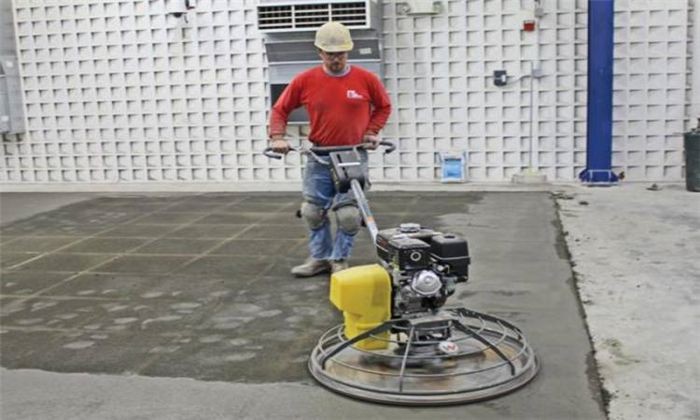
The blades of the working elements are mounted on a single troweling rotor in these installations. Style:
- They can be equipped with fuel or electric motors, which are connected to a single gearbox that transmits force to a rotating pin with working parts.
- The control panel has a button to turn the machine on and off, as well as a rheostat to increase or decrease the power of the power unit, which allows you to change the performance of the machine.
Strangenesses:
- The blades of single-rotor working parts of helicopters have a diameter of no more than 0.8, 1.0 or 1.2 m.
- The peculiarity of this troweling equipment lies in its compact dimensions, ease of operation, low dead weight and the absence of the need for special knowledge and experience for its normal operation.
Use:
- semi-dry floor screeds;
- concrete bases for finishing floor coverings with an area of no more than 400 – 500 m2 and strength class up to B10 – B12.5.
Limitations:
- equipment of this category is not used for processing floors made of heavy concrete with a class of B15 or more;
- for rough floor coverings made of materials based on coarse granite aggregate;
- for extended premises with an area of 500 – 600 m2 or more.
Double rotor
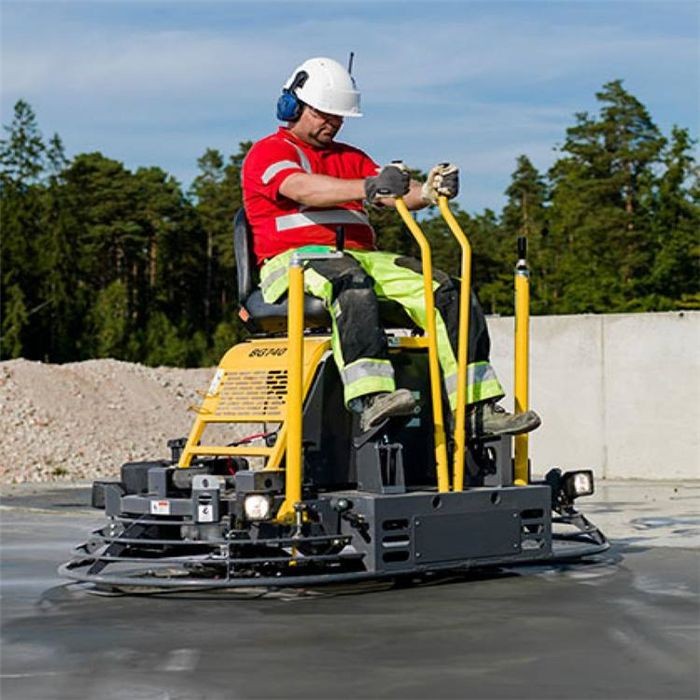
Complex professional equipment with more than two bladed working pins and a strong electric motor powered by a three-phase power network or an internal combustion engine running on gasoline (two or four strokes). Style:
- The device is a supporting frame on which a power unit, one or two gearboxes are mounted, and instead of a steering control handle, as in the first case, there is a seat for the operator.
- This machine is equipped with a transmission, starter and steering on a hydraulic drive to allow maneuvering within the processed space of the concrete plane.
- In addition to the drive of the working parts, the helicopter is also equipped with a mechanism that drives the landing gear for easy transportation of heavy equipment along the plane of the concrete screed.
- Working bodies with blades are equipped not only with a rotating, but also with a lifting mechanism for moving equipment along the floor at idle speed without the need for contact with concrete.
Strangenesses:
- Twin-rotor helicopters are characterized by increased power and reliability; blade diameters can exceed 1500 mm to handle extended areas.
- The power unit operates in conditions not only of heated rooms, but also on the streets or in other harsh climatic environmental conditions. The engine is equipped with safety systems and filters to prevent its failure in polluted ambient air conditions.
Use:
- Industrial enterprises, warehouse sites, shopping malls, street spaces when performing landscaping.
- Road work – to level the load-bearing base, as well as any other exploited spaces with an area of 600 – 800 m2 or more.
Limitations:
- The use of equipment is inappropriate when working in small residential or public spaces, as well as in narrow corridors and other cramped conditions, due to restrictions on maneuverability due to the large overall dimensions of the equipment.
- The difficulty of operating gasoline units in confined spaces due to the large amount of harmful gasoline exhausts.
When buying two-rotor machines, buyers should keep in mind that complicated equipment needs more frequent and careful maintenance. This means that regular maintenance, such as replacing consumables and lubricants, is necessary, as are small repairs when even tiny faults are found. Consequently, two-rotor
By engine type
All helicopters used for grouting and grinding concrete floors fall into two main categories based on the kind of power unit.
Electrical

These helicopters have electric motors that can run on a 220V or 380V power cable network. The motors can be single-phase or three-phase and have a maximum power of 8–10 kW. When turned on, they typically feature a single bladed rotor that spins and steering handles that make it simple to move the apparatus over a concrete screed surface. Style:
- An electric motor with a gearbox, a voltage stabilizer and a power cable are fixed on a supporting frame made of round pipes.
- The engine starts up when the start button is turned on, which sets the rotor with the blades located on it in motion.
- The control panel contains keys or a rotary switch for operating modes.
- Control is carried out by applying the muscular efforts of the operator, who moves behind the trowel.
Strangenesses:
- These devices are environmentally friendly, relatively silent operation, stepwise change in speed, compactness, ease of storage and transportation.
- Some models can be folded, allowing them to be transported in passenger vehicles.
Application: internal operated spaces, which include 500 m^2 or less of residential, public, or commercial space with variations in screed heights up to 15 mm and concrete class up to B15.
Limitations:
- high-strength concrete structures with a class of B20 and higher;
- extended rooms, workshop spaces, stadiums or screeds;
- performed outdoors, for example;
- during the arrangement of open storage areas or during landscaping.
Gasoline
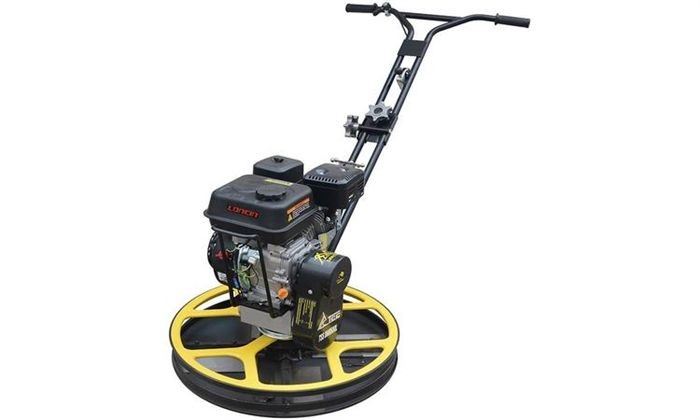
Hefty, powerful professional equipment with an internal combustion engine capable of producing up to 9 liters of power, either in two or four strokes. Alongside. The devices stand out for their dependability, wear resistance, increased strength of all working units, and steel blades. They are made to operate continuously for extended periods of time under difficult conditions. Style:
- On a powerful frame made of pipes or profile steel elements there is an internal combustion engine with a starter, a fuel tank of 0.9 – 1.8 liters and a gearbox.
- At the bottom of the machine one or two rotors are fixed, as well as a drive shaft that moves in several directions.
- Chassis is attached to the frame for easy movement of equipment.
- There is a throttle lever on the steering handle, which is connected to the throttle valve, which also allows you to change the intensity of engine speed.
Strangenesses:
- these machines are completely autonomous and do not depend on the electrical network;
- can be used in both dry and wet areas;
- are characterized by stability and duration of operation, durability and reliability;
- the speed of rotation of the working bodies changes in a stepless manner, depending on the force of pressing the throttle valve drive;
- professional machines are also equipped with a multi-speed transmission and a separate chassis drive.
Use:
- internal ventilated extended spaces;
- any outdoor concrete surfaces – foundations for roads, parking lots, warehouses, entrances;
- interior floor coverings in workshops or in supermarket sales areas; stadiums, sports complexes, concrete floors with a strength class of B25 and more.
Limitations:
- interior spaces in which there is no exhaust ventilation;
- small rooms;
- narrow corridors;
- spaces with a large number of corners, due to the limited maneuverability of large equipment.
Gasoline equipment is regarded as professional and is frequently acquired by sizable contracting firms that specialize in construction, repair, and finishing work. It is also frequently listed on their balance sheets. Since electric helicopters are deemed domestic, there are restrictions on their use and the amount of time they can run continuously before the motor overheats in inclement weather.
How to choose the right one?
When selecting a helicopter for the purpose of polishing or grinding concrete screed, it is advised to give particular consideration to the following crucial aspects of the equipment’s design and functionality:

- Availability of a certificate of compliance with regulatory requirements and equipment quality certificate.
- Availability of a company representative office and authorized dealers of the brand in our country.
- The quality of abrasives and the brand steel for the contact plane of the working disk, or the flared blades.
- Type of energy for bringing the engine to operation.
- Reducer category to transfer torque to the working bodies.
- The number of steps of the transmission, which allows you to regulate the intensity of the rotation of the working organs of the device.
- The number of degrees of freedom of the rotor is the possibility of its rise and lowering, changing the angle of inclination in relation to the horizontal plane.
- Diameter of rotating working bodies.
- Performance and power of a gasoline or electric power unit.
- The number of rotors by helicopter.
- Type of drive of the working bodies.
- The presence or absence of a seat for the operator.
- The price of the model is not recommended to purchase too cheap equipment, as this indicates low assembly quality, which contributes to the rapid failure of the unit already at the initial stages of its operation.
When selecting the best high-quality equipment, some of the most crucial factors to consider are the company’s name recognition, its country of origin, the year it was founded, and the quantity of positive user reviews that are available in independent online forums regarding a specific model.
Period of time from filling to grout
The duration varies based on the kind of screed:
- Floor screed made from cement-sand mortar, made using the semi-dry method, should begin to be smoothed no earlier than after 12 – 16 hours, when it has completely set and gained up to 30% of its design strength.
- In the case of a wet floor screed, given that setting can last up to 12 hours, smoothing operations should begin no earlier than 24 – 48 hours, but no later than 3 days after pouring the structure, since, in this case, , particles of binder components are difficult to process.
Preliminary preparatory work
Preparing the screed ahead of time through basic technological operations is advised before beginning work on grinding a concrete floor:
- Control of partial strength gain and completion of setting of concrete screed.
- Diagnostics of the quality of a concrete surface, identification of defects – chips, cracks, places with delaminations, non-vibrated areas, irregularities, holes, sagging and pits.
- Preparation of repair mixtures with subsequent sealing of large defects that cannot be sanded.
- Cleaning the screed plane from all types of dirt, dust and grease deposits.
- The desired mixture for polishing the structure is selected, namely, corundum, for large industrial facilities and high-carrying screeds, quartz – for standard retail or other commercial facilities, or polymer, which is excellent for residential facilities or office premises.
In the last step, the strength characteristics of the concrete screed are used to determine the scope of work. Next, abrasive materials for the working parts’ surfaces and the necessary grouting equipment are chosen, and the subfloor is finished to the desired state.
Using a helicopter grinder offers a contemporary, accurate, and efficient solution in the field of concrete floor finishing. This process uses specialized equipment to quickly level and smooth concrete surfaces while following predetermined guidelines and procedures. Comprehending the subtleties of this procedure is essential to attain robust and visually appealing flooring in building and remodeling endeavors. This article aims to provide readers with useful insights for effective floor preparation and enhancement by examining the key components, guidelines for use, and advantages of using helicopter grinding techniques.
How to grind correctly: technology and stages of work
Using a paddle smoother to grout or grind a concrete screed is a responsible and intricate process that calls for specific tools, experience, and knowledge.
In this sense, professionals should be trusted to smooth the screed field because they will finish the job quickly, correctly, and guarantee the outcome for a long time. If this isn’t feasible, you can complete the task entirely by hand, provided that you have access to a thorough technological roadmap for either the final or rough grinding. Below is a detailed description of these step-by-step instructions.
Rough
The following guidelines and considerations need to be made when rough grinding concrete screeds in any kind of setting:

- Before starting work, you need to make sure that there are no external defects in the screed that cannot be smoothed out, and that the repair mixture has polymerized and gained sufficient strength.
- Grouting with coarse abrasives is carried out in 2 passes along one track.
- Grinding is carried out in rows along the long side of the premises, strictly in one direction, to avoid local removal of too large a layer of concrete.
- The speed of rotation of the rotor is determined by the strength of concrete and the thickness of the screed – if the structure is filled with concrete with a class of B20 or more, and the power of the structure is from 100 mm, it is recommended to carry out processing at full speeds. If the screed has less strength or the thickness is less than 80 mm, you should start grinding at low or medium speed of the helicopter.
- The first penetration should begin only at low speeds, and during the second penetration it is allowed to increase the motor power.
- After each penetration, the level of the structure is recorded, and the quality of the surface is inspected.
- Coarse grinding is performed with steel, corundum or quartz abrasives, which effectively remove the top of the concrete structure.
- Between penetrations and grips, you should vacuum the screed and remove all elements of exfoliated materials from it,
- If, after starting grinding, the fresh screed begins to delaminate, you should stop work and wait for the end of its polymerization.
The category under consideration’s concrete surface should be smooth, free of pits and influxes, and completely ready for the finish flooring device based on the work’s outcomes.
Finish
Final sanding done in compliance with a set of guidelines and a particular technological map, while also considering a variety of subtleties:
- The number of passes for finishing grouting is determined by the quality of processing of the concrete plane, and can reach from 2 to 4 or more.
- It is allowed to polish only with polymer abrasives or attachments on the blades of the device to prevent the removal of chips or delamination of concrete.
- During polishing, in contrast to rough grinding, the trajectory of the helicopter can be in both the longitudinal and transverse directions.
- After each penetration, the floor plane is cleaned and inspected
- In the corners, the design is refined using hand tools – an angle grinder or a grinder.
- The finishing abrasive can periodically become clogged, requiring it to be cleaned and, in some cases, replaced as a consumable item.
Regarding the procedure in the video in detail:
It should be mentioned that final grinding of a concrete floor is done for the purpose of operating a concrete floor screed without the installation of a decorative layer; therefore, each section must undergo meticulous quality control, with all defects and evidence of defects carefully revised.
Difficulties of the process
Beginners may face several challenges when operating a helicopter, many of which have detrimental effects. Here is a thorough breakdown of all potential mistakes and potential solutions to avoid budget overruns and higher labor costs:
- Neglecting the need to carry out preparatory work for the concrete floor before treatment with a helicopter – large mechanical defects on the screed will remain on the surface of the material even after grouting.
- Choosing equipment for grinding with poor technical characteristics means the inability to achieve the expected effect, the risk of rapid overheating of the equipment and its failure.
- Starting work with equipment at increased speed – the upper layers of the concrete screed can peel off along with coarse aggregate, which will lead to delamination of the structure and the formation of cracks, chips, pits, holes.
- Neglecting to warm up a gasoline helicopter before starting to operate it in operating mode – there is an increased risk of rapid failure of the machine, which will lead to expensive repairs and replacement of some of the main parts and mechanisms.
- Performing rough polishing of the floor in a chaotic manner, without observing rows when driving one track at a time – defects will remain on the surface of the concrete subfloor that will require milling or additional grinding of the material.
- Treatment of concrete floors with a strength class of B20 or more with polymeric materials or low-hardness abrasives – there is a risk of rapid physical wear of the working parts without achieving the desired effect when processing screed concrete.
- Starting work on a concrete plane, the setting period of which has not been fully completed – particles of binding materials and filler will begin to crumble, which can lead to a complete loss of the load-bearing capacity of the screed.
- Operating an electric helicopter in wet conditions means there is a risk of short circuiting the main working components of the motor and mechanisms, which can not only damage the equipment, but also pose an increased danger to the operator.
In order to avoid mistakes and challenges when using a helicopter, it is advised that you become beforehand acquainted not only with the operating manual for this technological apparatus but also with expert lessons from experts, which are frequently made available online in the form of brief but educational videos.
Pros and cons of using
Because they possess numerous unquestionable advantages, helicopters for grinding concrete floors are frequently utilized in residential, public, or industrial settings at establishments belonging to different categories of responsibility.

- Quick leveling of concrete screed, preparation for laying the final floor covering.
- Complete sealing of the smallest pores, increasing the water resistance and frost resistance of concrete.
- Increasing wear resistance, surface and structural strength of concrete floor screed.
- A wide range of abrasives are available for free sale, which allows the consumer to independently choose the degree and depth of processing of the concrete structure.
- Possibility of using concrete screed as a finishing floor covering after polishing.
- High speed of processing extended spaces in premises for various purposes.
- Gasoline trowelling equipment can be used in outdoor conditions, with high humidity or at negative outside temperatures.
- Possibility of choosing different abrasives, depending on the desired degree of grinding or polishing of the concrete floor surface.
- There is no risk of defects, since the helicopter exerts the same pressure and impact over the entire area of the rough concrete floor in the room.
- Durability of the equipment – the helicopter can be used repeatedly, for several years, without the need for major equipment repairs, which is why such equipment is often listed on the balance sheet of many contractors.
- Possibility of carrying out minor repairs to the screed in case of minor physical wear.
- Ability to work with many materials – semi-dry or wet screeds made of concrete, or cement-sand mortar.
- It is an integral part of the equipment when installing a semi-dry room screed.
- Significantly reduces the time required to complete a full range of finishing works indoors.
However, because helicopters also have a number of serious drawbacks, some owners of private or public buildings frequently turn to using other equipment for leveling, grinding, and polishing concrete floors.
- The difficulty of working in enclosed spaces without a supply of fresh air with gasoline-powered equipment due to the high concentration of exhaust gases.
- High retail cost of equipment, which greatly limits its purchase by individuals.
- Difficulty working with fresh concrete immediately after the setting period of the plastic mass has ended.
- Difficulty in treating floors in small apartments or narrow corridors.
- Low maneuverability of the equipment due to the large diameter of the working body – blades or grinding abrasive disc.
- Large dead weight and dimensions, which complicates the transportation and storage of the machine.
- The need to manually refine corners of rooms and other hard-to-reach places.
- High retail price for consumables – abrasive discs, which are periodically subject to physical wear and tear and require replacement.
- Gasoline units require periodic maintenance, replacement of consumables and fuels and lubricants.
- The need for special knowledge and certain work experience for the error-free operation of this troweling equipment for concrete or cement-sand floor screeds.
Therefore, it is advised to weigh all the benefits and drawbacks, as well as potential expenses and the intended outcome, before deciding to treat floors with a helicopter.
Contacting a contractor to order a full range of turnkey services is the best option for installing a concrete screed and modifying it in a small apartment. This ensures that labor costs will be kept to a minimum and that all work will be completed in a reasonable amount of time at a reasonable price.
Average prices for units
Professional equipment, helicopters for grinding concrete or cement-sand screeds and floors are available from specialized production companies located in the Russian Federation and overseas. Due to the low demand for these products, most factories are in intense rivalry with one another for every significant client.
As a result, these cars’ suggested retail prices in the Russian Federation are roughly the same, specifically:

- Electric single-rotor – from 50 – 70 thousand. rub.
- Electric two-rotor – from 150 – 180 thousand. rub.
- Gasoline single-rotor – from 45 – 60 thousand. rub.
- Gasoline two-rotor – from 250 – 300 thousand. rub. and higher.
It is important that you realize right away that troweling equipment that is imported will always be less expensive because it is delivered thousands of kilometers away and must pass through customs clearance.
Regarding domestic helicopters, the aforementioned retail prices may differ slightly based on the area in which the company’s products are sold, the model’s year of manufacture, the difficulty of the logistics to the retail location, the brand’s internal advertising and marketing strategy, and the manufacturing company’s profit margin, which is influenced by the volume of products sold.
| Use of specialized helicopter machines for even surface grinding | Ensures uniformity and smoothness across the entire floor surface |
| High-speed rotations and adjustable blades for precision grinding | Allows customization based on the concrete type and desired finish |
| Dust extraction systems for minimizing airborne particles | Promotes a cleaner working environment and better air quality |
| Professional operators trained in handling and maneuvering the equipment | Ensures safe and efficient operation, reducing risks and ensuring quality results |
In the construction and renovation industries, there are several clear benefits to using a helicopter grinder to grind concrete floors. This technique improves the floor’s durability and visual appeal in addition to guaranteeing a level and smooth surface. Helicopter grinding is a dependable method that produces excellent results by efficiently eliminating flaws and readying the concrete for additional processes like coatings or polishing.
Helicopter grinding’s ability to quickly and efficiently handle large surface areas is one of its main advantages. Because of this, it is especially appropriate for commercial, industrial, and warehouse settings where timeliness is essential. Large floor areas can be covered quickly, which reduces interference with ongoing operations and makes it a viable option for time-constrained projects.
Furthermore, the longevity of the concrete floor is enhanced by the accuracy and uniformity attained through helicopter grinding. Through the removal of unevenness and rough spots, the process not only improves safety by lowering trip hazards but also extends the flooring’s lifespan, which eventually lowers maintenance costs.
To sum up, helicopter grinding is a contemporary method for producing level, smooth concrete surfaces that satisfy esthetic and functional standards. When looking for a disruptive-free way to improve the longevity and quality of their floors, contractors and property owners choose it for its efficiency, accuracy, and capacity to handle large-scale projects.


