
In the early phases of construction projects, excavation pits are crucial because they lay the groundwork for future buildings, roads, and other structures. The procedure must be carefully planned and carried out to guarantee efficiency and safety. Any construction project that is successful must have a thorough understanding of the characteristics of excavation pit development.
Selecting the appropriate tools is essential to the excavation process. The size of the project and the site’s requirements determine the kind of machinery needed. Simple tools like shovels and mini excavators may be adequate for smaller projects. More sophisticated machinery, like backhoes, bulldozers, and hydraulic excavators, are frequently required for larger projects. Every piece of equipment has a unique set of advantages, and selection is made taking into account variables such as soil composition, pit depth, and site accessibility.
An additional important consideration in excavation projects is cost. The cost of excavation work can vary significantly based on a number of factors. These consist of the pit’s dimensions and depth, the kind of soil, the tools needed, and the amount of labor needed. Unexpected difficulties, like rough terrain or bad weather, could result in extra expenses. Thus, getting a thorough quote and making backup plans are crucial to staying within your budget.
In conclusion, creating an excavation pit requires a combination of cost control, suitable equipment selection, and strategic planning. By being aware of these factors, you can make sure that your excavation project is successful and efficient, providing a strong base for the subsequent construction work.
| Feature | Description |
| Excavation Pit Development | Developing an excavation pit involves planning, measuring, and digging to the required depth and dimensions for a construction project. The soil type and site conditions must be considered to ensure stability and safety. |
| Choice of Equipment | The choice of equipment depends on the size and type of the excavation. Commonly used machinery includes excavators, backhoes, and bulldozers. The selection is based on the project"s scale, soil type, and specific needs. |
| Cost of Work | The cost of excavation work varies based on factors like the size of the pit, soil type, equipment used, and labor. On average, the cost can range from $50 to $200 per cubic yard. |
To ensure efficiency and safety, developing an excavation pit requires careful planning and the appropriate equipment. The type of soil and the size of the project determine which equipment, such as backhoes, bulldozers, and excavators, to use. Costs can vary significantly depending on labor, site conditions, and the rental of equipment, but being aware of these variables will help you plan ahead and prevent unpleasant surprises.
- When you need technology?
- Criteria for selecting equipment for digging
- Types of machines and what they do?
- According to the shape of the working tool
- By type of chassis
- Digging technology using working equipment
- Digging price per 1 cubic meter
- Pros and cons of use
- Video on the topic
- Development of pits, earthworks
- Pit development
- JCB Backhoe Loader vs Mini Excavator!
- Dug a pit, Working on an excavator Doosan190dx working on an excavator
- Digging a pit | safe slopes
- Pit development. Excavators
- DEVELOPMENT OF THE PITCH. Depth 6 meters.Clay.IN ONE ENTRY. Working on an EXCAVATOR. Time lapse.
- Development of a deep pit using a Volvo bl71b excavator loader. Depth 5.20m.
When you need technology?
Excavators are specialized vehicles designed to remove substantial amounts of soil from the ground in the least amount of time. The entire construction process will take a long time if they are unable to finish a task promptly and accurately. An excavator can move up to 100 cubic meters of dirt in an hour.
Making sure it doesn’t sit idle is crucial in order to guarantee the prompt removal of soil that has been excavated. You’ll need at least two trucks equipped with dumps for this. The dirt can be dug up by the excavator and then loaded into the body right away.
The second truck is loading while the first is moving dirt. This plan expedites the procedure. The number of trucks involved in the work increases with the distance to the soil unloading site.
Workers and tiny machinery are employed once the pit has been constructed. They complete all the wall details, level the areas that are out of the excavator bucket’s reach, and, if needed, reinforce the walls.
Criteria for selecting equipment for digging
Selecting the right kind and model of specialized equipment is a difficult process that depends on a number of variables. The primary tool used in foundation pit development are full-rotating, high-performance excavators. They can be tracked or on wheels.
This considers:

- volume of planned work;
- pit configuration;
- soil type, presence of groundwater, swampiness of the site;
- current condition of the construction site;
- tight conditions, room for maneuver;
- the presence of laid underground communications;
- property location. Possibility of access to the work site;
Types of machines and what they do?
Now let’s talk quickly about the types, principles of design, and operation.
An excavator is a specialized tool used for bucket-style soil excavation. It has a gasoline or diesel engine that drives the bucket, causing it to dig, through the use of hydraulics. The cabin is rotated by the same hydraulics.
According to the shape of the working tool
Excavators of the following varieties are distinguished:
- straight shovel — the insides of the bucket are turned in the opposite direction from the operator. Using a straight shovel, soil is taken from the bottom up. Thus, the overhanging cliff of the pit is leveled. The operation scheme is simple – the bucket is immersed from below, scoops up soil by moving down and straight. This type of equipment is mainly used in quarrying soil.
- Backhoe — backhoe excavators are more common in construction. The bucket is turned towards the operator, t.e. movement occurs downwards and towards oneself. Used for digging pits, trenches or other earthworks where precision is required.;
- Grab – a powerful large double bucket that scoops up soil. Often used on construction sites and installed on cranes. Sometimes excavator operators also use such attachments. In appearance and operating principle it is similar to jaws. It is lowered open onto the excavated soil, then lifted, the shutters are closed. Under the influence of its weight, the grab closes, taking with it a certain volume of soil.
- Dragline — practically not used on standard construction sites. Has a straight bucket that moves along the boom. Driven by a complex system of cables. Draglines are used to dig mines and some pits.
Apart from the bucket type, excavators are classified into single- and double-bucket categories:
- Single bucket — classic, mobile, medium performance.
- Twin-bucket – more powerful, usually has a backhoe and a bulldozer bucket. The shovel is installed at the rear, the bulldozer bucket is installed at the front of the machine. This design greatly improves functionality. The cabin rotates 360 degrees. The operator in one position controls the chassis and the bulldozer blade, in the other – fixes the machine on the supports and excavates the soil.
By type of chassis
They can be tracked or on wheels.

Wheeled vehicles are portable and practical, but they cannot approach any object.
Reinforcement has the potential to puncture the wheel, a risk that is sufficient for any construction site. The caterpillar is not afraid of these places.
Their cross-country skills are excellent. They weigh so much that they don’t need any extra stabilization.
However, because they may cause damage or even destroy the coating entirely, they shouldn’t be used on asphalt or concrete surfaces for extended periods of time.
The possibility of having the machine delivered to the location must be considered when placing an order for a crawler excavator. To put it another way, the tracked one will need to be moved on a wheeled tractor if the future pit is far away. The cost of renting this particular equipment will go up as a result.
Digging technology using working equipment
An excavator is not the only tool needed to dig a pit. It is imperative to guarantee the excavation of soil from the construction site, plan any necessary reshaping of the pit with a shovel or other mobile equipment, and potentially reinforce the walls.
Thus, the steps in the process order:
- Geology. Ground and soil analysis, selection of equipment;
- Soil scanning. There may be communications in the ground – electricity, water, gas, whatever. If there are, you need to turn them off and circle them around the future pit.
- Development of soil on one side, removal of the first layer.
- Organization of access roads. Mainly for soil removal.
- Digging a pit, simultaneously strengthening the walls, if necessary.
- Places inaccessible to the bucket are leveled and finished manually (with a shovel) or other mechanical devices.
Using theodolites and levels, surveyors oversee the entire process.
Plan of excavation using a shovel bucket in the straight position:
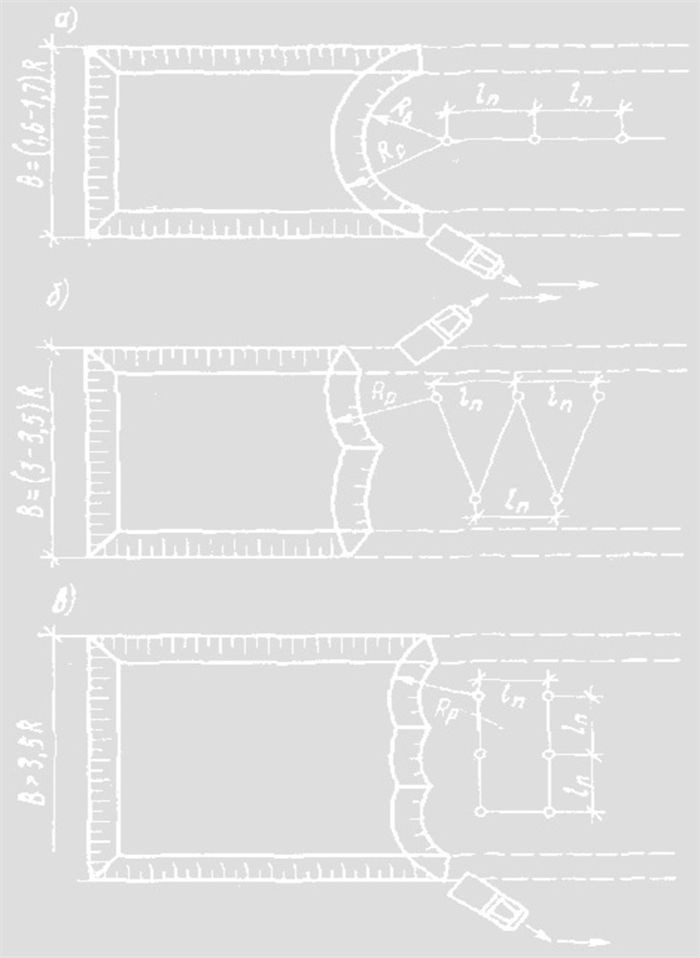
Diagram for excavating using a backhoe bucket:

Excavation work requires adherence to SNiP and the guidelines in reference Appendix 1 SNiP 3.02-01-87 foundations, bases, and earthworks.
Digging price per 1 cubic meter
The entire cost of the excavation and digging work is determined using an estimate that comprises:
- cost of delivery of equipment to the site,
- dump truck operation,
- soil disposal (removal distance),
- support of surveyors and engineers,
- cleaning the area, etc.d.
If the pit is deep, you will need to install tongue-and-groove fencing or slopes. It is important to consider that the removed soil is loosened and about 1.3 times larger when determining the volume of excavated soil.
The entire scope of work will determine the cost to dig one cube of pit. The approximate price in rubles for the Moscow region is:
| Distance/Volume | Up to 600 m. cube. | 600-4000 m. cube. | Over 4000 m. cube. |
| With soil transportation up to 500 m | 150 | 130 | 120 |
| With soil transportation up to 5000 m | 260 | 240 | 230 |
| With transportation to the performer"s site | 380 | 360 | 240 |
| With the removal of soil to specialized landfills | from 550 | ||
Pros and cons of use
Like any mechanization, the use of excavators in construction greatly cuts down on the amount of time and resources needed to complete a task. In this instance, the removed dirt is put straight onto a dump truck and either stored elsewhere or transported if needed.
This soil might be required for landscape design, strengthening of other structures, and other purposes later on in the building process.
If the equipment is being rented, the contractor will supply an expert for its management and upkeep; storage and repair expenses are not the responsibility of the client.

Every kind of excavator has benefits and drawbacks of its own.
When compared to tracked vehicles, vehicles with wheels or pneumatic wheels move more quickly and are more maneuverable. They are not subject to any limitations when working in cities.
The majority of wheeled models can be used as close to buildings as feasible and on streets without obstructing other vehicles due to their small turning radius platforms.
The ability to independently travel public roads to the location is its primary benefit. Additionally, wheels lessen the harm done to the construction site’s vegetation landscape. This is occasionally one of the most important considerations when selecting an excavator type.
In comparison to tracked ones, they are also less productive and less passable. Their application is restricted to low-bearing-capacity soils. Wheels may slide and sink into the earth on sand or swampy terrain.
The bucket of the smallest excavators has a capacity of at least 0.04 cubic meters. Models of the middle class: up to 2 cubic meters. Typically, the machine weighs no more than 25 tons. Your ability to move under your own power is limited as weight increases because of the increased load on the axle.
The benefit of tracked vehicles is that they can operate on nearly any type of soil and are not affected by the existence of roads. High performance, enhanced stability, and weather resistance characterize this unique equipment. This is made possible by the machine’s increased weight, its center of gravity’s closeness to the earth, and its wider surface contact area.
Wheeled excavators use special outriggers called outriggers to increase stability. This lessens the possibility that the bucket will slip out of the machine during loading.
They can dig deeper pits and rip out compacted soil. They also reportedly use very little fuel.
Transportation issues are a tracked vehicle’s primary drawback. These pieces of equipment usually only move independently inside the workspace. An specialized loading platform (trawl) is required in order to transport an excavator to the excavation site. The customer will incur additional costs as a result.
The excavator of choice is primarily determined by the task at hand and the equipment’s functionality. Wheeled vehicles are preferred when developing a small quarry or excavating a relatively small volume of soil, provided that the soil permits. Using more productive crawler excavators is more efficient in other situations.
In many construction projects, creating an excavation pit is an essential first step because it lays the foundation for the subsequent structures. Stability and safety are ensured through meticulous planning and execution of the process. Understanding the composition of the soil, the levels of the water table, and the surrounding environment are important. Future problems and complications can be avoided with careful planning and assessment.
For efficiency and accuracy in excavation, selecting the appropriate equipment is crucial. Traditional tools like shovels and picks are available, as well as more sophisticated equipment like backhoes, bulldozers, and excavators. The decision is based on the size, kind of soil, and particular needs of the project. In addition to expediting the procedure, the use of the proper tools guarantees a more precise and clean excavation.
The price of excavation work varies greatly depending on a number of variables. These consist of the pit’s dimensions and depth, the kind of soil, the tools required, and the project’s location. Unexpected problems, like running into subterranean utilities or having to deal with water problems, could result in additional expenses. To prevent unpleasant surprises, it’s critical to budget for these possible unforeseen costs.
In conclusion, careful planning, the appropriate tools, and a clear grasp of costs are necessary for the successful development of excavation pits. Construction projects can run smoothly and lay a solid foundation for future work by carefully attending to these aspects. Whether you’re a professional contractor or a homeowner, devoting time to the excavation stage will pay dividends later on.


