
Making sure wooden windows are adequately sealed and shielded from the weather is an important part of their upkeep. Putty is essential to this procedure because it acts as a sealant and filler, keeping the windows both visually beautiful and weatherproof.
While store-bought putties are practical, crafting your own can be a more affordable and personalized option. Making your own putty gives you complete control over the ingredients and lets you customize the mixture to meet specific requirements, like historical preservation, environmental concerns, or just personal taste.
Typically, linseed oil, chalk powder, and a drying agent like whiting or calcium carbonate are the main ingredients used to make putty. While the chalk powder adds bulk and opacity, the linseed oil gives the putty flexibility and aids in its adhesion to the wood. To ensure that the putty sets properly, a drying agent speeds up the curing process.
Mixing these ingredients together will give your putty the proper consistency and workability. Usually, the first step involves mixing chalk powder and linseed oil until a smooth paste forms. As you mix, gradually add the drying agent until the putty has a dough-like consistency that makes it easy to mold and apply.
- What it is?
- What is it used for??
- Requirements
- Composition of window product from the store
- How to cook it yourself?
- Drying oil and chalk
- Cement and vegetable oil
- Chalk and linseed oil
- Ash and tar
- Flour and sand
- Flax oil and limestone
- Talc and sunflower oil
- Chalk, rosin, rendered lard
- Other recipe options
- Required Tools
- Step-by-step application instructions
- Connection between frame and glass
- Seam sealing and protection
- Secondary sealing
- Pros and cons of using
- Finished product
- Homemade
- Average prices
- What else can be used to seal window structures?
- Video on the topic
- How to update old wooden windows yourself
- How to Make the Best Window Putty. Only 2 components needed
- How to make door or window putty
- DIY putty for windows made of chalk and drying oil.
- Putty is 100 TIMES BETTER than any purchased product Do-it-yourself medicinal composition FLAX IODINE OIL
- Window putty Ryazan t from 50 to +40
- DIY window putty. Recipe and instructions for use
What it is?
Putty is a plastic material that is made of synthetic or mineral materials and is used to seal window frames to reduce the possibility of them blowing out.
What is it used for??
Any location where wooden window structures are installed uses putty. The following are the uses of the substance:
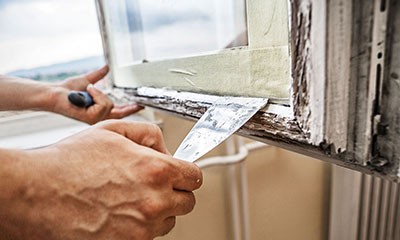
- Fixing glass in the frame, if the stacks of holding it has dry out, and the product is loosely fixed in the profile.
- Filling cracks and cracks formed under the influence of an aggressive environment over time.
- Compaction of the opening frame in the premises for the winter period, in order to avoid the formation of a cold bridge.
Note: Old wooden windows that have not had putty applied to them rattle in high winds, let in cold air during the winter, and have cracks that can lead to drafts.
This leads to the possibility of street dust collecting on the windowsill, where it may condense or ice during the winter and aid in the growth of mold.
Putty is available in most home stores across the nation, but if you don’t see it or it’s not good enough, you can make the material yourself.
Requirements
Following the putty application, the composition must wait for a while to polymerize before it can satisfy the following conditions to guarantee the window structure operates comfortably:
- When applied, the substance must have sufficient plasticity to penetrate even small cracks, reliably blocking the access of air through these defects.
- The components included in the putty must ensure a high level of adhesion of the substance to the wooden structures of the window frame. When applying the paste, it should adhere tightly over the entire surface of the defect.
- Do not decrease in volume due to loss of moisture upon drying. After application into the crack, the putty should fill the entire volume provided to it.
- The composition of the plastic paste should not contain toxic substances that can adversely affect human health when evaporated.
- The composition of the putty should ensure rapid polymerization after application – no more than 15 – 30 minutes, depending on the components.
- In the hardened state, the material should not deteriorate under the influence of ultraviolet rays, rainwater or condensation.
- The material must withstand significant temperature changes and have the proper degree of frost resistance.
Vital. Cracks should ideally only need to be re-treated with a fresh layer of putty once a year.
The material shouldn’t lose any of its mechanical and physical properties during this time.
Composition of window product from the store
The active ingredients of ready-made window putty, which is available in specialty stores that sell paint and adhesive materials, may include the following:

- Acrylic is a synthetic polymer component based on polyacrylic acids. The substance has a high level of adhesion to most surfaces and is widely used in the manufacture of high-quality paints and sealants for exterior or interior use.
- Cyanoacrylate is an adhesive composition whose action is based on entering into a chemical reaction with the treated surface at the molecular level. Differs in an increased speed of setting and hardening.
- Butyl substances – are used in the manufacture of window profiles. They are sold in the form of a viscous pasta, they are well sealed with window structures from any material, including from wood.
- Rubber – natural elastic material, environmentally friendly and hypoallergenic. It copes well with the task of sealing the cracks in the windows, quickly polymerizes, is characterized by increased durability.
- Polyurethane is a synthetic substance that does not destroy under the influence of direct sunlight and steadily enduring extreme temperatures.
- Silicone is a modern sealing substance that retains an elastic consistency throughout the entire life. Freely penetrates into each gap and has a high level of adhesion to all types of surfaces.
Each of these compositions has a high degree of dependability and longevity. The high chemical content and exorbitant cost, contingent upon the brand and composition of the products produced, are among the drawbacks.
How to cook it yourself?
Given the factory product’s low level of popularity, it is expensive and only supplied in small quantities to numerous retail locations. Because of this, there are numerous ways to make this product yourself using common household items and natural ingredients that should be in every home.
Drying oil and chalk
An affordable, practical way to seal cracks.
Components (per 100 g of the completed product):
- 20 g drying oil;
- 80 g crushed chalk without polymer additives.
How to Cook:
Drying oil and chalk are combined, and the mixture is thoroughly stirred to produce a homogenous, viscous paste.
Reference: The material can be painted, is simple to apply, and effectively seals window structures, but it quickly loses its effectiveness in the presence of abrupt temperature changes.
Watch the video to learn how to make putty with your hands using chalk and drying oil:
Cement and vegetable oil
Because hydraulic binder is more resistant to moisture, it doesn’t crumble when exposed to moisture in the air.
Components (per 100 g of the completed product):
- 20 g of vegetable oil sediment;
- 80 g of high-quality cement for facade decorative works.
How to Cook:
- Material requires unrefined oil.
- The bottle of oil should sit without shaking until sediment forms.
- Liquid oil is drained. Only the sediment is used for putty.
- Cement is added to the oil, the material is mixed until the lumps are completely decomposed.
The resulting putty is dependable in keeping the room safe from blowing in cold air and withstanding temperature fluctuations while maintaining its plastic state for an extended period of time.
Chalk and linseed oil
Professionals as well as consumers are in great demand for the substance made from these ingredients.
Components (per 100 g of the completed product):
- 25 g chalk;
- 75 g flaxseed oil.
How to Cook:
- A piece of chalk is crushed in a pharmaceutical mortar or grated until it becomes powdery.
- The powder is filtered through a flour sifter.
- Particles remaining on the sieve are re-grinded.
- The ingredients are mixed until smooth.
- To check the finished product you need to fashion a small ball. The consistency of the putty should resemble dough.
This natural sealant’s inherent yellowish tint, which resembles that of natural wood, is an advantage.
Vital. has improved ability to withstand both high and low temperatures.
Ash and tar
An effective remedy for window defects that has been around for a while.
Components (per 100 g of the completed product):
- 120-150 g tar;
- wood ash – until the required consistency is achieved.
How to Cook:
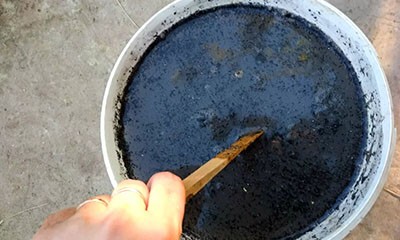
- The tar is boiled in a saucepan over low heat for 1.5-2 hours.
- Upon completion of the procedure, the liquid product should cool to room temperature – 18-20 o C.
- The ash must be crushed and sifted to a dust state, in which there should be no large inclusions.
- Ash is added to the tar 1 tablespoon at a time and mixed until a paste is achieved.
Due to its high degree of polymerization, the putty that is produced ought to be used right away for the intended application.
Flour and sand
The composition is meant to be used for room-side emergency window structure sealing.
Components (per 100 g of the completed product):
- 35-40 g of fine sand without foreign impurities;
- 35-40 g of food flour (wheat, corn, rice);
- 35-40 g of clean water.
How to Cook:
- The sand is carefully sifted on a fine sieve.
- The sifted sand is washed under port water and then dried.
- Flour is mixed with sand in dry form, the mixture is brought to a homogeneous state.
- Gradually, water is added 10-15 g at a time, and the composition is kneaded like dough. If necessary, the amount of water must be increased relative to the indicator indicated above.
Vital. Because of its poor resistance to atmospheric moisture, such homemade putty is not permitted for external use.
Flax oil and limestone
A sturdy putty that withstands wind and cold for several years, shielding glass and wooden frames without requiring replacement.
Ingredients (for a final product weight of 800 g):
- 400 ml linseed oil;
- 400-500 g limestone.
How to Cook:
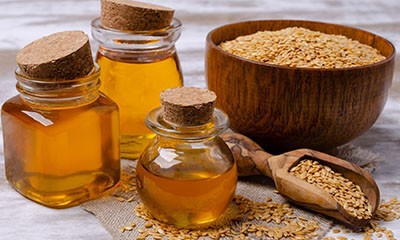
- The oil is divided into 2 glasses – 200 ml each.
- One glass is heated in a water bath until the boiling point of water is reached.
- The heated oil is poured into a suitable container, to which a glass of the same but cold product is added.
- Limestone is crushed with a hammer or in a mortar, filtered through a sieve. You can immediately buy the powdered product.
- The powder is gradually mixed into the oil, 50 g at a time, until a paste-like structure is achieved.
Owing to preparation-related quirks, the material might end up being excessive—between 800 g and 1 kg. Nonetheless, the putty’s performance qualities can be preserved for an extended period of time when kept at room temperature in a closed container.
Talc and sunflower oil
These ingredients provide enhanced moisture resistance to window putty, making it suitable for outdoor use.
Components (per 100 g of the completed product):
- 20 g of vegetable oil sediment;
- 80 g talc.
How to Cook:
- As a rule, talc is sold in the form of a fine powder and cannot be crushed.
- The oil is left to stand until a sediment forms, after which it is mixed with talc powder until a paste is achieved.
The putty has a maximum polymerization period of 30 to 40 minutes, so it should be applied to the window as soon as possible. It forms an elastic structure that is impervious to outside forces when it hardens.
Chalk, rosin, rendered lard
The material is simple to make, keeps well in the refrigerator for extended periods, is easy to apply, and is resistant to deterioration from UV light.
Components (per 100 g of the completed product):
- 9-10 g lard;
- 9-10 g rosin;
- 90 g chalk.
How to Cook:
- Chalk and rosin are crushed in a mortar and filtered through a sieve.
- Lard is heated in a water bath until it reaches a liquid state.
- A mixture of chalk and rosin powders is added to melted hot lard.
- The substance is mixed until the consistency of sour cream is achieved.
Reference: The resultant material exhibits improved water-repellent qualities and increased elastic properties.
Other recipe options
Apart from the folk recipes given above, there is another extremely successful multi-component mixture that can be used to prepare putty for sealing window structures and it lasts for several years.
Components (per 100 g of the completed product):
- 12 g natural beeswax;
- 24 g linseed oil;
- 18 g student chalk;
- 34 g of white lead powder;
- 12 g natural ocher.
How to Cook:
- The wax is grated and melted in a water bath.
- Chalk is crushed in a mortar and sifted.
- All components are thoroughly mixed until a homogeneous mass is achieved.
This recipe will yield putty that doesn’t require restoration or maintenance for many years.
Required Tools
Sealing window structures is an easy task that any adult with even a little experience using a spatula or sealant can complete. Ensure that the following tools are well-stocked so that the outcome lives up to expectations:
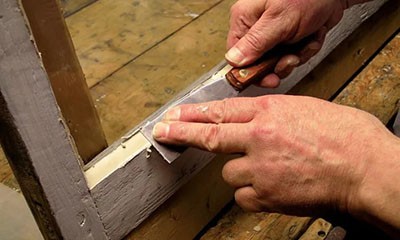
- If you are caulking window structures using ready-made materials from the store, you will need a special gun for conveniently squeezing the mixture out of the factory container.
- Knife or chisel to remove old substance and clean the surface to be treated.
- A construction or household hair dryer to soften old putty before removal.
- Sandpaper or fine-grit sandpaper to deep clean the wood before sealing.
- When using a homemade substance obtained based on one of the recipes listed above, you should purchase a dispenser and use the same gun.
- To compact the substance after application, you need to buy a spatula with a rubber working body.
- To push the substance into narrow crevices, you will need a set of small, sharp spatulas.
- After installing the putty, you should wash off the excess substance with a sponge dipped in a container of water.
Every hardware and construction store sells a comparable set of tools at a low price, making it affordable for the average person to purchase.
Step-by-step application instructions
Applying putty correctly will ensure that it will last for a long time after hardening. To achieve this, experts’ recommendations should be carefully followed, following the suggested algorithm below.
Connection between frame and glass
After this point in the process, you can start sealing windows, which requires you to follow these steps in order:
- The surface to be treated must be cleaned of old paint, dust and dirt. If there is previously installed putty, the substance is removed and the wood is sanded.
- If necessary, old materials are heated with a hairdryer before removal.
- Before starting work, all bare wood areas are treated with a penetrating primer.
- If the glazing beads holding the glass to the frame have dried out over time, they need to be adjusted to the window structure with a hammer. When elements are physically worn out, they must be replaced.
- If commercial putty is used, it can be applied using a gun.
- The homemade substance almost always has the consistency of plasticine. A small amount of material is separated from the total mass, from which a long and thin straw is rolled.
- The material is pressed into the gap with your fingers, after which it is pushed into it with spatulas.
Vital. The excess putty is scraped off the glass with a sponge and the wood with a knife once the majority of it is between the bead and the glass.
Seam sealing and protection
This process essentially replicates the prior algorithm with a few key differences:
- To detect gaps in the frame, work should be carried out in the cold season, since cold will penetrate into places with defects.
- Before pressing the substance, it is necessary to clear the gap from dust and dirt and clean it with the edge of a knife.
- If the gap in the frame is less than 1 mm thick, before using the putty it should be slightly warmed up to soften it and penetrate deeper into the structure.
- The substance is applied to narrow cracks using a spatula, and to wide defects the putty is applied with preliminary rolling in the hands.
Should the sealant’s hue not coincide with the frame’s tone, the wooden profile and putty can be painted together once it has solidified.
Secondary sealing
The same algorithm is used for putty application and compaction; however, in order to maximize efficiency, the old material needs to be removed from the gap before any work is done. There are various stages to this procedure:
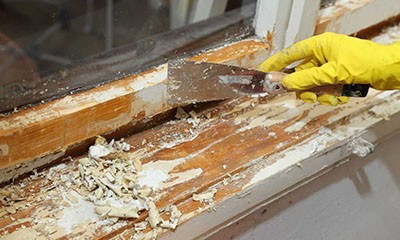
- The master tries to remove the old substance with a knife.
- If hard putty does not give in, you should use a hair dryer to soften it.
- Once the substance has become plastic, it is easily separated from the wood.
- Before installing new material, the gap is cleaned with a knife, spatula and sandpaper.
Vital. Make sure there is no leftover material in the gap before applying putty to ensure a tight connection.
Pros and cons of using
Although putty for wooden windows serves a vital purpose, there are certain drawbacks to this method.
Finished product
Benefits
- Balanced composition that is easy to apply.
- After polymerization, the putty will serve for the period specified by the manufacturer.
- Reliable glass fastening.
- Increased energy efficiency of the room is achieved.
- Long-term storage.
Drawbacks:
- Chemically synthesized ingredients contain toxic substances.
- Overpriced products from a factory manufacturer.
Homemade
Benefits
- Natural environmentally friendly composition.
- Easy to manufacture.
- Low cost of available ingredients.
Drawbacks:
- If errors are made during manufacturing, the putty quickly loses its performance properties.
- Extra labor costs during production.
- Some components do not respond well to sunlight and aggressive environmental conditions.
This post explains the key components of putty made especially for wooden windows and offers a step-by-step tutorial on making it yourself. Homeowners and do-it-yourself enthusiasts can ensure efficient window maintenance and preservation, enhancing both the visual appeal and longevity of their wooden windows, by learning the special requirements of wooden window putty and mastering a straightforward do-it-yourself technique.
Average prices
Retail stores all over the nation sell pre-made putties for sealing windows for the following prices:
- A standard briquette of dry matter in soft packaging, which is diluted with water, is sold at a price of 15-150 rubles (140-400 g).
- The substance in the form of a ready-to-apply paste is available for sale for 50-400 rubles (for 800-1200 g).
The following ingredients, which can be found in hardware or grocery stores, are needed to make homemade products:
- Natural drying oil – 120-350 rubles (100-250 g);
- White chalk – 100-120 rubles (1 package, 100 pieces);
- Flaxseed oil – 80-50 rubles (250-1000 ml);
- Vegetable oil – 70-100 rubles (500 ml);
- Flour – 50-75 rubles (1000 g);
- Birch tar – 40-150 rubles (40-80 ml);
- Dolomite limestone – 50-60 rubles (1000-3000 g);
- Talc without fragrances – 50-150 rubles (40-150 g);
- Rosin – 30-80 rubles (20-100 g).
Ingredient prices are listed for the least expensive economy class goods produced by domestic producers.
What else can be used to seal window structures?
Apart from the putties that can be made at home or purchased already, for caulking wooden windows Additionally usable materials include the following kinds:
- wood putties;
- polymer sealants for windows;
- one-component vapor-permeable briquettes.
If necessary, these materials can be applied to any kind of wooden structure to seal defects, gaps, and cracks.
For homeowners who want to maintain their windows with a personalized touch, creating your own putty for wooden windows can be a satisfying and affordable option. Homemade putty, as opposed to commercial substitutes, gives you complete control over the ingredients, guaranteeing a long-lasting, natural product that meets your needs.
Linseed oil, whiting (also known as calcium carbonate), and a tiny bit of turpentine are the main components used to make putty. To obtain the proper texture and adhesive qualities needed for filling in gaps and cracks in wooden window frames, these materials are combined in precise amounts.
The sustainability and environmental friendliness of homemade putty are among its main benefits. When utilizing natural ingredients like whiting and linseed oil instead of synthetic ones, you lessen your impact on the environment. Furthermore, if applied and maintained properly, the longevity of homemade putty can exceed that of commercial products.
It’s important to thoroughly clean and ensure the dryness of the wooden surface before applying homemade putty. Better adhesion and a delay in putty shrinkage or cracking are ensured by this preparation after it is applied. Putty’s effectiveness is further increased by using the right application technique, such as firmly pressing it into gaps with a putty knife.
You can learn more about home maintenance and save money by creating your own putty for wooden windows. By enabling homeowners to maintain their windows on their own, this do-it-yourself method promotes a sense of fulfillment and kinship with their living areas.
In conclusion, creating putty for wooden windows is an easy and accessible process that has advantages for the environment and the economy. Homemade putty offers a flexible solution that encourages sustainability and extends the life of your wooden windows, regardless of your experience level with do-it-yourself projects.


