
Sometimes it’s practical and more affordable to simply glue new linoleum over old when renovating your floors. It spares you the trouble of having to remove the old, potentially messy and time-consuming linoleum. But for a successful result, the right adhesive and adequate preparation are essential.
Cleaning the old linoleum thoroughly is the first step. To guarantee a solid bond with the new adhesive, all dirt, wax, and debris must be eliminated completely. After cleaning the surface with warm water and a mild detergent, rinse it well and let it dry completely.
To increase adhesion, the old linoleum’s surface must be roughened after cleaning. Sandpaper with a coarse grit or a floor buffer equipped with a sanding screen can be used for this. By taking this step, you can improve the grip of the new adhesive and lessen the chance that the linoleum will eventually peel off.
Your new flooring’s longevity and durability depend on the adhesive you choose. Select an adhesive of superior quality that is intended especially for the installation of linoleum. To guarantee a strong and long-lasting bond, carefully follow the manufacturer’s instructions regarding application and drying times.
Carefully cover the old surface with the new linoleum after applying the adhesive. Make sure there are no trapped air bubbles beneath the linoleum by starting at one end and gradually pressing it down. To ensure that there is maximum contact between the adhesive and the linoleum, smooth out the surface using a roller or other flat tool.
Lastly, let the adhesive cure in accordance with the manufacturer’s instructions before putting heavy objects or foot traffic on the freshly laid linoleum. For the adhesive to completely set and bond with the old and new layers of linoleum, this curing time is essential.
| Adhesive Type | Usage |
| Acrylic Glue | Works well for high-traffic areas and provides a strong bond. |
| Double-sided Tape | Quick and easy for small areas, but less durable. |
| Flooring Adhesive | Specifically designed for linoleum, ensuring a secure and lasting hold. |
| Spray Adhesive | Good for temporary fixes or small sections, but may not be as strong as other options. |
- Is it possible?
- Required or not?
- Requirements before performing work
- To the old coating
- To the new
- To glue
- Types of adhesive bases
- Dispersive
- Kiilto 2 Plus
- 2-K Eurocol 144 EUROMIX PU MULTI
- Reaction
- Tools and accessories
- Step-by-step instruction
- Preparing the base
- New coating
- Process: how to stick?
- Difficulties and errors
- Advantages and disadvantages
- Useful video
- Video on the topic
- IS IT POSSIBLE to lay LINOLEUM ON OLD LINOLEUM in an apartment (home). Good linoleum.
- Laying linoleum on linoleum NEVER do this
- Is it possible to lay new linoleum on the old one?
- Is it possible to lay new linoleum on old linoleum or not?? How to place it correctly in an apartment?
- Do they lay linoleum on linoleum?? Can you lay a new one on the old one?? Put it right! Lay beautifully!
- Is it possible to put new linoleum on top of the old one??
Is it possible?
Whether you can glue new linoleum over old linoleum is a topic of much debate. It is impossible to provide a clear response to this question because it depends on knowing a number of crucial details. Frequently, the decision to replace the covering arises from a shift in the room’s style, making the linoleum out of harmony with the interior’s color scheme. In addition, it is in very good shape. Here, the old linoleum is covered with new glue.
If the old linoleum is in good condition, does not have worn out, "rotten," crumbling areas, and lies flat on the subfloor without swelling or deformations, you can glue new linoleum over it.
However, if the coating is very old (used for ten to fifteen years), completely worn out, has many flaws, mechanical damage, and most importantly, has mold or mildew growing on it, then it is already unusable and needs to be taken apart.
Required or not?

The time needed to remove the old finish and prepare the concrete base for the new finishing coat is greatly reduced when new linoleum is installed over the old.
When a set amount of time is given for cosmetic repairs in public areas, this approach is frequently selected.
The old coating, if in good condition, will "cope" with these functions if more insulation and sound insulation are needed. The best low-cost option is "double" linoleum, which will be warm and won’t be audible when steps are taken.
When a room has better heat transfer and is on the first or last floor, this option is frequently selected. The floor will be considerably more insulated with two layers of linoleum.
It is preferable to remove the old coating and install a new one on a prepared base when repair work is being done that does not need to be finished quickly and there are no financial concerns.
Requirements before performing work
You should consider the minimum material requirements when determining whether to install new linoleum over old.
To the old coating
Experts advise carefully removing the old linoleum if it was installed without an adhesive base after removing the baseboards. Next, remove all dust and construction debris from the subfloor. This ensures improved material fit. Next, reapply the previous layer and secure it using any type of adhesive, like tile adhesive. The surfaces can receive a primer treatment and be degreased if required.
The old linoleum needs to be in acceptable shape. The tears are sealed and dirt-free if there are tiny cracks on it. It will be simpler to install the new coating on a stationary, monolithic "substrate" if the old linoleum is securely bonded to the floor base and there are no gaps or deformations.
To the new
To cover it completely, the newly purchased material needs to be slightly bigger than the old one.

There are classes of linoleum based on purpose and wear resistance:
- household – for residential premises;
- semi-commercial – for offices, public institutions;
- commercial – for industrial, production workshops, warehouses, etc.
If the new covering completely matches the old linoleum’s wear resistance type, it will be successful. Household on household, for instance, etc.
It is not advised to install new linoleum on top of old because it won’t adhere as well if it has a felt backing. However, the adhesive with the highest strength can be selected.
To glue
You should use the right adhesives to ensure that the new linoleum is securely adhered to the old. In this instance, regular glue won’t be sufficient for fixing. Because the linoleum’s surface is as smooth as possible, there is less material adhesion.
Selecting absorbent products that function well on non-absorbent materials is advised by experts. They cost a lot of money.
It’s imperative to properly prep the surface in order to glue linoleum over old flooring. Start by thoroughly cleaning the old linoleum to get rid of any debris, grease, or grime. To ensure better adhesion, use sandpaper to roughen the surface next. Apply a premium adhesive that has been suggested for installing linoleum evenly using a trowel. As you firmly press the new linoleum into place, make sure that any wrinkles or air bubbles are gone. Before stepping on the freshly installed linoleum, give it enough time to dry according to the adhesive’s instructions. When gluing linoleum over existing flooring, careful planning and the use of the appropriate adhesive are essential to producing a long-lasting and attractive finish.
Types of adhesive bases
Proper adhesive selection is necessary to ensure long-lasting and effective material fixing.
Dispersive
This adhesive base is premade and has a creamy or semi-liquid consistency. It adheres heavy tiles flawlessly and affixes linoleum with ease and security. When using this glue, no dust or debris will be present. Chalk, latex, rubber, and resins are all present in the glue. Linoleum is attached to a felt or fabric base made of polyurethane foam using glue.
Moreover, dispersion adhesives are separated into:
- acrylate – for rooms where the traffic of people is moderate or high;
- Gumilax – for gluing natural linoleum;
- bustilate – for felt-based coating;
- bitumen and dispersion mastics – for fabric bases.
The glue’s initial formulation is conductive. Because of linoleum’s antistatic qualities, it can be installed in areas with a lot of equipment, electrical equipment, PCs, etc.
Apply all dispersion adhesives to the old linoleum’s surface using notched trowels, then quickly install the new covering.
Benefits of using this adhesive:
- no sharp, unpleasant odors;
- environmentally friendly;
- safe for human health;
- has strong adhesion;
- durable;
- affordable cost.
Cons: Unsuitable for use in areas with high humidity. The adhesive’s properties deteriorate at low temperatures.
We are aware of the following varieties of adhesive:
Kiilto 2 Plus
An adhesive that is both frost- and waterproof, made in the United States, suitable for any kind of linoleum. excludes solvents having the highest adhesion and maximum adhesive capacity.
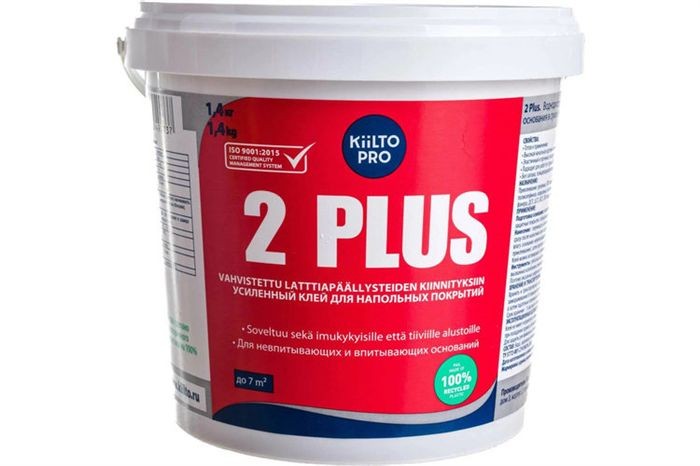
Reasonably priced packages starting at 2,600 rubles for 4 kg.
2-K Eurocol 144 EUROMIX PU MULTI
For interior finishing work, use Fordo Eurocol, a Russian brand of strong-fixation polyurethane adhesive. doesn’t include water or solvents, dries fast, and doesn’t shrink. Its strong resistance to heat and frost is what makes it unique.
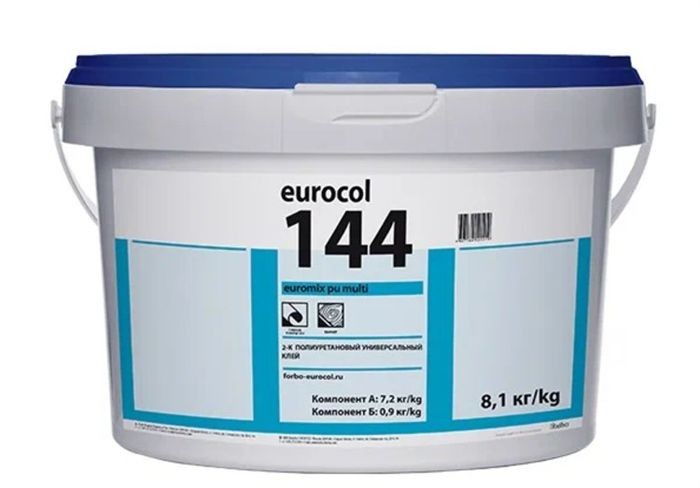
A plastic bucket weighing 8.1 kg can be purchased for 4,000 rubles, which is an affordable price and has moderate consumption.
Reaction
This glue, which comes in one or two components, has an instant "grab" of the surfaces of the materials being glued. The glue’s composition features a sophisticated molecular polymerization that works incredibly well when gluing. The composition includes hardeners and resins.
The adhesive and coatings’ base engage in a chemical reaction. A common term for it is cold welding. With respect to the corresponding concentration of adhesive components, it is separated into three types: A, C, and T.
Advantages:
- strong, resistant to force, mechanical loads, glued layers are obtained;
- fixed materials can no longer be separated;
- strong adhesion;
- the adhesive composition improves sound insulation.
Suggestioned for fastening materials in expansive areas, ensures longevity.
Minuses: Because some of the glue’s ingredients are hazardous, not all varieties are appropriate for regular use.
Hot welding and specialized equipment are typically utilized in industrial settings to repair commercial types of linoleum.

You can use cold welding in your house. Heavy-duty glue is used to seal these tubes. Cold welding of class A is selected for the installation of new coatings, and marking C is used to seal the joints between old and new linoleum.
Tools and accessories
Assemble the following tool list for work:
- rulers, construction meter and pencil;
- knives or scissors – for cutting the fabric, trimming when fitting at the walls at the corners;
- spatulas, brushes for applying glue;
- tools for cold/hot welding of fabric seams;
- wide rollers – for pressing, smoothing linoleum covering, eliminating bubbles and voids.
In order to quickly and uniformly press down the linoleum when it is being fixed to the adhesive base, you can use boards. You can use a rag to wipe away any extra glue. Wearing personal protective equipment (mask, goggles, gloves) is recommended when performing work.
Step-by-step instruction
It’s best to install new linoleum over old flooring if it looks good, is firmly affixed to the subfloor, and has a limited lifespan.
Preparing the base
Get the previous coating ready:

- Well-preserved linoleum is cleaned of dirt, dust, and wet cleaning is carried out. Let it dry.
- Dismantling the baseboards.
- If the covering is fixed with glue over the entire area of the room, there are no deformations or defects, then there is no need to separate it.
- If small tears are found without damage (mold, mildew), they are sealed.
- If there are abrasions, holes, cracks, additional material (suitable in thickness and structure) and glue for restoration are required.
When fixing a hole, cut out a larger patch of linoleum and use mastic to seal the edges. Cold welding is used to seal the joints. Filling the adhesive base and applying weight to the area of deformation is how small swellings are "treated."
It will be disassembled if, while preparing the previous coating, moldy areas are discovered. Two treatments are applied to the concrete base: primer and antiseptic.
It is recommended to use double-sided tape or silicone sealant to fill in the cracks. Sealant can also be used to fill in seams and joints. To apply a fresh layer, all areas that were glued must dry completely.
Additional insulation, soundproofing pads, and leveling planes are not required when laying new linoleum over old. The old linoleum will serve all these purposes.
New coating
Before installing new linoleum, it must be kept in a warm room for a day. This allows the material to naturally take on a straight shape after being rolled out.
To help the material "adapt" to the temperature change, it is advised to leave it in a roll in a warm room for 20 to 24 hours if it was bought during the colder months.
Process: how to stick?
When installing new flooring over old, do it gradually:
- New linoleum is cut to fit the area of a specific room. Placed in place.
- In small rooms, the coating can be glued not entirely, but along the perimeter and in some places.
- Laying begins from the far corner/wall towards the exit, so as not to step on glued materials that may become deformed.
- Select the strongest glue. For a fleecy bottom layer – bustylate, PVA, and for smooth PVC – compositions with latex.
- Old linoleum coated with glue.
- New linoleum is immediately applied to it and the surfaces are pressed firmly, smoothed with rollers or boards – eliminating the appearance of air bubbles.
- The joints of the canvases are glued together by cold welding.
Installing the skirting boards can start once the glue has fully dried.
Reaction glue is only applied along the edges and in certain spots in the center of the canvas; dispersion glue is applied in one continuous layer over the entire canvas.
Difficulties and errors
Progress may lead to a few errors:

- they did not notice areas affected by fungus in the old coating and laid a new one on top – the coating can quickly become unusable (rot);
- smooth linoleum was laid on a coating with a textured structure – after a while the “relief” will be noticeable;
- a light coating is laid on a material with a dark pattern – you should select linoleum with an identical shade, otherwise the bottom layer will “distort” the color of the coating on top;
- despite the defects of the old linoleum (waves, unevenness), a new one was laid – during operation, the new linoleum will also receive deformations and will not look neat.
Without filling in any tiny holes in the previous coating, voids would form, causing the material to deteriorate more quickly and eventually fail.
Advantages and disadvantages
The act of adhering new linoleum over old has several benefits and drawbacks.
Advantages
- minimal preparation for installation;
- installation takes a minimum of time;
- the old material “plays” the role of a “warm substrate”, sound insulation;
- waterproofing improves;
- no “dirty”, dusty dismantling and preparation of the concrete base is required;
- old linoleum usually has a flat surface – which means laying the second layer will be easier;
- additional softness – it’s pleasant to walk on the surface;
- special glue can be purchased in stores – it is always in stock;
- glue price is affordable.
Without calling in contractors, you can complete the work yourself. This kind of floor redesign is a cost-effective choice.
Minuses:
- it is necessary that the old coating be hard and smooth, then the new linoleum will fit perfectly;
- soft coating is easier to tear and push through;
- Work can only be carried out in a warm room with a temperature not lower than +18ºС;
- For gluing, you should choose only a suitable adhesive with a very strong hold.
Because of the rise in floor height, it might be challenging to open the door when installing the second layer of linoleum. Because the old covering was not removed, potential issues with the concrete or wooden subfloor will go unchecked.
Useful video
Regarding the benefits and drawbacks of the technique demonstrated in the video:
Refinishing your floors without going through the trouble of full removal can be accomplished with the practical method of applying glue to old linoleum. Make sure the old linoleum is dry, clean, and firmly attached to the subfloor before beginning. To create a smooth surface, any damaged areas or loose edges should be fixed first.
Selecting the appropriate adhesive is essential for a good application. For this reason, pressure-sensitive adhesives are frequently suggested since they make it simpler to realign the newly installed linoleum. To achieve a strong bond, make sure you carefully follow the manufacturer’s instructions regarding application and drying times.
Make sure the new linoleum is properly aligned and wrinkle- and air-free before applying it. To guarantee proper contact between the layers and to release any trapped air, use a roller. For a tidy finish, carefully trim extra material from corners and edges.
Let the adhesive fully cure after installation before putting the floor through a lot of wear and tear or cleaning. A newly installed linoleum floor can last longer with proper care, such as routine cleaning and avoiding excessive moisture.


