
Because of its affordability, ease of maintenance, and durability, linoleum flooring is a popular choice for many homes. But mishaps do occur, and a common problem that homeowners might face is a burn mark on their linoleum. On an otherwise immaculate floor, a burn—from a dropped cigarette, a hot iron, or any other source of heat—can be an eyesore.
Thankfully, linoleum burn repairs are easy to do and don’t always call for expert assistance. You can get your floor back to how it used to be with the correct equipment and a little perseverance. You can save money and preserve the aesthetic appeal of your house by following this guide, which will walk you through the process of fixing a burn in your linoleum.
Assessing the damage will be the first step in deciding the best course of action. Deeper burns may need to be patched, but smaller, shallower burns may be repaired with little difficulty. The repair process will go more smoothly if you gather the required materials before you start. You can treat the burn mark and prolong the life of your linoleum flooring by following these easy steps.
| Step | Description |
| 1 | Cut out the damaged area |
| 2 | Use the piece as a template to cut a new piece |
| 3 | Apply adhesive to the subfloor |
| 4 | Press the new piece into place |
| 5 | Seal the seams with a seam sealer |
- What it is?
- Causes
- Can it be fixed?
- Remedy methods
- Through
- With glue
- Patch
- How can you smooth out parts of layers??
- Defect to base layer
- How to choose a method for repairing damaged pavement?
- Prevention of occurrence
- Useful video
- Video on the topic
- Holes in linoleum. See how to disguise.Holes in the linoleum. See how to disguise.
- LINOLEUM REPAIR: with a hole, from burns, torn. How to fix a hole in linoleum with your own hands
- How to repair a hole in linoleum | Lifehacks from Nechetov | nechetoff | SUBSCRIBE ⬇️🔔 #Shorts
- How to repair linoleum after a fall
- What to do if you burn parquet or laminate flooring with charcoal from a hookah?
- WHAT TO DO IF YOU HAVE BURNED PARQUET OR LINOLEUM WITH HOOKAH CHARCOAL
- Do-it-yourself linoleum repair in the house
What it is?
Burning linoleum occurs when a spot of high temperature exposure causes deformation and a breach in the integrity of a particular area of the floor covering. Acid and other dangerous chemical liquids coming into contact with the coating’s surface can also cause burning.
Causes
Any kind of linoleum, regardless of its strength category, thickness, number of layers, or composition, can be burned. Everything is dependent on the coating’s critical temperature properties and the level of exposure.

Burn-through could be brought on by:
- Unintentional Impact. For example, the fall of a lit cigarette, coal from a stove, a switched-on soldering iron. It all depends on the purpose of the room.
- As a result of damage to household equipment. For example, a burst light bulb, melted wiring, torn coil of an electric stove.
The coating’s poor resistance to high temperatures is the primary cause of burning. For all varieties of linoleum, the temperature deformation point typically ranges from 25 to 45 degrees. The coating only modifies the structural integrity (becomes plastic) at such temperatures. Long-term exposure to higher temperatures causes the coating to burn through.
Can it be fixed?
Depending on the extent of the damage, a burn through linoleum may be repairable. If the coating burns pointwise, unaffected over a wide area, damage can be fixed. Damage of the following kinds is repairable:
- Damage to the wear-resistant protective layer.
- Burn through to the base layer with deformation of the decorative layer.
- Through damage.
A location cannot be restored if exposure to high temperatures took place over a greater than 0.3 m area and changed the coating’s structure, causing waves, stretches, or bubbles to form around the hole. Replacing the linoleum all the way around is preferable.
Remedy methods
The common forms of linoleum burning are described below, along with some methods for removing them with different materials.
Through
The burning causes the most serious harm. Large-scale damage, including potential separation from the base of a particular area and structural changes throughout, is its primary drawback.
The extent of the damage determines which burn repair technique is best. You can use linoleum mastic treatment and basic grouting with glue for spotting. Patches can be used to repair more significant damage.
With glue
Now, let’s examine how to use glue to remove a minor burn.
In order to work, you’ll need:

- Linoleum mastic.
- Polymer adhesive grade “C”, for working with old coatings.
- Color pigment. Matches the color of linoleum.
- Putty knife.
- Stationery knife.
Additional requirements:
- Use a knife to clean the edges of the damage down to the very base.
- Clear the hole of debris.
- Pour glue into a small container and mix it with colored pigment. Pigment is added as the similarity of composition and color coating increases.
- Scoop up glue with a spatula and fill the hole with it. Filling is not carried out to the entire volume. It is worth leaving 1-2 mm to the main protective layer.
- Wait for the glue to dry completely.
- Next, using linoleum mastic, fill the remaining space. The damage site is leveled to the level of the coating.
You must remove any leftover composition from the area surrounding the damage and clean it with a clean rag once the mastic has solidified.
Among the benefits This approach can be identified:
- Sealing the detachment from the base of the area around the damage. Provides protection from moisture and dust.
- Protection of the linoleum structure from delamination (multilayer coating models).
- Preserving the integrity of the natural coating.
- Creating a durable, monolithic layer while maintaining aesthetic appeal.
The choice of pigment is this method’s primary drawback. A complex ornament’s contours cannot be precisely replicated when burning. The coating will have an obvious stain.
Patch
The installation of the patch using a precise selection of the circuit schematic is the second repair technique. It will have to be put to use:
- A piece of linoleum of the same type and color.
- Polymer glue of the brand "C".
- Stationery knife.
- Ruler.
- Pencil or pen.
- Polyethylene film.
- Small cargo.
The actions’ algorithm:
- Accurately determine the boundaries of damage, focusing on a change in the structure of the material around the burning.
- Draw a square with a ruler and a handle so that the damage is in its center.
- Put a piece of linoleum into the outlined square and fit it under the texture of the figure.
- Cut a patch from a prepared piece.
- Cut a piece of coating, focusing on outlined lines.
- Clean the hole and base of dust and dirt.
- Apply prepared glue to the hole.
- Put a prepared patch on a glued base.
- Smooth out the patch from the center to the edges.
- Wipe off any glue that protrudes from the gaps with a clean, dry cloth.
- Place a plastic film over the patch and place a weight on top of it.

After the patch has fully healed, you must wait, remove the weight and film, and either wipe off or carefully cut off any exposed glue.
Principal benefits of a comparable repair method:
- Strong fixation of the patch.
- Sealing the delamination around the damage.
- Protection of linoleum from peeling, accumulation of dust and moisture.
This method’s primary drawback is that it works best in areas with little to no daily traffic. Patch subsidence, peeling, and rupture can result from frequent friction and surface pressure. Additionally, in order to use this method, you must buy or find a piece that has the same pattern as the damaged area.
How can you smooth out parts of layers??
The depth of deformation determines which method is best to remove damage caused by burning through a portion of the coating. If the protective layer on the surface is damaged, you can either use mastic grouting or just use the edge to smooth the burned area. To smooth the edges, you’ll need a narrow spatula or a coin.
Damage repair is done in the following ways:
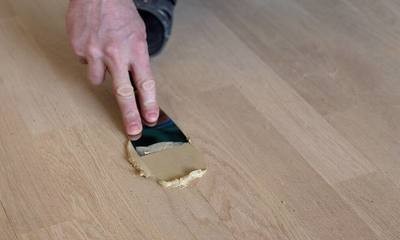
- Rub the melted edges of the damage with light pressure on a coin or spatula.
- If there is delamination, peel off the edges of the protective layer to the point where they are fixed.
- Rub the edges again.
The ease of repair is the only benefit of this kind of work. There are numerous drawbacks:
- Possibility of peeling under load, washing, exposure to UV radiation.
- Lack of next layer protection.
- Possible change in structure, especially with natural linoleum. The area may swell or begin to crumble, which will lead to an increase in the depth of the damaged area, right down to the very rough foundation.
This type of repair is only applicable in situations where the damage is situated in low- or no-load areas, like those adjacent to walls.
Using linoleum mastic or specialized polymer wax, the damage is grouted as part of the second repair technique. Wax is preferable because of its transparent structure. In order to work, you’ll need:
- wax;
- putty knife;
- stationery knife;
- if there is peeling at the edges of the damage.
Additionally:
- Use a knife to cut off the peeling edges of the damage.
- Rub the edges of the burnt layer with a spatula.
- Apply wax to the area and level it to the level of the coating.
The wax needs to be cleaned with a soft, clean cloth once it has solidified. This method’s benefit is that the decorative layer is protected and the damaged layer is restored. The potential for deformation under high loads is another drawback.
Defect to base layer
Linoleum that has been burned to the base layer is another kind of damage. This damage is more extensive and has a flaw in the ornamental layer. By repairing the damaged layers partially, this burning is prevented. In order to work, you’ll need:
- Polymer glue grade “C”.
- Linoleum wax or mastic.
- Colored pigment to match the main color of the coating.
- Stationery knife.
- Putty knife.
Mechanism of action:
- Use a knife to clean the cavity of the damaged area, cut off the peeling of the protective layer.
- Stir the glue and pigment in the container, taking into account the color contrast of the composition.
- Using a spatula, fill the damage with glue. The composition should fill the hole to the protective layer.
- After the glue has hardened, apply linoleum wax and level the layer to the level of the protective layer.
Next, use a soft, dry cloth to polish the area. Restoring the coating’s structure and shielding all layers from dust, moisture, and peeling are the primary benefits of these repairs. The inability to replicate a complex pattern’s contour is a drawback.
This kind of repair works well under additional coverings (carpets, rugs) or in places with little traffic.
How to choose a method for repairing damaged pavement?
The area’s location and the extent of the damage determine which burn repair technique is used. The owner of the coating needs to consider:

- Burning of the protective layer can be eliminated by simply leveling the edges only in areas with light load. It is worth considering that the burn site remains unprotected from external influences and can even be damaged by UV radiation. This is especially taken into account when natural linoleum is damaged.
- Burning to the base layer can only be eliminated by filling the cavity with glue or mastic. The possibility of delamination at the edges is taken into account.
- Damage to the coating down to the rough base can also be repaired by filling with glue, regardless of whether a patch is applied or not. It is important to protect the coating from peeling, air and moisture.
When selecting a burn sealing technique, it’s critical to accurately determine the extent of the issue and its location. It is important to keep in mind that the composition used for repair needs to be able to sustain loads for a prolonged period of time (based on where the burned area is located), not deform the surrounding area, and withstand certain loads.
Although burns in linoleum flooring can be unsightly, they are actually quite simple to repair. You can fix the damaged area and bring back the original appearance of the floor with a few basic tools and materials. With the help of this guide, you will be able to remove the burned area, repair it in a seamless manner, and make sure it matches the rest of the floor. These suggestions will assist you in getting a polished finish without having to replace the entire floor, regardless of the size of the burn or scorch mark.
Prevention of occurrence
When heating appliances or fires are handled carelessly, linoleum can burn. This could start a fire and is extremely risky. In order to avoid these issues, the property owner needs to:
- In residential premises, it is necessary to apply non-combustible material to the floor in the area of stoves, stoves and other heating appliances.
- Non-combustible material or sheet steel is also laid in technical rooms or work areas.
- You can place a rug under incandescent lamps. Incandescent lamps often burst and can also burn through the coating.
- Use acids and alkalis carefully.
- Closely monitor unextinguished cigarettes, matches, hookah charcoal.
The building owner can prevent the floor covering from burning and the fire from spreading further by simply being vigilant. The highest temperature at which linoleum’s structure can alter should be considered when making a purchase; do not apply the coating in areas that will experience high temperatures.
Useful video
Extra details in the video:
Although it may seem difficult, fixing a burn in linoleum is a manageable task if the proper equipment and procedures are used. Knowing how to fix a burn can save you the money and trouble of having the entire floor replaced, regardless of how big or small the burn is.
You can successfully restore the appearance of your linoleum for minor burns by employing a straightforward method of filling and trimming. After carefully cutting out the damaged area, replace it with a matching piece and glue it in place. For burns that haven’t gone too deeply through the flooring, this method works well.
If the burns are more extensive, you may need to replace a portion of the linoleum. This entails removing the damaged area and replacing it with a new component. A seamless repair depends on making sure the new component complements the existing linoleum’s color and pattern. The secret to getting a professional-looking outcome is patience and accuracy.
Your linoleum flooring can last longer if you give it regular maintenance and swift attention to any damage. You can maintain the best-looking floors for many years to come by taking care of burns and other problems as soon as they happen. You can confidently handle burn repairs and preserve the aesthetic appeal of your linoleum floors with these doable steps.


