
Do you want to update the appearance of your house without going over budget? One great way to do this is to finish your facade using facade plaster and foam plastic. This process not only makes your house look better, but it also improves insulation, which increases energy efficiency.
Facade plaster works well with foam plastic as a base material because of its lightweight and manageability. Together, they produce a weather-resistant exterior that is both beautiful and strong. With the correct instructions, you can take on this project and change the exterior of your house, regardless of your level of experience with do-it-yourself projects.
We’ll guide you through the process of applying facade plaster and foam plastic to finish your facade correctly in this article. From surface preparation to final coat application, we’ll offer you helpful pointers and recommendations to guarantee a polished finish. Let’s begin the process of giving your house the makeover it needs!
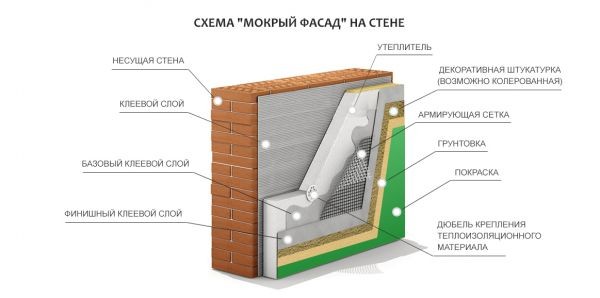
| Step | Description |
| 1. Prepare the surface | Clean the facade, remove any dirt or loose material, and ensure it is dry and smooth. |
| 2. Install foam boards | Attach foam boards to the facade using adhesive and mechanical fasteners, ensuring they are aligned properly. |
| 3. Apply base coat | Cover the foam boards with a thin layer of base coat plaster to create a smooth surface for the next layer. |
| 4. Embed reinforcement mesh | Place a fiberglass mesh into the wet base coat to strengthen the facade and prevent cracks. |
| 5. Apply finish coat | Spread the final layer of facade plaster over the reinforced base coat, ensuring an even and smooth finish. |
| 6. Paint (optional) | If desired, paint the finished facade with a suitable exterior paint for added protection and aesthetics. |
- Facade plaster – advantages and disadvantages
- Types of plaster mixture that can be used for application to foam plastic
- Consumption of façade plaster on polystyrene foam
- Preparing the surface for application
- Reinforcement and priming
- Technology of façade finishing with polystyrene foam plaster
- Useful video
- Video on the topic
- Decorative plaster Bark beetle ● The facade insulation with foam
- Foam reinforcement of the facade. How to do it right and how to do it! [No. 6]
- How to insulate the facade with foam.
- Warming of aerated concrete with foam with facades of facades with clinker tiles, decorative elements of the PPS
- Gluing the insulation per facade. How to apply glue correctly, why it is impossible to apply glue with a comb?
- Do not allow this error when warming the facade do not ruin the insulation
Facade plaster – advantages and disadvantages
Conventional plaster is not suitable for plastering walls that have been finished with foam plastic. This is complicated by the possibility that the mixture will just fall off after drying, necessitating more plastering.
In this sense, selecting the proper plaster that will adhere to the foam properly and endure a long time is crucial. Let’s look at the plasters that work best for this application and will end up working best.
Let’s examine the foam itself before selecting a plaster. It is possible to discern the two significant indicators listed below:
- this material has a smooth and even surface, so there may be problems with the adhesion of the mixture;
- not every composition has a sufficient level of viscosity and can cling to a smooth surface. That is why it is important to choose facade plaster designed to work with polystyrene foam.
Skilled artisans advise utilizing reputable andwell-liked brands of finishing compounds, such as Ecomix and
Ceresite, however, should be noted that any plaster with strong adhesive qualities in respect to polystyrene materials can be utilized. The most crucial thing is to plaster the entire working surface with a mixture from a single manufacturer rather than combining mixtures from several brands.
The second thing you should be aware of is that some manufacturers advise applying a protective layer first, then foam gluing compounds. Others create all-purpose mixes that can be used for any kind of finishing task. For those looking to cut costs, the second option is appropriate, but don’t expect a high-quality final product.
Some qualities, like resistance to moisture and frost, are required of the chosen mixture. Find out more about using foam plastic to insulate walls.
This is particularly important if we are discussing painting the facade rather than adding more finishing touches like decorative putty.
The plasters listed below work best for finishing facades:
- cement;
- cement-polymer;
- polymer.
In terms of price, polymer compositions are the priciest; on the other hand, they are the most resilient and do not fracture both during application and after drying. Since there are hardly any drawbacks to any type of plaster, consumers should select their choice based on factors like cost, ease of use, and the features of the required work. The work will be finished more quickly if the composition is applied with ease.
Types of plaster mixture that can be used for application to foam plastic

Let’s examine the kinds of plasters that work well on polystyrene foam in more detail.
Given that we are discussing external decoration, the plaster needs to be able to tolerate a wide range of temperatures and atmospheric conditions.
In this sense, mixtures containing gypsum should be immediately removed from the list of appropriate combinations.
As we’ve already mentioned, the best option would be cement or polymer compositions—that is, those that are available at hardware stores rather than those that are made at home by combining cement, sand, and water.
The problem is that special compositions contain extra ingredients that give the plaster strength and durability. Now let’s look at the compositions that work best when applied to foam plastic.
There are the following categories of compositions:
- Mineral. Sand, water and cement are used to create them. They are not durable, but have a low cost.
- Acrylic. The mixtures are based on acrylic resins. The material perfectly allows air to pass through and allows the material inside to “breathe”. Features high vapor permeability.
- Silicate. This plaster is sold in buckets, and it has an alkaline reaction. You need to work with it very carefully.
- Silicone. They have increased elasticity and, when applied, form a uniform, beautiful layer.
Apart from the differences, there are a few other noteworthy points. It is preferable to use easily applied and distributed thin-layer materials. Low plasticity and the potential for cracks to form during application are characteristics of cement-sand compositions. A common feature of all these compositions is their heightened resistance to algae, fungi, and mold.
Finishing a facade with foam plastic and facade plaster is a cost-effective way to improve the appearance and insulation of your house. To guarantee longevity and visual appeal, proper surface preparation, material application, and attention to detail are required.
Consumption of façade plaster on polystyrene foam
Two types of mixtures are used for plastering the facade of a building that has been finished with foam plastic. The first is required to level the surface, and the second is used to glue the reinforcing mesh. Furthermore, there are all-purpose mixes that are appropriate for both kinds of labor.
It’s crucial to calculate the necessary mixture amount accurately if you choose to purchase two different kinds of materials at the same time. Here:
- glue consumption will be 4 kg per square meter, and plaster should be calculated based on 6 kg per square meter;
- if we are talking about a universal mixture, then the consumption will be equal to 10 kg per square meter;
- to calculate polymer plaster, it is worth using an indicator such as 9-10 kg per square meter, provided that 3.5-4 kg will be spent on gluing the reinforcing mesh, and the rest will be required to create a leveling layer.
Preparing the surface for application
It is crucial to properly prepare the work surface before starting to plaster walls finished with foam plastic. To do this, you will require:
- seal the joints between the sheets using polyurethane foam and wait for it to dry;
- if excess is formed, it must be cut off with a sharp knife;
- most often, foam plastic is attached using “umbrellas”, so it is important to make sure that the caps are sufficiently recessed and do not protrude, since this will create additional difficulties when applying plaster;
- after this, you will need to sweep the surface of the wall from dust and prime it. This will increase the adhesive properties of the wall and even simplify the work;
- the next steps will be to reinforce and level the walls. If dry plaster is purchased for this purpose, then the mixture should be prepared before reinforcement begins, otherwise it will quickly lose its qualities.

It is crucial to keep in mind that plastering can only be done on firmly fixed insulation.
In order to prevent ugly cracks from forming on the plaster after plaster application, it is imperative to fix any loose foam.
Reinforcement and priming
There are two methods for adding reinforcement or a unique mesh to the walls:
- In the first case, the mesh is applied to the prepared area and coated with plaster solution on top. The composition penetrates into the cells and the material quickly sticks. It is not easy to do such work alone, since you will need to hold the mesh with one hand and apply the mixture with the other, so it is better to first fix the mesh and then apply the solution.
- The second method is to first apply plaster to a section of the wall, and then attach a mesh to it. Gradually pressing the cells into the composition with a spatula, the master glues the mesh to the surface.
Whichever reinforcement technique is selected, the building’s corners, doorways, and slopes must be adhered to first, followed by the entire surface.

The mesh is divided into strips measuring 30 to 40 centimeters and then bent and adhered to the desired location to strengthen window and door openings. The plaster needs to be rubbed with sandpaper or a specialized trowel to remove any irregularities after it has dried, which could take a few hours to a day.
Following this, a unique compound is applied to the wall surfaces to improve the plaster’s inherent protective properties. Selecting a liquid, uniform primer is preferable since it will give the coating texture and improve material adhesion.
Technology of façade finishing with polystyrene foam plaster
The application of a leveling layer completes the finishing process.
Here, the worker must exercise the utmost care and responsibility because the leveling layer will cover up any flaws in the reinforcing coating and lay the groundwork for painting or applying decorative putty to complete the walls.
In actuality, plastering brick or concrete walls is not all that different from this work.
It is worthwhile to apply the plaster thinly with a regular spatula.
The sections’ joints should be mixed in relation to the mesh joints, which is a crucial consideration during the finishing process. Stated differently, stitches shouldn’t cross over one another.
When it comes to painting later on, the finishing should be done with extra caution because any unevenness will just be highlighted by the paint, and the walls won’t look very beautiful.
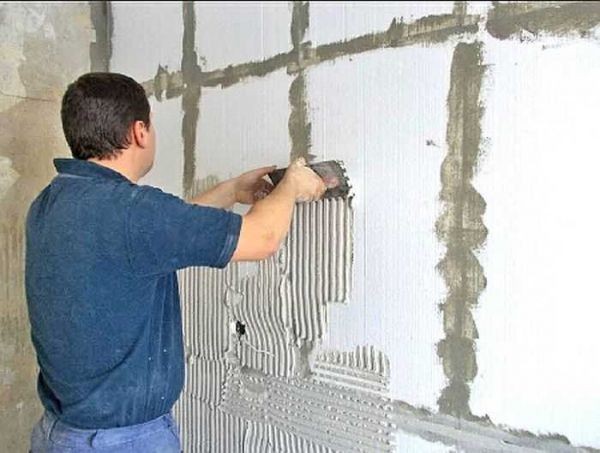
It is advised to sand the surface with sandpaper or a specialized mesh after the coating has dried to guarantee an absolutely smooth surface. Grouting during the first three to four days is crucial because if you don’t, the composition will harden considerably and become very challenging to sand later on.

Textured finishing plaster is an exception in this instance, but it all depends on the size of the grains.
Useful video
Master class on plastering and using foam plastic to insulate a wall:
Using facade plaster to finish a facade with foam plastic is a great way to improve your home’s insulation and appearance. Although the process requires meticulous planning and execution, the end results are well worth the effort.
You can create a strong and appealing facade by following the right procedures, which include priming the surface, adding insulation, and plastering the entire structure. This method adds an extra layer of insulation to your home, which not only makes it look better but also increases energy efficiency.
Keep in mind to select premium materials and adhere to safety precautions at all times. You can accomplish this project successfully and reap the rewards of a beautifully finished and well-insulated facade with perseverance and attention to detail.


