
Fire resistance is one of the most important factors to take into account when guaranteeing safety in construction. One of the most important steps in protecting residential and commercial buildings is the installation of fireproof plasterboard partitions. The purpose of these partitions is to slow the spread of fire, giving people more time to evacuate and minimizing damage to property.
Also referred to as fire-rated drywall, fireproof plasterboard has been specially treated to withstand high temperatures. This makes it a great option for building smoke- and fire-resistant barriers. Whether you’re building a new structure or remodeling an existing one, knowing how to install these partitions can have a big impact on the project’s overall safety.
Installing fireproof plasterboard partitions is a multi-step process that starts with material selection and ends with proper fitting and sealing. To guarantee that the partitions function properly in the event of a fire, careful attention to detail is necessary, and it goes beyond simply fastening boards to a frame. Building occupants can feel more at ease knowing that these partitions are durable and functional when installed properly.
We’ll go over all the important details of installing fireproof plasterboard partitions in this article. We’ll go over the supplies you’ll need, the equipment you’ll need, and the step-by-step instructions to ensure a polished and secure installation. These tips will assist you in getting the best results whether you are a professional contractor or a do-it-yourself enthusiast.
| Step | Description |
| 1. Planning | Measure the area and plan the layout of the partitions. |
| 2. Framing | Install the metal or wooden studs to create the framework. |
| 3. Insulation | Place fireproof insulation between the studs for added protection. |
| 4. Plasterboard | Attach fireproof plasterboard sheets to the framework. |
| 5. Joints | Seal the joints with fireproof tape and compound. |
| 6. Finishing | Sand the surfaces and apply a fire-resistant finish. |
- What kind of design is this?
- Scope and purposes of application
- Varieties
- 1 type
- 2 type
- Requirements according to regulatory documents
- Which sheets are suitable?
- Fire-resistant drywall (GKLO)
- Moisture resistant (GKLV)
- Moisture-resistant and fire-resistant (GKLV)
- Top 5 manufacturers
- Knauf
- Magma
- Volma
- Gyprock
- Dano-gips
- What is needed for the device?
- Materials and consumables
- Tools
- Installation Features
- Bugs and difficulties
- Advantages and disadvantages
- Video on the topic
- Smooth profiles – CURVED partitions. How is this possible? Drywall installation.
- Plasterboard partition. Installation of a two-layer plasterboard partition with a doorway
- 1000 SQUARE OF GYPSUM CARDBOARD IN 1 DAY! #044
- Soaring ceilings in a 2-room apartment. Where is the mistake? #stretch ceilings #renovation #apartment renovation
- Doorway ➥ Installation and Covering with plasterboard ✦ PLATO & Siniat
What kind of design is this?
A plasterboard fire partition is a kind of enclosing structure that satisfies fire resistance standards, ranging from EI15 to EI120, and is placed between adjacent rooms.
The technical properties of plasterboard, the quantity of plasterboard layers in the enclosing structure, the overall thickness of the space-planning element, and the caliber of fireproof insulation installed in the supporting frame’s body all affect a fire partition’s ability to withstand flames.
Special technologies are used in the manufacturing of fire-resistant plasterboard partitions, which fully comply with GOST 30403-96 and GOST 30247.0-94 requirements. This permits the designer to incorporate these structures into working drawings without any violations.
Scope and purposes of application
In the following categories of residential, public, or commercial spaces used for tasks with different functional purposes, plasterboard fireproof partitions have been installed:
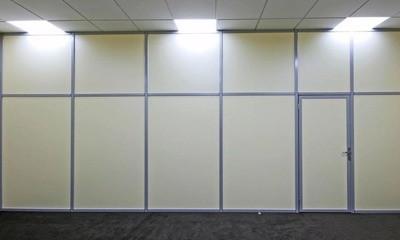
- Between different fire compartments inside buildings.
- Between residential apartments or hotel rooms.
- For fencing off rooms with different technological parameters.
- If it is necessary to isolate a space in which fire hazardous processes occur.
- If there are special fire safety or space-planning requirements for premises, in accordance with standards or design assignments.
- In case adjacent premises are intended for transportation or temporary stay of fire crews.
- In partitions leading to fire escapes, vestibules, elevator halls and other evacuation routes in the building.
Since the air binder cannot withstand the effects of an aggressive environment and has a low frost resistance class, these fireproof partitions are typically used only indoors. This does not imply the use of gypsum boards outside.
Varieties
In actual use, a variety of fire-fighting enclosing structures composed of unique sheets of gypsum board are employed; these structures fall into two main categories. The characteristics of these kinds of enclosing space-planning elements are explained in detail below.
Various building structural elements, such as walls, ceilings, partitions, and other elements, are subject to requirements for fire resistance, which refers to the ability to maintain the stability of the structure and position during prolonged exposure to open fire. These requirements vary depending on the type of element. The index EI is used to identify this parameter, which is expressed in minutes.
1 type
In order to serve as a complete wall separating offices, apartments, or nearby industrial spaces with potentially dangerous technological processes, a fire partition composed of fire-resistant plasterboard must ensure that its position and shape remain stable for a minimum of 2.5 hours, or ei 150.
The fire resistance limit of such a partition, if it is an extra enclosing structure placed in the vestibules or on the stairwell, should be at least EI45.
A double carrier frame of reinforced galvanized profiles, two layers of fire-resistant GKL from each side, and a heater made of at least 75–100 mm thick basalt cotton wool are needed to construct such an enclosing structure.
2 type
The second kind of fire partitions is installed in spaces where there is a low risk of a fire occurring. These spaces include adjacent office rooms that are listed under one tenant’s balance, apartment rooms between bedrooms and kitchens, and rooms between rooms.
The fire resistance requirements for such structures are listed below, ranging from EI15 to EI30. This can be readily met by using 12.5 mm thick fireproof GC sheets arranged in a single layer. Mineral wool insulation installed in the body of the supporting frame consisting of galvanized posts and imposts is no thicker than 50 mm.
Requirements according to regulatory documents
The following regulatory documents strictly follow the requirements for fireproof gypsum plasterboard partitions as per the laws that are in effect in our nation:

- SP 2.13130.2020 “Fire protection systems.
- SP 163.1325800.2014 “Structures using plasterboard and gypsum fiber sheets”.
- GOST 6266-97 “Gypsum plasterboard sheets (GKL). Technical specifications".
- SP 1.13130.2009 “Code of Rules”. Fire protection systems. Evacuation routes and exits".
The following design, space-planning, and functional requirements are provided for all fire partitions made of Civil Code fire-resistant sheets in compliance with these regulatory documents:
- The dimensions of the sheets, as well as their thickness, must fully comply with the current assortment approved at the international level.
- The fire resistance limit of fireproof gypsum board sheets must be at least EI
- All sheets must have mechanical resistance to bending, as well as resistance to impact loads.
- The finished gypsum plasterboard partition, taking into account the number of layers of plasterboard sheets, as well as the thickness and physical and mechanical properties of the insulation, must fully satisfy the fire safety requirements for a specific room.
- All guides must be installed in strict accordance with the technological map, project and album of standard solutions approved by authoritative government bodies.
- Sheets of plasterboard in fire partitions must be installed with an overlap of at least 25% of their width, if they are attached in 2 layers. When fixing enclosing elements in 1 layer, care should be taken to fill the seams in advance so that the finished structure is completely impenetrable to open fire during a fire.
- GKL sheets with a fire-resistant core must be tightly adjacent to the orthogonal walls, floor and ceiling of the room, and also pressed tightly with self-tapping screws to the guides of the supporting frame.
- To increase the fire resistance, when installing gypsum board sheets, it is recommended to use a special heat-resistant sealant, which ensures increased tightness of the structure.
Typically, every gypsum board sheet manufacturer that is officially registered in our nation creates its own technical specifications based on GOST requirements.
These specifications act as a technological road map for the material’s production. Selected sheets from each batch undergo full-scale testing, and the enterprise’s management is granted a certificate of compliance with the specifications for each product unit as a result. A state document of this kind ensures quality, dependability, and the ability to use structural components in a project that has passed the examination and is operational.
Which sheets are suitable?
Different types of gypsum board sheets, categorized by design, core thickness, and technical characteristics, are appropriate for the installation of fire partitions.
Fire-resistant drywall (GKLO)
The most popular type of material used to make plasterboard partitions; it has higher density, polymer additives, elasticity, and vibration-proof qualities.
Differentiations:
- differs in the type of edge – flat or U-facing, in thickness – 10, 12, 12.5 mm;
- according to the degree of fire protection, which depends on the structure of the core – from EI10 to EI30, depending on the manufacturer and power of the product.
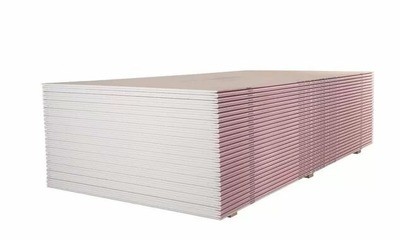
Details:
- Thickness – 10, 12, 12.5 mm.
- Overall dimensions – 2.5 x 1.2 m.
- Core density – from 1100 kg/m3 .
- Ultimate bending resistance – 35 kgf/cm 2 .
- Fire resistance – from EI15 and more.
- Edge type – U-shaped, extended.
- Maximum humidity of gypsum boards – up to 10%.
When installing an anchor for a single- or double-layer structure, the maximum load is 25 or 45 kg.
Get all the details you need to make drywall fireproof here.
Moisture resistant (GKLV)
Fire partitions are not meant to be made of this material. Regardless of the number of layers of material atop the supporting frame composed of galvanized sheets, these structures are distinguished by the highest fire-resistant properties due to their unique physical and mechanical properties as well as the density of the core.
Water resistance, grades W4 through W6, and the technical attributes listed below are used to classify them.
Details:
- Thickness – 12, 12.5 mm.
- Overall dimensions – 2.5 x 1.2 m.
- Core density – from 980 kg/m3 .
- Ultimate bending resistance – 32 kgf/cm 2 .
- Fire resistance – from EI10 and more.
- Edge type – U-shaped, V-shaped, flat, extended.
- Maximum humidity of gypsum plaster boards – up to 12%.
Find out more about gypsum board that resists moisture here.
Moisture-resistant and fire-resistant (GKLV)
Universal structural elements include asbestos-containing components that offer superior fire resistance for the entire structure and compliance with fire safety regulations, as well as polymers in the core structure that prevent the stratification of the material’s crystal lattice at high humidity.
Categorized based on the thickness and mechanical strength of the core material, as well as the degree of fire and moisture resistance.

Technical details:
- Thickness – 12, 12.5 mm.
- Overall dimensions – 2.5 x 1.2 m.
- Core density – from 1050 kg/m3 .
- Ultimate bending resistance – 38 kgf/cm2 .
- Fire resistance – from EI15 and more.
- Edge type – U-shaped, V-shaped, flat, expanded.
- Limiting humidity of boards GKL – up to 11%.
It is also feasible to install these economy-class partitions using the least expensive standard GC sheets, which are devoid of any unique characteristics.
Type 2 partitions are being built from such structural elements, provided that the supporting frame is lined with two layers of plasterboard, followed by a layer of reinforced putty with a minimum fire resistance limit of EI10 and mineral wool insulation positioned in between the supporting frame’s guides.
Top 5 manufacturers
The TOP 5 most well-known producers of these materials are listed below, along with information on their brands, key parts, models and modifications, benefits, and average costs in the Russian Federation, to make the process of choosing plasterboard sheets for use in building fire partitions easier.
Knauf
Big German company with two fully operational full-cycle factories in Russia.
The parent brand closely monitors every product under its brand, ensuring the best possible quality, dependability, and longevity. Because there are so many official dealers in the Russian Federation, customers can buy Knauf products at affordable prices, which helps the manufacturer’s growing popularity.
The company manufactures standard-diameter fire-resistant products with a thickness of 10 to 12.5 mm. The quality certificate states that EI30 and higher is the fire resistance limit.
If two layers of gypsum plasterboard sheets are used as the partition’s lining, and 50 mm of VENTI-BATTS mineral wool insulation is used, the partition’s fire resistance rating will be at least EP90.
Benefits
- All plasterboard sheets from the Knauf company are affordable and of high quality.
- The company has developed its own system of guides, racks, reinforced, distribution and corner profiles, as well as their connections.
- The consumer has the opportunity to purchase all partition elements at a single point of sale.
- Detailed documentation on the correct construction of these enclosing structures is available on the brand’s official website.
The average cost for one Glo sheet is between 450 and 580 rubles.
Magma
This business extracts natural fossils, primarily limestone and various forms of air binders. The brand management established a plant in 2002 to produce gypsum mixtures, drywall sheets, and specialized components for them. The brand’s own stores operate in practically every area of the Russian Federation, and the plant products are renowned for offering the best value in terms of both price and quality.
The factory manufactures the entire line of standard structural, acoustic, refractory, and moisture-resistant drywall. Every product undergoes regulatory testing at every stage of production and complies fully with GOST requirements.
Polymer binders prevent delamination of the core structure even during long-term use in harsh conditions, and safe, non-combustible materials are added to the brand’s fire-resistant plasterboard to prevent allergies in those who depend on it.
Benefits
- high quality;
- products are approved by many state companies involved in the construction of strategic facilities;
- ease of construction;
- wide range of models;
- acceptable cost of production.
The average cost of one sheet of fire-resistant plasterboard is between 420 and 500 rubles.
Volma
Based on the Volgograd Gypsum Mixtures Plant, the company was established in 1949 and underwent two rebrandings and renovations. With its current ISO 9001 international quality certificate, the company is eligible to bid on nearly all government contracts.
Factory products are characterized by increased sound-proofing, moisture resistance, and fire-fighting qualities, as well as the highest accuracy of the geometric dimensions of gypsum boards and core homogeneity.
Products from the company are utilized worldwide for construction, finishing, and repair tasks.
Every fire-resistant sheet has a unique non-flammable impregnation that ensures the structure’s longevity, complete fire resistance, and conformity with all regulations.
Benefits
- perfectly accurate overall dimensions;
- tight fit of the sheet to the guides, convenient cut edge for mating the partition elements;
- The company"s product range includes 5 standard sizes and thicknesses of fire-resistant cladding materials for the building envelope.
The average cost for one GKLO sheet is between 400 and 550 rubles.
Gyprock
One of the top French companies, founded in 1932, specializes in producing pre-made systems for plasterboard partition construction, including fire-resistant buildings that satisfy all Russian regulations.
In 2004, a full-cycle plant and the brand’s official representative office opened for business in the Nizhny Novgorod region. Because of the products’ exceptional fire resistance, robustness, and dependability, the company’s products are listed among the brands of the biggest foreign hoteliers who open hotels in the Russian Federation.
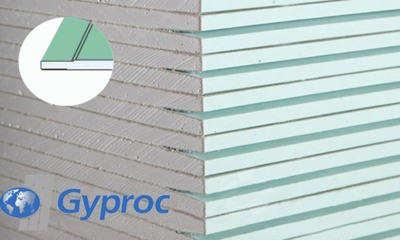
Enhanced resistance to mechanical impacts and the ability to endure at least 30 minutes in an open fire without losing their shape stability or rupturing the core structure are the distinguishing features of high-strength flexible sheets.
Benefits
- This brand is engaged in the production of a full-fledged construction system, offering consumers unique profile elements made of punched galvanized steel, which provides the highest rigidity.
- The thickness of the finished partition fully complies with both federal Russian and international fire safety requirements.
Average cost: between 580 and 740 rubles. for a single fire-resistant gypsum plasterboard sheet.
Dano-gips
KG Stroy Systems LLC, a relatively new business that was established in 2006, is one of the most promising in our nation because of its sophisticated automated conveyor line that includes CNC machines and a large selection of products.
The nomenclature for the entire brand is distinct:
- high surface quality, excellent technical characteristics;
- mechanical strength and fire resistance from EI30 and above, which makes fire partitions from this manufacturer one of the most reliable in their class.
The company sells fire-resistant gypsum board sheets in just two standard sizes: 12 and 12.5 mm thick. Nonetheless, the majority of customers praise the material for its superior performance qualities, ease of installation, and high quality. In residential or public buildings, fire partitions constructed in accordance with the company’s standard solutions album can be used for at least 15 to 20 years.
Benefits
- Official dealers of the brand operate in almost every region of the country, which guarantees a single price for all types of product units.
- Modern automated equipment of the plant guarantees the highest quality, reliability and absence of errors and deviations from geometric dimensions.
The average cost for one GKLO sheet is between 400 and 450 rubles.
As a result of its subjectivity, lack of advertising, and reliance on actual customer reviews, the aforementioned rating cannot be used as a recommendation for a specific product.
What is needed for the device?
You will need basic and consumable materials, tools, mechanical and electrical equipment, and plasterboard partitions that are fireproof.
Every piece of machinery and equipment needs to be well-made, sharpened, functional, and prepared for use. It is advised to buy inventory, necessities, and consumables from reliable vendors only as this reduces the possibility of manufacturing flaws and ensures a long service life.
Materials and consumables
The following basic and consumable materials will be needed by the craftsman to construct plasterboard partitions using fire-resistant gypsum board sheets:
- Basic materials:
- GKLO sheets of the required thickness and with the required physical and mechanical parameters.
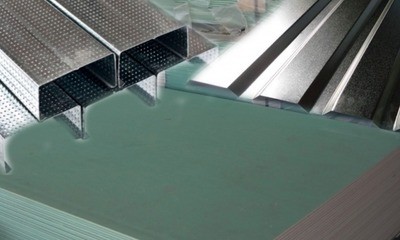
- Galvanized starting, vertical, horizontal and other guides for mounting the supporting frame.
- Insulation for filling the space between sheets, usually mineral wool with an increased fire resistance limit.
- Consumables:
- Connectors, crabs, corners for fixing all the nodal points of the load-bearing frame of the partition.
- Self-tapping screws for fastening gypsum board sheets.
- Dowel-nails for fixing starting profiles to reinforced concrete structures.
- Wedge anchors when it is necessary to fix reinforced profiles to reinforced concrete or stone structures.
- Fire-resistant sealant to ensure tight adhesion of gypsum board sheets to profiles.
- Serpyanka for reinforcing seams between gypsum board sheets after installation.
- Putty mixtures, interior paint, wallpaper and other finishing materials, in accordance with the specifications for the design project.
It should be mentioned that every sheet of plasterboard needs to have a quality certificate detailing all of the material’s functional and technical qualities, regardless of the supplier or retail price.
Tools
A specific set of tools is required by the craftsman when building fireproof partitions out of sheets of gypsum board by hand:
- For taking measurements and markings on adjacent structures, profiles and on gypsum board sheets:
- Laser rangefinder.
- Laser or bubble level for accurately marking the installation location of starting profiles on ceilings, walls and floors.
- Steel construction tape with a blade length of at least 3000 mm.
- High precision metal ruler with a length of 1000 mm.
- Joiner"s steel orthogonal angle.
- Marker or pencil with a soft lead for marking.
- A plumb line on a nylon cord to ensure the verticality of the wall structure during its construction.
- For cutting plasterboard sheets:
- Construction knife with retractable blade.
- Hacksaw for metal.
- Metal scissors with large handles for easy cutting.
- For a large volume of profiles – a cross-cutting machine with an abrasive disk and a rotating bed, or a regular grinder.
- File or sanding disc for cleaning the cutting area.
- Planer for drywall, if necessary, adjusting the ends.
- For installation partitions:
- Drill with a set of metal drills.
- Screwdriver with a set of bits.
- Phillips or slotted screwdriver for tightening screws.
- If necessary, install reinforced profiles on anchors – a set of open-end or socket wrenches with ratchets, or special attachments for a drill / screwdriver.
- For finishing the building envelope.
- Spatulas with different blade lengths.
- Abrasive float for sanding putty after drying.
- Glue for cobwebs or other finishing materials.
- Paint milking cuvette.
- Brushes and rollers for applying a layer of interior paintwork.
It is advised to only use the tools that the supplier recommends, as their technical specifications fully meet technological requirements and guarantee safe material cutting, installation plane preparation, and ideal element fixing to the supporting frame and orthogonal building structures.
Installation Features
You need to consider several crucial details, adhere to specific guidelines, and closely follow the technology map when building fire-resistant plasterboard partitions by hand:
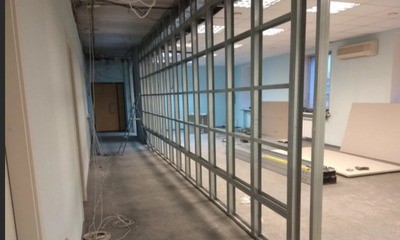
- Before starting installation work, a laser level is installed that projects a solid line on all adjacent structures to which the starting profile will be fixed. This electronic marking eliminates errors while maintaining the correct position and verticality of the enclosing structure.
- The frame is assembled strictly sequentially – starting with the starting profiles to which the racks are attached, and at the very end the distribution imposts are fixed, which guarantees its maximum rigidity.
- Effective insulation is installed in the partition body only after installing one of the facing layers.
- All self-tapping screws when fixing gypsum board sheets must be recessed 0.5 – 1.5 mm into the body of the core, which ensures the possibility of sealing them with putty, and they do not protrude onto the front side of the enclosing structure.
- Sheets of drywall should fit tightly together, without gaps.
- The seam is filled through the cut edges of the product.
- If it is necessary to arrange sheets in 2 layers, ligation of seams will be required.
- When installing a fire wall with a fire resistance limit of more than EI60, it will be necessary to install a double load-bearing frame with a stud spacing of at least 200 mm.
- Typical dimensions of a supporting frame cell range from 400 x 400 to 600 x 600 mm.
- Fastening gypsum board sheets to self-tapping screws should be done no closer than 10 – 15 mm from the end of the product.
- To ensure fire-fighting properties, gypsum board sheets must be tightly adjacent to the ceiling, floor and orthogonal walls, which requires careful trimming and fitting before fixing them.
- When fixing gypsum board sheets, it is recommended to transfer the location of the frame profiles to the front plane of the material in advance, which ensures that the threads of the hardware accurately fit into the galvanized elements.
It is advised that you familiarize yourself with the master classes and album of standard solutions—which experts frequently share publicly with other network users—before installing partitions.
Regarding the general guidelines in the video for erecting gypsum plasterboard partitions:
Bugs and difficulties
Building gypsum plasterboard partitions that are fire resistant is a difficult process that calls for specialized knowledge and expertise. This means that a novice building these enclosing structures by hand could run into a number of issues that have unfavorable outcomes:
- Incorrect marking of the frame, which leads to a violation of the geometry and vertical alignment of the structure – it is recommended to use only a laser level to mark the starting profiles.
- Insufficient stability of the frame – to install the load-bearing part of the partition, you need to use only rack profiles, which are characterized by an increased cross section and shelf size.
- Loose adhesion of gypsum board sheets to frame studs or imposts – it is always recommended to use heat-resistant sealant to fix the facing materials to the load-bearing part of the partition.
- Cutting hardware heads through a gypsum board sheet to the full thickness – when fixing elements with a screwdriver, it is necessary to set the tightening force limit to the minimum value in advance.
- A dull knock after fixing the plasterboard sheets to the frame – the insulation must be tightly adjacent to the cladding elements, and the distance between the rows of screws should not exceed 600 mm, which requires their installation opposite almost every profile.
It is important to remember that any mistakes made in the building of fire-resistant structures run the risk of the work not being accepted and posing a risk when the structures are used in areas where there is a fire risk. Infractions within the technology map have the potential to allow fire to spread into nearby rooms, with unpredicted consequences for the building and everyone within.
Adding fireproof plasterboard partitions to your building is an easy way to make it safer. These partitions enhance your building’s overall fire resistance in addition to aiding in the containment of fires and allowing residents more time to flee. Selecting fireproof plasterboard is an affordable, simple-to-install solution that greatly increases security without sacrificing aesthetic appeal or design flexibility. This guide will help you install these crucial safety features in your home or place of business by guiding you through the necessary steps and considerations.
Advantages and disadvantages
Due to the numerous benefits associated with these construction and installation tasks, designers and property owners frequently choose to construct fire partitions using gypsum boards:
- Satisfying fire safety standards in force throughout the country.
- The possibility of erecting partitions of any radius or broken configuration, due to the special physical and mechanical properties of gypsum board sheets and special technology for cutting them.
- The structures are characterized by their low dead weight, which does not require additional calculations of floor slabs when remodeling apartments, private residential buildings, office or industrial buildings.
- Ease of construction – it is not at all attractive to involve professionals to perform this work.
- The possibility of installing effective insulation between gypsum board sheets, which provides heat and sound insulation, and also increases the fire resistance limit of the finished structure.
- Complete absence of wet processes during the construction of partitions.
- An almost perfectly smooth plane upon completion of installation significantly reduces the amount of finishing work, in contrast to brick or block walls and partitions.
- Low cost of materials and labor for the construction of these partitions.
- The ability to cut window and door openings at any stage of the structure’s operation, without losing its load-bearing capacity.
- Possibility of cutting facing material without residues.
- On the website of each officially operating company in the Russian Federation for the production of gypsum board sheets, each potential buyer can use an interactive calculator to calculate the required amount of material, which will eliminate the risk of error.
- The compact dimensions and thickness of the sheets allow the manufacturer to pack them in bundles, which significantly reduces the cost of logistics.
- Environmentally friendly modern material that does not generate dust and does not emit harmful substances.
However, in spite of these benefits, there are a number of drawbacks to this method of building partitions and fire barriers, which is why many designers, builders, and clients choose to build vertical enclosing structures made of brick or reinforced stone that are monolithic in order to create a fire barrier:
- The fragility of the material – even with a slight impact, dents and chips appear on its surface.
- The need for reinforcement and sealing of seams, and, if the technology is violated, cracks may appear on the surface of the finished finish.
- Standard sheets have dimensions of 2500 x 1200 mm, which makes working alone much more difficult, and the master almost always needs an assistant.
- The need to drill reinforced concrete floors and load-bearing walls to install the starting profile.
- To ensure proper fire-resistant properties, it is necessary to follow a complex technological map, install two flat profile frames, which should not intersect with each other, so as not to cause heterogeneity of the enclosing structure.
- Without dense mineral wool, the fire resistance of a wall or partition is minimal, and effective insulation significantly increases the cost of the space-planning element.
- Regardless of the installation of insulation or reinforced racks, the finished structure is characterized by increased sound conductivity, as well as elasticity; it is easily deformed from strong impacts with the formation of cracks.
You should consider all of the room’s functional needs before deciding to build gypsum plasterboard partitions. You should also consider the space-planning parameters and other significant factors that will help you use the space as efficiently as possible.
Enhancing the safety and functionality of any building can be achieved with great effect by installing partitions made of fireproof plasterboard. Because of the fire resistance of these partitions, there will be more time for evacuation and less smoke and flames will spread. You can considerably increase the fire resistance of your spaces by selecting the appropriate materials and carrying out the installation processes according to plan.
The simplicity of installation of fireproof plasterboard is one of its main benefits. Even people with a moderate level of do-it-yourself experience can install these partitions with the correct tools and methods. In order to preserve the boards’ ability to withstand fire, it is crucial to make sure they are appropriately measured, assembled, and fastened, paying special attention to joints and seams.
Furthermore, in addition to improving safety, fireproof plasterboard partitions also provide superior thermal and acoustic insulation. Because of this, they are the perfect option for both residential and commercial buildings where energy efficiency and noise reduction are crucial factors. Because of their adaptability, they can be utilized in a variety of environments, including home interiors and offices.
Building plans that include fireproof partitions are a prudent investment in comfort and safety. You can make sure that your fireproof plasterboard partitions work well and provide you and your property with increased protection by adhering to best practices and seeking professional advice when necessary.


