
Adding a concealed blind space to your home can improve its appearance and usefulness at the same time. This is a great do-it-yourself project if you want to add a little privacy and improve the curb appeal of your house. It’s an easy way to improve your outdoor area that you can do on your own without hiring a pro.
We’ll walk you through setting up a hidden blind area from beginning to end in this guide. Whether your goal is to conceal unsightly utilities or to create a private garden nook, you’ll find useful advice and techniques to help you accomplish a polished and tidy finish. Prepare to update the exterior of your house with a fun and fulfilling project!
| Step | Instructions |
| 1 | Plan the area where you want to create the hidden blind zone. Measure the space around the house. |
| 2 | Clear the area of any debris, plants, or obstructions. |
| 3 | Dig a trench around the house where the blind area will be. The trench should be deep enough to accommodate your chosen material. |
| 4 | Install a layer of landscaping fabric in the trench to prevent weeds from growing. |
| 5 | Fill the trench with gravel or another drainage material to ensure proper water flow. |
| 6 | Place your chosen edging material, like stones or bricks, around the trench to create a finished look. |
| 7 | Ensure the area is level and compact the material to secure it in place. |
| 8 | Clean up any remaining debris and check that the area is functioning as intended. |
What does the concept mean??
Blind areas are separated into hard and soft categories based on the type of coating. The first option consists of asphalt and concrete that is sealed with paving slabs. to the second with a lawn covering, gravel, crushed stone, and crushed granite scattered about.
Rigid blind areas don’t always blend in with the surroundings; they need maintenance and are more costly to repair. Thus, in certain situations, going with a soft coating would be the best course of action.
A hidden blind area is a heat- and moisture-insulated coating that protects a building’s base without changing the building’s overall appearance.
It is made by covering the conventional "pie" (subterranean layers of building materials) of the blind area with a lawn. Simultaneously, the design’s primary functionality remains entirely intact.
In what cases is it possible to create a structure, and in what cases is it not??
Owners design the area surrounding the building with a hidden blind area for a number of reasons.

- There is no desire or time to pour concrete. The process of creating a rigid blind area is labor-intensive, requires significant costs for materials and takes a lot of time to dry the material. When frost is approaching and the construction budget is tight, many choose the simplest and most economical option – a hidden soft blind area.
- There is heaving soil on the site. The hidden blind area is laid on the top soil layer, the depth does not exceed 40 cm, which is half the level of soil freezing in central Russia. With the onset of cold weather, heaving soil begins to move: the moisture inside freezes and begins to expand, creating additional pressure on the foundation and the blind area itself. Insulating the structure allows you to minimize the effects of heaving on the base, and the soft blind area cannot be damaged; its “pie” does not contain materials that can crack.
- An excellent option for any type of foundation: strip, monolithic, pile, columnar.
Grass has a high relative humidity, collects dew, and is home to microorganisms. Expert builders advise against erecting such a structure close to homes with wooden foundations (especially old buildings).
On the outside, wood can get wet and moldy, which can then spread inside structures. Alternatively, you will have to continuously maintain a waterproofing layer around the entire perimeter of the basement walls.
Buildings with a solid foundation lined with brick, stone, concrete, or other moisture-resistant materials are exempt from restrictions.
A concealed blind area around your home adds useful functional space while also improving the property’s appearance. This tutorial will lead you through the entire process of making this feature on your own, from organizing and assembling supplies to starting construction. Whether your goal is to create a low-key garden area, enhance curb appeal, or improve drainage, following these simple instructions will help you get a clean, polished look with the least amount of hassle.
Advantages and disadvantages
Benefits of the hidden blind area
- does not require expensive repairs, maintenance of the coating is minimal;
- cannot be destroyed, the structure is flexible, without the participation of rigid building materials;
- does not respond to temperature changes;
- You can choose any finishing coating you want (lawn, flowers, plants, etc.).);
- protects the lower layers from freezing and heaving if insulation is used;
- saves the budget of the building owner, minimum materials, easy to do with your own hands.
Less strength than a rigid blind area and the requirement to maintain lawns, plants, and weeds are drawbacks.
Layers, what they consist of, their sizes
This building element’s design is simple enough that you can make it yourself:

- Clay. You should choose a material without impurities, clean. It is not recommended to make the layer more than 10 cm, since clay tends to swell from frost. A thin layer will not affect the structure in any way, but will close the lower soil from moisture penetration.
- Waterproofing. To protect against water, use a roll layer of roofing felt or other material. A modern highly effective material is popular – a membrane.
- Sand cushion, is formed from material moistened in water. A thickness of 5 cm is enough.
- Geotextile. It is used to separate sand and the next layer of crushed stone. When water gets inside the structure, the sand cushion does not capture the crushed stone, remains dry and does not wash away.
- Crushed stone. Drainage layer, helps to remove moisture from the foundation of the building. Its thickness is 10-15 cm.
Another layer of geotextile is used to finish the "pie" of the hidden blind area, and a finishing coating is applied to it to conceal it.
In certain instances, the blind area is additionally insulated with special material, particularly in areas that experience severe frosts. Two waterproofing sheets are sandwiched by the thermal insulation layer. For these purposes, layers of polystyrene foam are typically utilized. One sheet is 5 cm thick; if you arrange it in two layers, the thickness increases to 10 cm.
SNiP stipulates that the blind area’s width must be at least one meter, as long as it is 20 cm wider than the roof overhang line.
What materials is it made from??
The finishing coating renders this architectural element entirely undetectable to unwary observers, which is the unique feature of the hidden blind area. What is employed to produce this outcome:
- Lawn. Ready-made layers of fertile soil with planted grass are sold in rolls or made by home owners. With its help, the appearance of the blind area is transformed and becomes uniform, merging with the rest of the area.
- Shrubs, ornamental plants, flower beds. Entire landscape compositions are created from them, combined with each other, forming a single system with the rest of the site. Use small plants, climbing ones and those that have a horizontal root system that does not penetrate to depth.
- Crushed stone, gravel, granite chips. Material with small and medium fractions makes the area well-groomed. In a modern design, they can be colored, successfully combined with the cladding of the building, and they can be used to make drawings.
Crushed stone and green areas are combined by contemporary landscape designers, who also plant flowers, build flowerbeds on the blind area, and use stones to create stone compositions. Due to the severe weather, such designs of concealed protection from moisture and cold are still uncommon in Russia. However, mixed coating is gaining traction in the southern states.
How can you hide a structure and how to do it?
The easiest option is to cover with crushed stone, gravel, and granite chips. The material layer is applied on top of the geotextile litter after a sand pillow. Leve and compact are required after coating. Green areas and lawns need different maintenance.
You’ll require:

- Speech shovel;
- thread, pegs, plumb line, construction level;
- clay;
- waterproofing (roofing material, membrane);
- bitumen mastic;
- insulation (polystyrene foam 5 cm);
- geotextiles;
- sand;
- fertile soil;
- Sowing material.
Area of phased creature soft blindness coated in grass and insulated:
- Remove the upper fertile layer of the soil, digging up a trench 25 cm deep. To measure the plumb line. 20 cm width exceeds the line of the roof overhang.
- Clean, moistened in water, tamp the clay under the slope from the wall of the basement. Tilt height 2-3 cm per 1 m width of the blind area.
- Put a layer of waterproofing (roofing material, membrane) with an overlap on the wall of the basement, process the joints of the material with bitumen mastic.
- Lay the insulation in even layers, insulate the joints with polyurethane foam or other auxiliary means, while maintaining the slope. You can add an additional layer of insulation along the foundation wall.
- Another layer of waterproofing with an overlap on the wall.
- Carefully compact the wet sand evenly and cover it with geotextiles.
- Sprinkle the structure with crushed stone and add another layer of geotextile on top.
- Lay the soil close to the base wall, the thickness of the layer depends on the soil level throughout the entire area, sow lawn seeds (or roll out ready-made rolls of lawn grass).
Grass is mixed with tiny shrubs, flowers, and plants. Include crushed stone and stones in the design.
Potential choices for a lawn:
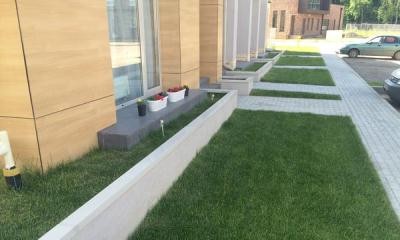
- Parterre. High density of grass, uniform, looks beautiful (they are planted with it on the territory of estates and architectural monuments). Cons: you can’t walk on it, it requires maintenance, it’s expensive.
- Gardening. Contains seed grasses, suitable for picnics, you can install swimming pools, etc. Also requires care and weed control.
- Meadow or Moorish. Scatterings of flowers grow on it, it looks like a wild flower bed. It is important to choose the right flowers so that they bloom alternately. Cons: Needs watering, weed control, attracts bees and other insects.
- Sports. You can run around it, play for children, etc. Therefore, it constantly needs to maintain a well-groomed appearance (haircut, watering, weed removal).
It is not advised to use artificial turf. Its higher moisture penetration rate compared to natural material causes the blind area and foundation to deteriorate more quickly.
Possible mistakes
It’s critical to be aware of beforehand:
- In regions with heavy rainfall, it is recommended to install a high-quality drainage system and create a storm sewer. Water from the roof should go into the collector and not accumulate at the foot of the blind area, forming swamps.
- Be sure to observe the slope when creating a protective coating. Without it, the blind area loses its functional purpose.
- Lawns and other green spaces require care and treatment against pests. Experts recommend periodically washing the plinth wall and treating it with antifungal agents.
The quality of the seed and soil are crucial components. The lawn is meant for private homes, thus the soil needs to be pure.
Using your hands, locate a hidden insulated blind area; see the video instructions:
Adding a hidden blind area to your home’s exterior can be a great way to improve its appearance and increase privacy. You can successfully design and implement this feature yourself, giving your outdoor space more style and functionality, by following these simple steps.
Never forget that meticulous planning and attention to detail are essential for a project to be successful. Take precise measurements of your area, select materials that are appropriate for your needs and climate, and pay close attention to the installation guidelines. This will guarantee that your hidden blind area is long-lasting and attractive.
You can accomplish a professional-looking outcome that improves your home’s curb appeal and offers a private haven with a little work and do-it-yourself expertise. Savor the undertaking and the fulfillment that comes with finishing a project that enhances the appeal and value of your home.


