
For those wishing to improve the outside of their homes, stone house siding is becoming a popular option. With an elegant and classic appearance, this siding alternative imitates the appearance of real stone without the heavy weight and expensive price tag. It’s simple to find a look that complements any architectural style because it comes in a range of colors and styles.
The longevity of Stone House siding is one of its key benefits. Because it is made of high-quality materials, it is resistant to bad weather, such as wind, snow, and heavy rain. Because of this, it’s a great choice for homes in areas with harsh weather. Stone House siding also resists rot and pests, requiring less upkeep and providing your home with longer-lasting protection.
The simplicity of installation for Stone House siding is an additional advantage. Stone House siding can be installed reasonably quickly and simply, in contrast to natural stone, which necessitates expert labor and specific tools. This minimizes interruption to your daily routine during the installation process and lowers labor costs as well.
There are a few drawbacks to take into account, though. Though more affordable
- Description of Stone House siding
- Specifications
- Kinds
- Advantages and disadvantages
- Installation nuances
- Useful video
- Video on the topic
- Brick stone house siding
- Siding U-Plast review after 2 years of operation.
- About STONE HOUSE facade panels Stone
- Siding Stone House S Lock Taganay New 2026
- Stone House Siding IS BREAKING ? WORTH BUYING?
- Siding Stone House Yu-plast – installation instructions
Description of Stone House siding
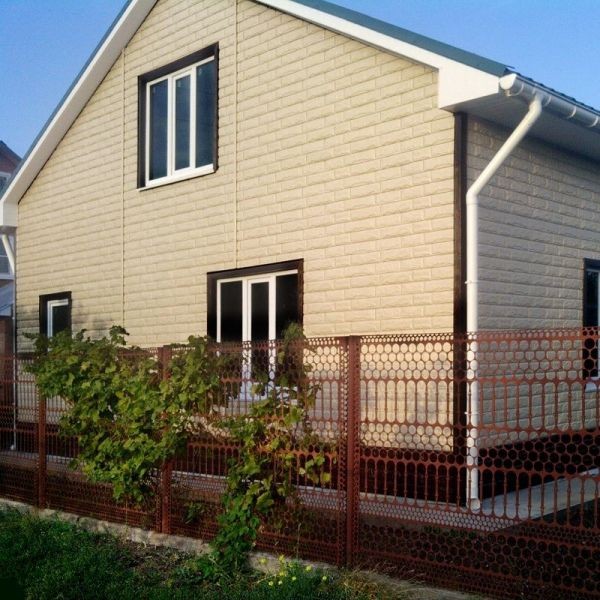
One kind of siding panel that mimics brickwork is called Stone House. PVC is the substance utilized to create the panel.
Given that the facade of a house is one of the most exposed structural components, it must be shielded from the damaging effects of the environment.
Variations in temperature, moisture, and UV radiation can all drastically shorten a building’s service life.
The strength of the material used in Stone House is such that the building’s façade will not be vulnerable. When facing a facade made of natural stone, the cost of the work may increase.
You can achieve the same high level of home protection as natural stone cladding thanks to Stone House siding, which also has a similar appearance.
When it comes to practicality, using faux stone siding panels rather than real stone is thought to be the best option in terms of functionality.
Unlike natural materials, the material is sufficiently durable and doesn’t need special care to maintain its appearance.

Specifications
In terms of the material’s technical attributes, they are differentiated as follows:
- the length of the panels is 3m;
- the width of the working surface is 2.3 m;
- The area covered by one panel is 0.7 m2;
- in one package 10 pieces of panels;
- the total weight of one package is 17.26 kg;
- the thickness of the panel is up to 1 mm.
Kinds
There are various types of stone house siding, which are separated according to the panel texture.
Based on the kind of masonry that siding mimics, it can be classified as follows:
- rubble. A variety that gained its popularity when decorating mansions;
- hewn. It features a beautiful relief, creating a romantic look for the house;
- rocky. A type of siding that is ideal for finishing the facade of a house located within the city limits;
- Clinker. It is considered a universal variety for lining of any type of building;
- Dolomite. Suitable for decorating mansions of quite large sizes;
- sandstone. Gives the house a strict style, ideal for the lining of cottages and summer cottages.

Advantages and disadvantages
The following can be observed if we look at the Siding Stone House panels from the perspective of the benefits that come with using such material:
- The process of installing the panel at the house is quite simple. This is due to a slight weight of the product, There is no need to resort to the use of additional labor for caring work;
- moderate level of mechanical strength allows siding to remain integral. With the influence of the mechanical type, it has some elasticity, which allows the panel to acquire its original appearance when struck;
- the material is resistant to rotting and corrosion;
- the structure of the material is maintained throughout the entire operational period;
- the material is a good barrier to wind, rain, hail and other atmospheric phenomena;
- fastening is carried out in such a way that subsequently the surfaces are not afraid of deformation from impacts;
- It is very easy to care for the product; you just need to rinse it under running water;
- products do not emit toxic substances.
In reference to the drawbacks, we can state the following:
- Despite the impact resistance of the material, it is still very fragile. In case of strong mechanical impact, it may break and to restore the integrity of the entire system of siding panels, it is necessary to replace the cracked element;
- if the temperature level changes very often, this promises a regular transformation of the material, namely expansion in the case of a high temperature level and contraction if the temperature is low. This leads to some losses regarding the quality of the product, it becomes more fragile;
- Despite the declared level of color fastness, the material still fades. This happens on the side of the house that faces the sun. Over time, it turns out that the brightness of the color on the building is not the same. Dark tones of panels are most susceptible to color loss.
Installation nuances
Combining all of the panel’s components into a single system and fastening them to the pre-erected frame and to one another constitutes the essential installation process:
- The installation process begins from the starting strip, which is attached horizontally to the bottom of the house.
- After this, they begin to install the corners, under which the siding elements are then inserted.
- To securely attach the panel, locks are used, which signal the connection of two panels with a characteristic click.
- The cladding of the building in the areas of doorways and windows is carried out separately, since it is necessary to cut the elements in accordance with the dimensions of the door or window.
- Sheets that are placed in the penultimate row are decorated using a finishing strip.
It is advised against attaching siding panels too closely to one another in order to achieve a high-quality and dependable system.


Useful video
You can see how to install Stone House siding in this video:
| Pros | Cons |
| Durable and long-lasting | Can be expensive |
| Low maintenance | Heavy and difficult to install |
| Resistant to weather and pests | Limited color options |
| Improves home insulation | Requires professional installation |
| Increases property value | Not environmentally friendly |
Stone House siding can improve the appearance and lifespan of any home because it offers a special blend of beauty and toughness. Because of the natural stone appearance, homes have a distinctive, sophisticated appearance that is both timeless and elegant. Stone House siding’s resilience to extreme weather allows it to provide long-term protection and lessen the need for regular maintenance or replacements.
Stone House siding does have certain disadvantages, though. Cost is a major concern because it is typically more expensive than other siding options. Furthermore, the installation procedure can be more difficult and time-consuming, frequently needing expert assistance to guarantee a proper completion. This may increase the total cost and duration of home remodeling projects.
Many homeowners discover that the advantages of Stone House siding outweigh the disadvantages in spite of these difficulties. Its durability and low upkeep needs can eventually result in cost savings, and a home’s market value can be greatly raised by its attractiveness. Ultimately, personal priorities like budgeting will determine if Stone House siding is the best option.
Stone House siding is a popular option for homeowners looking for a strong and appealing exterior because it combines aesthetic appeal with durability. On the plus side, its natural, elegant appearance improves curb appeal and it offers excellent protection against the elements with little maintenance needed. But compared to other siding options, it has higher upfront costs, and installing it can be more difficult and time-consuming. Many people believe that Stone House siding’s timeless beauty and long-term advantages make the investment worthwhile, even with these disadvantages.


