
The longevity and safety of metal stairs are crucial when building or remodeling a structure. To guarantee they are dependable and safe, metal stairs for residential, commercial, or industrial settings must adhere to tight regulations. The GOST (State Standard) and SNIP (Construction Norms and Regulations) standards in Russia contain these specifications.
A thorough set of regulations covering everything from the materials used in metal stairs to their design and installation is provided by GOST and SNIP. By adhering to these standards, you can be sure that the stairs will endure frequent use, fend off deterioration, and offer everyone safe access. They outline crucial elements like dimensions, load bearing capacity, and even the kind of welding that will be employed during construction.
Respecting these guidelines is about protecting everyone’s safety and wellbeing when using the stairs, not just complying with the law. Metal stairs that are built and maintained correctly lower the possibility of mishaps and increase the structure’s lifespan. It is essential for builders and renovators to comprehend and follow these rules as part of their jobs.
We will examine the main GOST and SNIP requirements for metal stairs in this post. We’ll go over the particular regulations that control the planning, procurement, and installation procedures, arming you with the knowledge you need to guarantee that your building or remodeling project satisfies the strictest requirements for quality and safety.
To guarantee durability and safety, it’s imperative to build metal stairs in accordance with GOST and SNIP guidelines. In order to ensure that the stairs are durable enough to endure frequent use and environmental stresses, these standards specify precise requirements for materials, design, and installation techniques. Adherence to these regulations guarantees the stairs’ structural soundness and enhances user safety by averting mishaps and injuries. Anybody working on building or remodeling projects that involve metal stairs must comprehend and abide by these regulations.
- Standards GOST 23120 78
- Standards GOST R 53254–2009
- Standards GOST 26887-86
- Video on the topic
- Interfloor staircase in a frame house according to SNiP. Build Your Own House.
- SNiP standards for stairs in residential buildings.(part 1)
- GOSTs, SNiPs. REQUIREMENTS TO RAILINGS AND RAILINGS. RailingsGlavSnab
- SNiP standards for stairs in residential buildings.(part 3)
Standards GOST 23120 78
This document specifies how platforms, fences, and metal stairs are to be arranged. When installing products outside in temperatures as low as –65 C, GOST 23120 78 must be followed.
When installing these elements in construction, the following guidelines are followed:

- product elements must provide resistance to loads within 200-400 s;
- the angle of the flight of stairs to the opposite wall varies between 45-60 degrees;
- the width of the steps varies from 500 to 900 mm with a slope of 45 degrees;
- the width of the steps, with a slope of 60 degrees, should be from 500 to 700 mm;
- the maximum march height varies from 4.2 m for a slope of 45 degrees and up to 6.0 m for a slope of 60 degrees;
- the height of the fence varies from 1000 to 1200 mm;
- structural elements manufactured in the workshop are processed in such a way as not to cause injury to persons using this product;
- to prevent a person’s foot from slipping along the surface of the steps, their inclination should not exceed one degree.
Standards GOST R 53254–2009
This standard governs the fabrication and positioning of metal stairs at installation locations for the purpose of planning emergency and evacuation descents in commercial and residential buildings, as well as the arrangement of transportable structures.
The following specifications are provided by Gosstandart for the production of metal stairs:
- the tread depth should not exceed 250 mm;
- the width of each step must be at least 900 mm;
- fence height – at least 1200 mm;
- if the height of the flight of stairs exceeds 20 m, it is necessary to use only marching products;
- with a lifting height of less than 20 m, it is possible to use vertical products;
- if two flights of stairs are located in close proximity, an opening of 750 mm must be maintained between them;
- fire escapes must be protected with anti-corrosion paints or varnishes.

(function(s, t, w, d, n)) We have w[n] = w[n] || []; w[n]. push(function()) Rendering Ya.Context.AdvManager (blockId:"R-A-510923-1",renderTo:"yandex_rtb_R-A-510923-1",async:true>);>);t=d.getElementsByTagName("script")[0];s=d.createElement("script");s.src="//an.yandex.ru/system/context.js";s.async=true;t.parentNode.insertBefore(s,t);>).
The following guidelines are prescribed by GOST for vertical metal stairs:
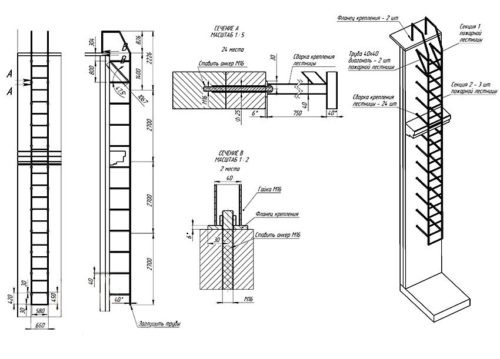
- to ensure safety, the lower flight of a stationary staircase must be retractable;
- in places where embedded parts are installed for installing a vertical staircase there should be no cracks or chips that violate the integrity of the surface;
- the fastening of fire escapes must ensure the safe descent of an adult;
- each step must withstand a vertical load of 180 kgf applied to the central point of the structural element;
- the degree of load for fencing the structure must be 54 kgf or more;
- the vertical distance between the extreme points of the steps is limited to 350 mm;
- the distance from the supporting surface to the edge of the structure is from 300 mm;
- the distance from the bottom point of the extreme step to the ground surface is limited to 1500 mm;
- The size of the steps in width is allowed from 600 mm for structures without fencing, and not less than 800 mm for products with fencing;
- Maintenance of stationary stairs according to building codes is carried out at least once every 5 years.
Standards GOST 26887-86
This standard specifies requirements for vertical and inclined metal stairs. The standard considers the production and application of different kinds of aluminum stairs.
The following guidelines are found in state regulations and pertain to the fabrication and installation of stairs:
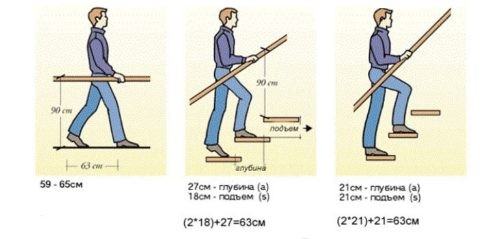
- the width of the flight of stairs is set to 0.9 m;
- for one flight of stairs the maximum number of steps is set – 18 pieces;
- the minimum height of steps is up to 160 mm, and the maximum height does not exceed 200 mm;
- the depth of the step (tread) for a vertical staircase should be 0.3 m;
- the tread depth for a spiral flight of stairs varies from 100 mm at the internal fastening point to 400 mm at the extreme point near the wall;
- if the width of the flight of stairs is more than 110 cm, it is necessary to provide for the installation of double-sided railings;
- the height of the railing for indoor spaces varies from 90 cm to 120 cm, with a handrail 55-85 mm wide;
- if the stairs are installed in residential buildings where small children live, the railing is equipped with an additional handrail at a height of 450 mm;
- the gap between the vertical posts of the railing is allowed within 150 mm;
- when designing a flight of stairs in production, it should be taken into account that the fence must withstand a resistance of more than 100 kg per p.m.
| Requirement | Description |
| Material Quality | Metal stairs should be made of high-quality, durable materials to ensure safety and longevity. |
| Load Capacity | Stairs must support the maximum expected load, including dynamic forces, as specified by GOST and SNIP standards. |
| Dimensions | Step height, width, and depth must meet the standard dimensions to ensure user comfort and safety. |
| Anti-Slip Surface | Steps must have a non-slip surface to prevent accidents, especially in wet conditions. |
| Handrails | Stairs should be equipped with sturdy handrails on both sides for support and safety. |
| Installation | Proper installation procedures must be followed to ensure the stability and safety of the stairs. |
| Corrosion Protection | Metal parts should be treated to resist corrosion and extend the lifespan of the stairs. |
| Fire Resistance | Stairs must comply with fire resistance requirements to provide safe evacuation routes during emergencies. |
GOST and SNIP standards must be met by metal stairs in order for them to be functional and safe. These rules offer a precise framework for the planning, building, and upkeep of metal stairs, assisting in the reduction of mishaps and structural failures. Builders and property owners can guarantee the dependability and longevity of their staircases by following these standards.
Ensuring that construction projects comply with GOST and SNIP requirements also improves their overall quality. It exhibits a dedication to professionalism and high standards, both of which are beneficial to the standing of contractors and builders. It also guarantees that the staircases fulfill the required ergonomic standards and are accessible and comfortable for all users.
In the end, adhering to these rules is about creating safe and comfortable surroundings for everyone, not just about fulfilling legal requirements. We support the overarching objective of constructing longer-lasting, safer structures by giving these standards top priority when creating metal stairs.


