
Having access to hot water at all times is crucial to enjoying a traditional bath experience. An essential part of ensuring a steady supply of hot water and improving your bathing experience is a water heater tank. Making the right decision for your bathroom setup can be aided by knowing the different types of tanks and their advantages, whether you use an electric heater or a wood-fired stove.
Tanks for heating bath water come in a variety of styles. Stainless steel, which is renowned for its sturdiness and corrosion resistance, is used in some. Others could be constructed from copper or galvanized steel, each with a unique set of benefits. The choice of material is frequently influenced by things like spending limit, longevity goals, and particular heating requirements.
The tank’s placement is yet another crucial factor. Certain tanks are positioned directly above the stove, enabling the heat to rise and warm the water on its own. Others could be installed independently and linked by a network of pipes. Your personal preferences and the design of your bathroom will determine which approach you take.
To guarantee that your water heating system operates effectively, maintenance is also essential. Deterioration of performance can be avoided by routine cleaning and inspection to avoid mineral and other deposit accumulation. These easy steps can help your tank last longer and guarantee that you will always have hot water available.
Your bathing experience can be substantially improved by making an investment in a high-quality water heating tank. You can have the luxury of hot water in your bath for many years to come if you know what options are available to you and how to maintain them.
| Type | Description |
| Storage Tank | A tank that stores hot water for later use, providing a steady supply. |
| Instant Heating Tank | A tank that heats water on demand, ensuring hot water is always available. |
| Material | Common materials include stainless steel, which resists corrosion and lasts longer. |
| Installation | Can be installed inside or outside the bath, depending on space and preference. |
| Capacity | Varies from small (20 liters) to large (200 liters) based on needs. |
| Energy Source | Uses electricity, wood, or gas to heat the water. |
- What are tanks for
- Tank requirements
- Types of tanks
- Material of manufacture
- Cast iron
- Steel
- Enameled steel
- Stainless steel
- Plastic
- Installation methods
- Tank on a pipe
- Built-in
- Mounted
- Pristavnoy
- Remote
- Operating rules
- Criterias of choice
- Tank volume
- Material of manufacture
- Water heating method
- Water filling method
- Price
- Useful tips
- Popular manufacturers and prices
- "Teplodar" Parus
- "Ferrum" Comfort
- "Horizontal"
- Installation instructions
- Video on the topic
- DIY Heat Exchanger for a Bath! MORE Hot Water in a Dugout Bath THAN IS NEEDED
- HOW TO HEAT water in a BATH? Three options for heating WATER in a BATH.
- 3 Ways to heat water in a bath | How to choose a tank for a bath
What are tanks for
With the advent of the first baths in Rus", the owners faced a number of difficulties: by splashing cold water on the stones, they, firstly, quickly cooled them down, and secondly, they started the process of cracking the rock, as a result of which the stone backing had to be changed quite quickly. The solution to the problem came with hot water. To obtain it, a cast iron bowl was attached above the fire with chains. The water in it heated up for a long time, which is understandable: the metal itself slowly accumulates heat, and the flame gave off the main heat to the stones (don’t forget that our ancestors heated in a black way). But the water did not cool down for a couple of days, allowing the housewives to do the laundry.

For contemporary baths, hot water is required:
- for soaking brooms;
- steam supply;
- rinsing after going to the steam room. Dousing yourself with cold water after jumping out of the steam room is, of course, great. But not everyone likes this procedure, and everyone’s health is different. Therefore, in most cases, a couple of basins of lukewarm water are poured onto the head;
- body washes;
- wet cleaning of all bathhouse premises.
And here’s one more crucial detail that’s frequently overlooked in contemporary architecture: hot water in a steam room raises air humidity, allowing you to create the ideal microclimate. It makes sense why our ancestors positioned water tanks on or near stoves.
You can use a gas or electric boiler to heat water. However, there is a significant drawback that experts are unaware of (they cite other reasons to give up on this heating method): contemporary water heaters only function in the presence of a constant supply of cold water, which in the winter will simply freeze inside the bathhouse (good insulation is necessary for the pipes, which ruins the interior and takes up space). Installing a water supply or developing an independent water supply is also not financially feasible.
As an alternative, heating elements—tubular electric heaters—can be used to warm water in tanks. However, there is a slight chance of receiving an electric shock here.
Water tanks for bathrooms are still relevant as a result.
Tank requirements
The metal water tank in the bathroom is meant to provide hot water to users. The stove’s heat causes the heating to occur. Any size or shape of hole at the top of the tank can be used to supply cold water, and shut-off valves are used to drain hot water.
It is evident from the definition that the tank operates under challenging conditions, including high temperatures—up to 1000 o C in certain cases—and water within. As a result, it must meet the following reliability requirements:
- must have high resistance to corrosion so that owners do not have to wash themselves with rusty water;
- do not deform at high temperatures;
- have a significant operational resource.
Additionally, the tank needs to have a number of qualities, including:
- hold enough water;
- warm up quickly;
- easy to fill;
- just cleanse.
Types of tanks
There are numerous classification systems for sauna tanks. The following qualities are crucial in real life:
- material of manufacture;
- location (sometimes found: “method of heating water”, which is not important);
- volume.
Material of manufacture
The bath’s original water bowl was fashioned of cast iron. Iron took its place, namely stainless steel and then galvanized steel. Plastic is starting to appear in contemporary bathrooms. Every material has advantages and disadvantages of its own.
Cast iron
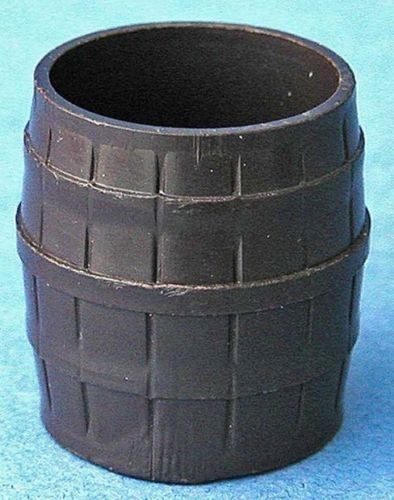
Cast iron was the first material used to create sauna tanks. He ruled by himself in the steam room for a very long time. It started to gradually lose ground when steel was introduced. These days, this kind of metal has lost its glory because plastic is more widely available and generally has no place in a steam room. The benefits and drawbacks of cast iron have not vanished despite its decline in popularity.
- high strength;
- durable metal – can last 50 years or more;
- no deformation due to strong heating;
- with proper care it does not corrode – the water is always clean and free of foreign odors;
- has low thermal conductivity, due to which it retains heat for a long time;
- easy to clean from dirt.
- water takes a long time to heat up due to the low thermal conductivity of the material – the other side of the coin, when a plus is also a minus;
- it weighs a lot, which makes transportation and installation difficult;
- the price is prohibitive for many owners;
- almost impossible to find on sale. As an option, custom-made in the form of a barrel.
Steel
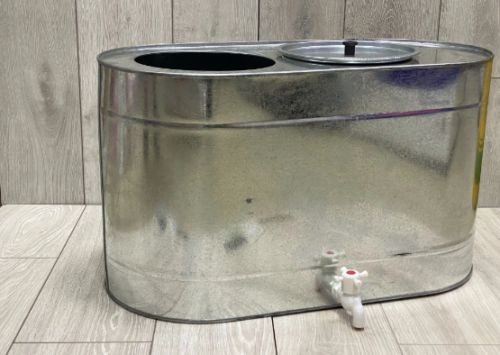
Steel’s intense pressure caused cast iron to start losing its standing. The material is still competitive in the market for bath hot water tanks today, despite serious drawbacks.
- a budget option;
- It’s quite easy to make at home with your own hands, and of any volume and shape;
- quite high level of strength;
- light weight (compared to cast iron), resulting in easy installation.
- service life is relatively short – depends on the thickness of the metal;
- may deform above the level of poured water, at high temperatures. Therefore, when heated, it must be full or made of metal with a thickness of 2 mm or more.
- Over time it starts to rust.
Enameled steel
Tank enameling aids in the corrosion problem’s resolution. Nevertheless, this solution’s many benefits—such as its lovely appearance, low maintenance requirements, rust resistance, and reasonable cost—outweigh its one drawback, which is cracking. However, there’s no need to draw comparisons between a cast iron bathtub coated in enamel and an enameled iron tank. As is well known, the protective layer is not malleable by nature. As a result, steel does not shield a thin glassy layer from chips and cracks like heavy-duty cast iron does. Accidental light blows can result in a web of microcracks. Rusting is an absolute given in damaged areas. It will be necessary to replace the tank.
An enamel pan with a capacity of 40 liters can be used instead. If at all possible, it is set on the stove. Use two pans if there are a lot of people. This is a practical choice if you want hot water fast. All you have to keep in mind is that enamel is frightened of prolonged exposure to an open flame.

Stainless steel
The most dependable and widely used kind of metal, stainless steel, is now accessible thanks to the growth of the metallurgical sector. Because of this, a bathhouse’s stainless steel tank—which holds both hot and cold water—has become essential. The material’s strengths enable this with the fewest drawbacks possible:
- durability;
- light weight – easy to transport and install;
- corrosion resistance;
- minimal likelihood of deformation when heated strongly;
- high thermal conductivity;
- easy to maintain;
- attractive appearance;
- Wide choice of fastening type, shape and volume.
- high heat transfer coefficient, as a result of which the water cools quickly;
- higher price compared to analogues made from other materials;
- there are a large number of homemade tanks (counterfeits) on sale, which greatly reduces their service life.
Plastic
Plastic tanks are uncommon because they can only be installed in another room because they are not allowed to be installed in steam rooms due to the high fire risk. However, it does not imply that they lack supporters. Plastic products do have certain benefits and drawbacks, after all.
- the lowest price;
- do not rust;
- lightweight – can be moved and installed without assistance.
- do not retain heat;
- the only way to heat water is through a heat exchanger;
- can only be installed in a washing room or in a waiting room, which negatively affects the microclimate of the steam room.
Installation methods
The area of the steam room, the stove’s power, and the tank’s volume must all be considered when selecting the type of tank installation. For instance, using a little heater to heat the water directly from the stove is not advised because smoke can heat the water and cause less heat to escape into the street. The tank is moved to another room, etc., if the steam room is small. There are lots of choices. All you have to do is use them properly.
Depending on how they are installed, tanks can be:
- samovar type;
- built-in;
- mounted;
- attached;
- remote.
Tank on a pipe
The well-known old Tula samovar served as the inspiration for the installation of a tank around a pipe. The term "samovar" refers to the container because hot flue gases from burning wood in both locations heat the water.
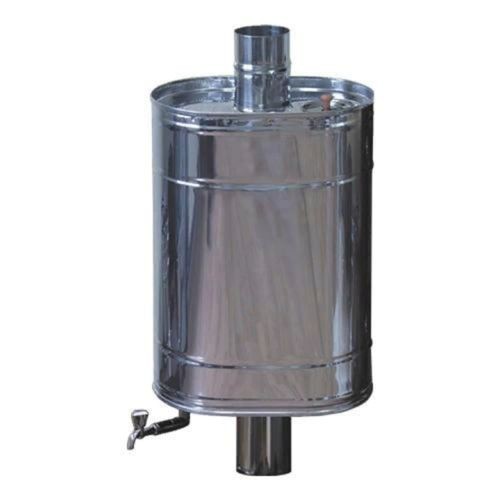
There are numerous benefits to this method:
- large variation in volume – from 25 to 70 l. No longer produced – leaning on the stove can crush it, especially with a wall thickness of up to 2 mm;
- any shape: cylindrical, oval, rectangular and even triangular;
- water heating is fast – the smoke temperature is very high, from 120 to 250 o C (depending on the volume of the firebox). So, 25-30 liters of water heat up to 80 o C in about an hour. For a larger volume, 45-55 liters, you will have to wait about an hour and a half. Large tanks heat up in about 2-2.5 hours;
- The heater’s performance does not decrease – there is no need to heat other structural elements of the stove;
- the steam room space is not cluttered (space is saved);
- the water remains heated for a long time;
- can be installed in the attic, which will allow you to use hot water for showering;
- simple installation that does not require experience or special skills.
- it is problematic to fill with water;
- Difficulties arise when descaling. In many cases, such an operation cannot be performed at all without removal;
- the amount of remaining water is not visible. Climbing through the neck to take measurements when the stove and the container itself are hot is extremely dangerous;
- very difficult to dismantle when replacing: it is necessary to disassemble the chimney. Some experts advise jacking it up. But there are two nuances here that are ignored: how to place the jack under the chimney and how to remove the tank if the lift is in the way;
- due to the rapid cooling of smoke, the process of soot deposition is accelerated;
- The container cannot be installed on a brick pipe.

Manufacturers have started to offer side-mounting tanks on pipes for baths, dubbed "backpacks," recently. The name comes from the fact that it is hung on the chimney with unique metal straps. There is a semicircular recess in the middle of the container that runs the entire height in order to increase the contact area (water heats up faster). She presses against the chimney pipe while holding onto the tank.

The tank on the pipe’s strengths and weaknesses are altered considerably by this installation option.
- water is heated by smoke;
- the useful area of the steam room is not stolen;
- fairly simple dismantling;
- To descale, simply remove the tank.
- water takes a long time to heat up;
- cools down quickly;
- it is problematic to fill in cold water – only from a hose, which is impossible to do if there is a well. In this case, some experts advise using a funnel and a mug. I wonder how quickly they will fill a 70L tank;
- extremely difficult to check occupancy or balance.
Built-in
Because the built-in tank is above the firebox—or rather, acts as its top—the water is heated by the wood burning directly above it. This is a reasonably practical way to install a container. This has a lot of benefits. Verdicts and flaws, sometimes grave ones.

- water boils quickly;
- stays hot for a long time;
- installed on all types of stoves, including brick;
- steam room space is saved;
- simple installation;
- You can take water through a tap or with a ladle;
- easy to pour: you can use a bucket or a hose;
- easy to control the balance.
- fast heating has a downside – you need to constantly add water. Boils away. The lid doesn"t help either;
- the walls of the tank should be thicker due to contact with open fire (at least 1.5 mm, and preferably the bottom – 2.5 mm, walls – 2 mm);
- enameled containers are excluded – the enamel cracks;
- tank dimensions are limited by the size of the heater;
- thicker walls increase the weight of the tank, reducing the volume accordingly to 40-50 l. Otherwise, the steel heater may not withstand it, especially when heated to high temperatures, when the metal becomes plastic (for stoves made of cast iron and brick this is not a problem);
- with a wood-burning metal heater, a family of only 2-3 people can wash themselves. There simply won"t be enough hot water for more people;
- Due to the prolonged boiling time, the microclimate of the steam room changes for the worse – it is impossible to steam immediately: the heavy steam burns the respiratory organs. Therefore, you need to pour boiling water over the stones several times so that light steam displaces waterlogged air from under the ceiling space.
Mounted
Special hooks are used to hang the hanging tank on the stove. The heater’s and the container’s walls’ thermal conductivity causes heating to occur. The differences between mounted and remote tanks are unclear in several tank-related materials. The way they heat water is where they fundamentally diverge. Due to the stove wall in the first instance, and with the aid of a heat exchanger in the second.
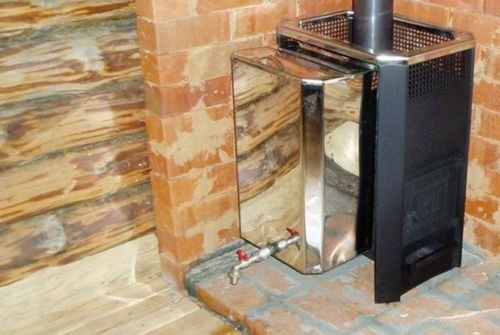
There are advantages and disadvantages to the mounted tank.
- large volume with support on the floor (100 liters or more);
- easy installation and maintenance;
- with a significant volume, it serves as an additional heat accumulator, increasing the time of bath procedures;
- no problems with excess humidity.
- water takes a long time to heat up. At the same time, it may not boil, which is a plus for some connoisseurs, and a significant minus for others;
- Some models have problems drawing hot water through the tap – it is located too low. Therefore, it is better to buy containers with an open top so that you can use a ladle;
- draining is very difficult – it won’t work through the tap, because.To. it stands on the side, and you will have to install a special drain hole in the bottom yourself. And it’s not a fact that the work will be done efficiently.
Pristavnoy
The container can be firmly pressed up against the stove instead of hanging from the heater’s wall. To heat water, there are two methods available:
- from the wall of the heater;
- using a heat exchanger. This option is considered classic for a Russian bathhouse with a brick stove.
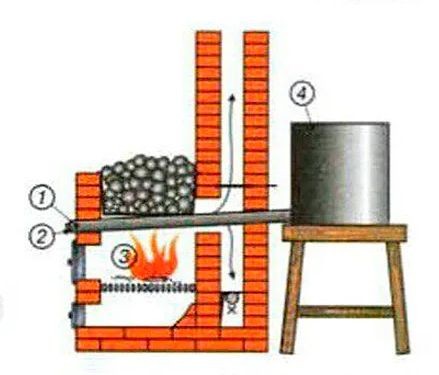
The benefits and drawbacks of the first scenario are exactly the same as those of suspended tanks. The second option has a few benefits and very few drawbacks.
- The volume of the container can be any, up to 500 l;
- the water boils almost simultaneously with the heating of the steam room, which allows you to obtain optimal humidity;
- a large amount of heat is accumulated, which makes it possible, firstly, to extend the time of bath procedures, and secondly, to thoroughly dry all the wooden elements of the steam room;
- just add water;
- the tap is welded to the bottom, which eliminates the problem of draining water.
- the useful area of the steam room decreases;
- increased wood consumption.
Keep in mind that the chance to steam under ideal conditions outweighs the drawbacks for true enthusiasts of steam and brooms.
Remote
A bath tank with a heat exchanger is installed in the laundry room if there is not enough space for the steam room. Here, there are a few benefits. However, the site team claims that the drawbacks are still greater.

- can be installed where convenient;
- no restrictions on volume;
- no contact with fire or hot stove. Therefore, containers can be made of any material.
- takes a long time to warm up;
- cools down quickly;
- complex installation. The slightest mistake can lead to a pipe rupture in winter (water does not completely drain from the heat exchanger);
- hose length is limited to 2.5 m. If the length is longer, the water in the tank will not be able to warm up well;
- During combustion, there must be water in the heat exchanger. Otherwise, the pipes will become deformed;
- It is difficult to fill water with a bucket – the neck of the tank is high.
Operating rules
Maintaining adherence to the operating guidelines will contribute to the hot water tank in the bathtub lasting longer:
- during the installation process, adhere to the manufacturer’s recommendations;
- add water until the heater lights up;
- during periods of frost, completely drain the water;
- Rinse the container 2-3 times a year using descaling products;
- use the tap with extreme caution to avoid burns.
A water heating tank is necessary to create a relaxing and effective bathing experience by supplying steady hot water for bathing and unwinding. This post will discuss the various kinds of water heating tanks, how to install them, and maintenance advice to keep your bath ready and welcoming all the time. Knowing the advantages and features of different heating tanks will help you make an informed decision that meets your needs and preferences, whether you’re building a new bath or remodeling an old one.
Criterias of choice
The following things need to be taken into consideration when ordering a hot water tank:
- container volume;
- material of manufacture;
- water heating method;
- water filling method;
- price.
Tank volume
It is thought that one person can drink 10 liters of boiling water or 15 to 20 liters of water heated to 80 degrees Celsius. You can quickly calculate the necessary tank volume by counting the washables. Additionally, you will need 20–25 liters for the steam supply and wet cleaning. It’s a theory, though. As a rule, enthusiastic steamers use receptacles that have the maximum capacity—200 liters or more. The cause is the heat that the water absorbs, which enables you to keep comfortable washing conditions for an extended period of time.
Material of manufacture
The best option is a stainless steel tank with a thickness of at least 1 mm, or better: 1.5-2.0 mm – the walls will not play during filling and heating. You can purchase containers made of food grade steel AISI 304. But it"s quite expensive. You can reduce costs by about 1.5 times by replacing one grade of stainless steel with another grade – AISI 430. In terms of its technical and operational characteristics, it is not much inferior to its food analogue. Making a tank from another grade of stainless steel is impractical – over time it will begin to oxidize and become covered with rust, which will inevitably lead to a leak.
Water heating method
Brick kilns can use built-in tanks and containers with a heat exchanger. You have two options for a cast iron or metal heater: a hanging tank or a built-in tank. If the "samovar" tank can be filled with cold water without any issues, it can be installed.
Water filling method
You can purchase any kind of tank for an autonomous water supply system or system in your home; the issue arises when you attach a hose to it. It is best to avoid using tanks on a pipe and a remote container if you must transport water in buckets.
Price
There is a cost associated with quality. As a result, you shouldn’t skimp on purchasing an AISI 430 equivalent or a food-grade steel container. After all, chromium and nickel must be added to the alloy in order to give metal anti-corrosion properties. It also has a financial cost.
You don’t need to worry too much when selecting a cold water tank in a restroom; any material with a volume of at least 40 liters will do. It can always be refilled, after all.
Useful tips
Apart from the aforementioned criteria, it is imperative to attend to the minutiae that may escalate into larger issues during operation.
- There are many fake stainless steel tanks on sale. It"s easy to check: hold up a magnet. It should slide down easily or not react to the metal at all. In other words: the magnet should not stick to the container. The exception is the bends where the internal stress changes. To be sure, you can experiment at home with cutlery and clearly see the difference between ordinary steel and food grade stainless steel. The second method is to run a file along the edge of the container. If the brass color appears yellow, the steel is stainless. But it’s unlikely that the seller will allow you to experiment like that.
- You can make a stainless steel tank yourself. But it must be remembered that when welding in the open air, alloying metals burn out. Therefore, the anti-corrosion protection disappears in the seam area. There are two ways to avoid the problem: use a special semi-automatic machine with the ability to weld in carbon dioxide or cover the welding areas with special compounds. They can only be applied to a thoroughly cleaned and degreased surface.
- A large tank (more than 100 l) is best heated using a heat exchanger.
- Tanks raised above 1 m must have taps – when scooping boiling water with a ladle, there is a high probability of getting burned.
Popular manufacturers and prices
Numerous companies produce bath tanks. In terms of technical and operational features as well as manufacturing quality, their products are essentially the same. As a result, rating is challenging (the highest-quality containers could not be located on the Internet).
In our instance, the site team monitored the most popular products across multiple platforms and, by analyzing the frequency of favorable reviews, created a list of the top producers. The fact that there is little variation in product volume is the list’s lone drawback.
As a result, we advise you to click on the link to another piece of our website to view the stoves with tanks rating. The image is more impartial.
"Teplodar" Parus
The Russian company "Teplodar" provides a large selection of hot water tanks for bathrooms. You can select a product based on its price, shape, and fastening method. Stainless steel is the metal. The tank "Teplodar" Parus for 55 l garnered the most favorable evaluations.
- is attached to the chimney;
- water is heated to 70-75 o C;
- filling through the hatch from above;
- steel grade – AISI 430;
- metal thickness – 0.8 mm.

- long service life;
- high-quality performance.
- rather high price – starts from 7200 rubles.
"Ferrum" Comfort
The "Ferrum" Russian company specializes in manufacturing chimneys for sauna stoves. It makes sense, then, to manufacture "samovar" tanks for their own goods. The 73 l "Ferrum" Comfort tank is regarded as the best in the line.
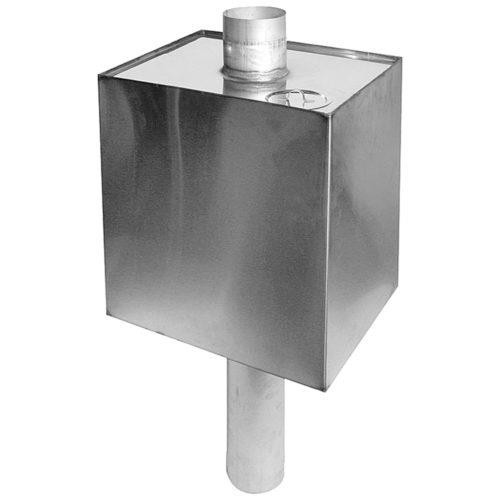
- excellent quality of welded seams – laser welding is used;
- beautiful appearance;
- long service life.
- High price – more than 10500 rubles.
"Horizontal"
A variety of bathhouse tanks are manufactured by the Russian company "Vesuviy" under the "Horizontal" brand. The best steel AISI 439 capacity is 60 liters, which is thought to be the best.
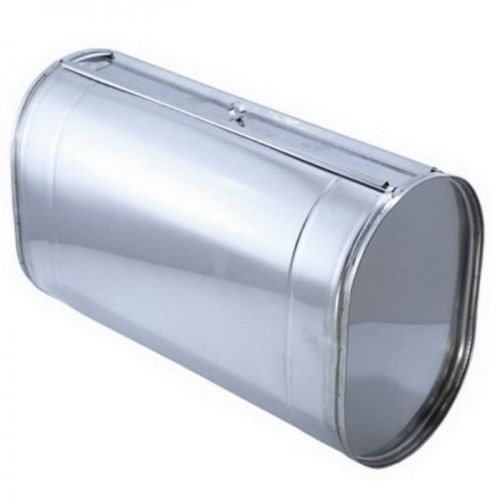
- Available price-5.2-6.0 thousand. rub.;
- high level of tightness;
- high temperature resistance.
- thin walls – only 0.5 mm, side 0.8;
- There is no tap.
Installation instructions
The container is installable with your hands. The most important thing is to follow the manufacturer’s detailed instructions. We will examine the work process using the "samovar" tank as an example, which is heated by smoke directly (the tank’s internal pipe has been removed):
- Part of the pipe between the furnace and the ceiling equal to the height of the container is cut. In this case, it is necessary to leave a minimum of 20 cm between the container and the ceiling;
- The upper part of the chimney rises by 25-30 cm and is attached to the rafter system;
- a 10 cm long fitting is installed at the top and bottom of the chimney to connect the tank to the chimney;
- if the diameters do not match, an adapter is used;
- a tank is placed on the lower nipple;
- the upper part of the chimney is lowered down until the nipple is fully inserted into the tank;
- the joints between the tank and the connecting pipe are sealed with heat-resistant sealant – this operation prevents smoke from entering the steam room;
- for more reliable fixation of the tank, the entire structure is fastened with metal brackets.
To ensure a relaxing and effective bathing experience, selecting the appropriate bath water heater tank is essential. It’s crucial to take into account the tank’s dimensions, construction material, and suitability for your heating system. These elements will control the water’s heating rate, efficiency, and duration of heat.
Because of their strength and ability to withstand corrosion, stainless steel tanks are a popular option. Additionally, they are not too difficult to clean and maintain. They may, however, cost more than alternative materials like galvanized steel or aluminum. You can make an informed decision that suits your needs and budget by balancing the costs and benefits.
The installation procedure is another thing to think about. While some tanks can be installed by professionals, others are made to fit into current systems with ease. Making sure your tank is installed correctly can stop leaks and other problems that might ruin your bathing experience.
Ultimately, your unique needs and preferences will determine which bath tank is best for you. You can choose a solution that improves the longevity and functionality of your bath by being aware of the options available and the features that each type of tank offers. Cheers to taking baths!


