
Selecting the ideal washbasin has a big impact on bathroom design, both in terms of practicality and style. Pedestal washbasins are unique among their kind because of their timeless elegance and useful design. Typically, these fixtures have a basin held up by a freestanding pedestal, giving them a classic appearance that goes well with many different types of interior design.
Washbasins on pedestals stand out due to their integrated design, which unifies the basin and pedestal into a single, harmonious piece. Pedestal sinks, as opposed to countertop or wall-mounted sinks, offer a sturdy base while hiding plumbing connections, giving the bathroom a tidy and uncluttered appearance.
Washbasins on pedestals provide a flexible alternative to countertop basins that rest atop cabinetry or wall-mounted basins that need extra wall support. They are popular because they can fit into smaller areas without sacrificing style, which makes them perfect for both opulent, larger settings and tiny bathrooms.
- Main types of pedestal washbasins
- Difference from other types of washbasins
- How to choose a high-quality and suitable product?
- TOP 10 best pedestal sinks
- Preparatory work
- Installation of a sink and mixer
- Video on the topic
- Choose only such a sink | The sink to the bathroom
- Release for the sink, washbasin, sink. Varieties. How to choose? Review.
- Do not buy the sink until you look at it!!!
Main types of pedestal washbasins
The following shapes are possible for bathroom pedestal sink types:
- straight. Some of the most common types. This design is compact;
- corner. An innovative solution for small spaces. Minimum occupied space;
- oval;
- round;
- square.

It is important to keep in mind that the stand’s shape must match that of the washbasin. The leg should have a rounded, smooth shape if the plumbing fixtures do; a square design works best with a cubic pedestal. Corner sink on pedestal is very practical because of its compact design.
- One-piece. It is a monolithic structure.
- Prefabricated. The sink and pedestal are assembled at the installation site.
In line with the materials used to make sinks:
- Porcelain. Pleasure for true aesthetes, although not everyone can afford it. It has a homogeneous structure without impurities, illuminates when illuminated, and produces a clear, ringing sound when struck.
- Faience. It is perhaps the most budget option. It has a heterogeneous porous structure and produces a dull sound when struck.
- Porcelain tiles. The new composite material is characterized by increased strength. Compared to the previous two options, if you drop something heavy, the sink will withstand.
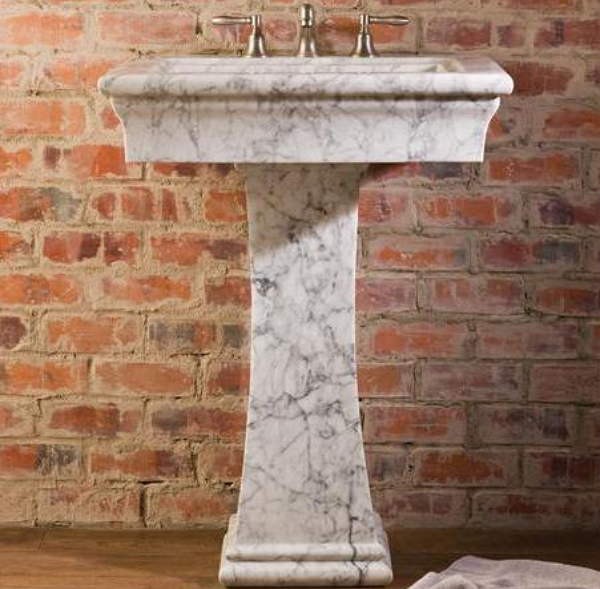
Additionally, there are models composed of tempered glass, granite, marble, acrylic, and ceramics.
In the bathroom, pedestal sinks come in two varieties:
- with hole for mixer;
- deaf.
Select the design that you find most convenient. However, bear in mind that if installing the mixer is not in your plans, you will need to install a plug if there is a hole. Your personal preferences and the interior color tone of the bathroom serve as the primary determining factors when it comes to color.
Difference from other types of washbasins
Let’s examine the qualities and features that set the "tulip" apart from other designs. You must pay close attention to the following benefits of this kind of plumbing:

- masks communications well;
- sinks of this design can withstand significant loads due to their support on the floor;
- if the walls of the bathroom are not particularly strong, then this design, due to its feature of resting on the floor, is most suitable;
- aesthetics.For a regular sink without a stand:
- the failed communications are visible;
- does not withstand loads when resting on the sink;
- This design is not suitable for weak walls.
Compared to a bathroom sink on a pedestal, a sink with a cabinet offers a big benefit: beneath the sink is a practical space for keeping various items and household goods.
There are, however, some serious drawbacks as well. For example, cleaning will be difficult in a small bathroom, and there will be a dead zone between the bathtub and sink. Additionally, a sink and bedside table seem clunky in a small space.
We examine the unique characteristics that set pedestal washbasins apart from other varieties. The elegant and classic design of these pedestal-mounted sinks elevates the aesthetics and functionality of bathrooms. Pedestal sinks have a standalone design in which the basin and pedestal combine to form a single unit, in contrast to wall-mounted or countertop sinks. This feature not only conserves space but also provides a timeless appearance that goes well with both traditional and modern bathroom designs. When building or remodeling bathrooms, homeowners and designers can make well-informed decisions by knowing the differences between pedestal sinks and other types, effortlessly combining functionality and aesthetic appeal.
How to choose a high-quality and suitable product?
You should measure the opening distance, the plumbing pipe outlet points, and the distance from the washbasin to the bathtub before making a purchase. This will make it easier for you to remember the product’s size when you buy it.
We produce solid and prefabricated pedestal sinks. You should think about the following factors when making your decision:

- The shapes of the outlines of both the pedestal and the sink should be the same. If one of the elements has smooth outlines, the second should not differ from it.
- To avoid such an unpleasant incident as the possibility of flooding your neighbors, it is extremely necessary to have an overflow.
- It is not recommended to choose a very small sink, as splashes will fly in all directions during use.
- There is a hole under the mixer. If there is hidden wiring, then the hole will not be needed, and you will have to buy an additional plug.When buying a washbasin with a pedestal for your bathroom, we recommend:
- Check the kit for the presence of a siphon, bent corrugation and other components.
- Check whether the pedestal fits tightly under the bathroom sink. It should fit smoothly and without distortion.
- It is necessary to place the leg on a level place and use a level to check how even the sides of the product itself are.
- Take into account the distance between the wall and the stand, not forgetting the need to lay communications.
- The presence of an overflow hole in the bowl. If the sink is filled to the brim, the excess liquid will drain into the drain rather than spill onto the floor.
- Possibility of self-installation. A pedestal without extra partitions and other elements on the back side is much easier to install.
- And, of course, carefully inspect the products for scratches and chips.
It is important to remember that choosing an option with a detachable pedestal is preferable because fixing a monoblock is far more difficult in the event of a breakdown.
TOP 10 best pedestal sinks
Ranking of the most popular pedestal washbasin models in 2018 and 2019, along with a price range:
- Roca Debba 732799400Y+733799000Y. Spain. Rectangular porcelain bowl with overflow and two marked tap holes. Dimensions (width): 60 x 48 x 85 cm. White color. Cost 3,900 – 4,700 rubles.

- Vitra S50 Corner. Türkiye. Corner porcelain bowl with tap hole and overflow. Dimensions (width): 40 x 40 x 81cm. Pedestal width 18.5 cm. White color. Price 4,100 – 5,400 rubles.

- Jacob Delafon Odeon Up E4733. France. Stylish corner bowl made of sanitary porcelain with fittings for a mixer and overflow. Dimensions: 48 x 36 x 82 cm. White color. Cost 7,900 – 9,200 rubles.

- Rosa Ressa. Russia. Kirov plant. Semicircular earthenware bowl with overflow and tap hole. Dimensions (width): 56 x 42 x 84 cm. Color: white, blue, dark blue, brown, dark brown. Price 1,800 – 2,900 rubles.

- VitrA Normus 9600. Türkiye. Semicircular earthenware bowl with overflow and tap hole. Dimensions (width): 55 x 42 x 81cm. Pedestal width 18.5 cm. White color. Cost 2,900 – 3,450 rubles.

- Belbagno Alpina BB10100L+ BB10100R. China. Square or oval earthenware bowl with overflow and tap hole. Dimensions (width): 56 x 46 x 84 cm. White color. Price 6,000 – 9,500 rubles.

- SKS Prestige. Russia. Stary Oskol. Oskol plant. Semicircular earthenware bowl with overflow and hole for mixer tap. Dimensions (width): 63 x 46 x 86cm. Pedestal width 20 cm. Color: black, red, green, purple, white, blue. Cost 2,000 – 2,900 rubles.

- Santek Boreal-60. Russia. Cheboksary. Semicircular bowl “tulip” made of sanitary ceramics with overflow and hole for mixer tap. Dimensions (width): 59 x 48 x 91 cm. Pedestal width 19 cm. White color. Price 1,900 – 3,000 rubles.

- Santeri Vorotynsky. Russia. Semicircular bowl “tulip” made of sanitary porcelain with a hole for a mixer, without overflow. Dimensions (width): 57 x 46 x 84 cm. Blue color. Pedestal depth 20 cm. Cost 1,700 – 2,500 rubles.

- Universal Nostalgia. Russia. Novokuznetsk. Semicircular porcelain bowl with tap hole and overflow. Dimensions (width): 55 x 44 x 86 cm. White color. Leg width 16 cm. Price 700 – 1,100 rubles.

Customers are very interested in domestic products because they are less expensive than plumbing fixtures from other countries.
Preparatory work
Installing a pedestal sink on your own is an easy task that can be performed by anyone. Initially, you must confirm that the flooring is level. The structure will not be stable and may sway as a result of the uneven surface.
Prior to beginning installation work, you must gather the required supplies and equipment:
- hammer drill with tile drill;
- the size of the nozzle must correspond to the size of the bolts;
- hammer;
- adjustable wrenches;
- marker or pencil;
- building level;
- tow or FUM tape;
- silicone sealant;
- fasteners.
The kit needs to have fasteners for the pedestal and washbasin.

At the assembly site, which is the bathroom, the pedestal and sink are put together and installed. The structure can be aligned along the tile seams if the room’s dimensions permit.
The best location for the holes is at the seams, as this greatly lowers the chance of the tiles chipping. It’s acceptable if the structure’s height prevents this. All you have to do is exercise caution when drilling holes.
Installation of a sink and mixer
You can now go ahead and install the sink on the leg straight away:
- Using a level, you can check how level the equipment is, and if the result is positive, marks are placed on the wall through the installation holes of the sink for future drilling.
- The plumber then moves back to double check that the holes are level with each other.
- Next, holes are drilled according to the marks made. If you have to drill on tiles, you need to work slowly, with light pressure, so that chips or cracks do not appear on the tiles.
- Then the dowels are screwed into the holes and carefully driven in with a hammer. For reliability, you can insert a little plaster or construction glue into the hole.
- After this, you can begin assembling the drain, according to the assembly and operating instructions included with the product. It is strongly recommended to install rubber seals on both sides in the center and without gaps. This measure will help avoid leaks when using the washbasin for its intended purpose.
- Then, a mesh fastening screw is screwed into the drain hole, and an outlet corrugation with a bend is connected to the siphon, which is placed in the sewer outlet.
- The installation bolts are screwed into the dowels, but not completely. There must be a gap so that the washbasin can be placed on them. Don"t forget about the rubber seals.
- Next, the washbasin is installed. The bolts are carefully tightened to secure the product, two turns at a time until the sink is securely fixed.
- After this, you need to turn off the water supply to install the mixer. It must be connected to the piping using flexible hoses. As a rule, the hot and cold water outlet points are located above the sewer hole, which allows you to hide all communications in the stand.
- The washbasin has a special technological hole for the mixer. To connect the hoses, provide a tight fit and prevent a leak use a toch tone or.
- And finally, a pedestal is installed under the bowl. To seal the junction of the washbasin with the wall, silicone sealant is used, transparent or white.
You can call the installation of a pedestal-style washbasin finished. Water should now be connected, and the design’s functionality should be checked.
| Types of washbasins on a pedestal | Differences from other types |
| 1. Pedestal Sink | Stand-alone design, hides plumbing |
| 2. Console Sink | Supported by legs, open design |
Anyone renovating a bathroom should be aware of the various kinds of pedestal washbasins available. These fixtures are a popular option in contemporary home design because they provide both practicality and visual appeal.
Pedestal washbasins are distinctive because of their timeless elegance, which frequently goes well with conventional bathroom designs. Its unique feature is the pedestal that holds the basin, hiding plumbing connections and giving the area a classic charm.
On the other hand, because they mount to the wall directly instead of using a pedestal, wall-mounted washbasins have a sleek and simple appearance. This design improves the practicality of smaller bathrooms by saving floor space and making cleaning around the basin area easier.
Countertop washbasins come in a variety of design options to suit those who are looking for variation. These sinks, which are set on bathroom countertops, are made of different materials, sizes, and shapes, so homeowners can personalize the look of their bathrooms to suit their tastes.
The decision between countertop, wall-mounted, and pedestal washbasins ultimately comes down to personal taste, room constraints, and functional requirements. Every variety enhances contemporary bathrooms with a distinct combination of aesthetic appeal and practicality, resulting in a well-balanced and thoughtfully designed living space.


