
Selecting the appropriate materials is essential when organizing a building project. Aerated blocks, which are renowned for their superior insulation qualities and light weight, are a common choice for wall construction. However, for effective planning and execution, it is imperative to comprehend the weight of these building blocks.
A number of variables can affect an aerated block’s weight. These consist of the moisture content, density, and size of the block. Because aerated concrete blocks are typically lighter than regular concrete blocks, handling them is simpler and the overall load on the foundation is decreased.
You must know the density and volume of an aerated block in order to compute its weight. Usually supplied by the manufacturer, the density can vary from 300 to 800 kg/m³. You can calculate the weight of the block by multiplying its volume (length x width x height) by its density. A typical block, for example, would weigh about 18 kg and have dimensions of 600 x 200 x 300 mm and a density of 500 kg/m³.
Comprehending the mass of aerated blocks facilitates the estimation of the total load on the structure, transportation planning, and safe handling throughout the building process. With this information, you can make wise choices and guarantee the success of your project.
- What does the concept mean??
- The difference between specific and volumetric
- What does mass depend on??
- How much can aerated concrete weigh?
- Why do you need to know the meaning??
- Requirements for different types of foundations
- How to calculate for one piece and 1 m3 of aerated concrete block?
- Consequences of incorrect calculations
- Video on the topic
- Aerated concrete weight
- REINFORCEMENT OF AERED CONCRETE / HOW AND WHY TO REINFORCE AERATED CONCRETE WALLS / reinforcement of aerated concrete walls
What does the concept mean??
The force that an aerated concrete block applies to the support to keep the material from falling is indicated by its mass.
Here, weight is defined as the pressure applied to a wall composed of the same material as the wall itself.
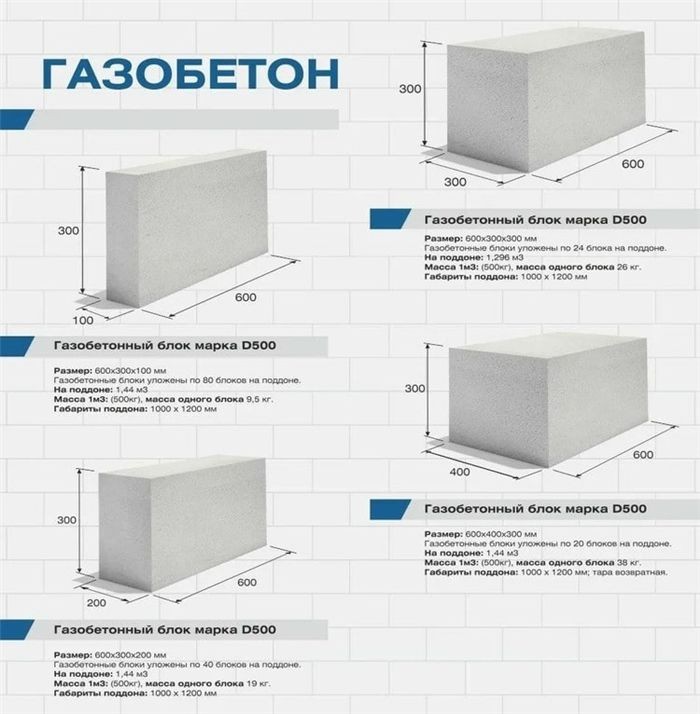
A type of masonry known as block aerated concrete is used for a residential building’s walls. Each block has a specific mass based on its size and material density. Everything beneath it is directly impacted by this weight.
Those stones closest to the foundation bear the brunt of the weight. For this reason, it is advised to always use dense, heavy blocks that are resistant to crushing for the bottom rows.
Weight in kilograms is used to identify aerated concrete blocks. Usually, this computed value indicates the load’s density. When transferring raw materials to a construction or sale location, the idea is crucial. Transport equipment needs to be able to support the weight of raw materials, which is why the blocks are sold in pallets with the total weight of all the materials listed on them.
The difference between specific and volumetric
Apart from the conventional notion of weight, there exist volumetric and specific concepts as well. You must define each in order to determine the differences.
A product’s specific gravity is determined by dividing its weight by the volume it holds. The product’s density is indicated by its volumetric weight.
When determining the loads on walls and floors in residential and non-residential buildings, specific gravity is frequently used in the design and construction process. Next, compute this parameter while accounting for every material unit. In the transport of cargo, volumetric is more frequently utilized. Delivery and courier services must be aware of the volume of space occupied by a particular material.
Additionally, specific displays the unit volume of a material in its dense state—that is, when it is devoid of all voids and pores. It is given as either kg/m3 or g/cm3. Volumetric weight is measured in exactly the same unit.
When comparing materials, volumetric gravity usually always has a lower value than specific gravity. Volumetric weight is used more often in construction because it is useful in determining the overall mass of walls and the structural strength of buildings.
What does mass depend on??
An aerated block’s mass is determined solely by two factors: its size and density. As you are aware, aerated concrete density comes in multiple grades, which are represented by the letter D and span from 300 to 1200. One gas block’s mass indicates the volume that each of the solid constituents in that block occupy.
Because block aerated concrete is made by adding specific additives that allow the structure to breathe, stones with varying densities will have different masses. For instance, the large number of voids in D300 density blocks, which are used as heat-insulating material, cause them to have such a low density.
Such a stone can have up to 75% of its total porosity in raw materials. This implies that even with its large dimensions, the weight of such a block will be small.
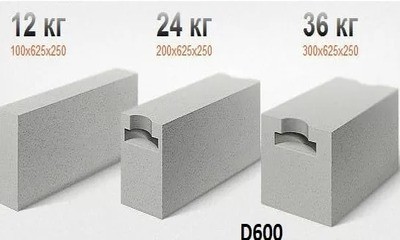
The same circumstance with a high density aerated concrete stone, like D900. With dimensions of 625x300x250 mm, a stone with this density will weigh more than a stone with the same size but a density of D600 already. Porosity, which makes up up to 55% of the blocks of the designated type, is another reason for this.
Because the block becomes smaller than solid particles, the mass of the stone decreases as the percentage of porosity increases.
How much can aerated concrete weigh?
Aerated concrete blocks vary in mass depending on their density and size. Stones with varying densities will have different masses despite having the same dimensions.
For instance, you can think about a few of the options in the table.
| Name of the material | Density | Weight, kg |
| 600x200x250 | D400 | 15.6 |
| D500 | 19.5 | |
| D600 | 23.4 | |
| 600x200x400 | D400 | 24.4 |
| D500 | 31.2 | |
| D600 | 37.4 | |
| 600x250x375 | D400 | 29.2 |
| D500 | 36.5 | |
| D600 | 43.9 |
Gas blocks with the same size but different weights are displayed in the table. It is dependent upon the raw material’s density: voids are more prevalent in D400 density than in D600 density.
By the way, since blocks with these qualities completely meet SNiP requirements, the last option is typically selected for wall construction in residential buildings.
Volume charts are frequently available at the factory or in every store. To ensure the selection of material, you can request that the seller send you a copy of this list for inspection. Similar details are available on selling companies’ websites and can be provided upon request.
Why do you need to know the meaning??
You should be aware of a type of building material called aerated concrete for a number of reasons:
- in order not to violate the rules of loading into transport equipment;
- to calculate the load that the entire volume of raw materials produces on the foundation;
- to check whether the class or grade of a block corresponds to its price;
- to check deviations from quality standards.
Although loading regulations are not directly related to building walls, this is a crucial consideration if the client chooses to transport the block to the location. Aerated blocks are a fairly fragile material, so if the volumetric mass of the entire material is calculated incorrectly, the transport may malfunction, the load may fall out, and there will be a significant amount of waste after the fall.
By knowing the mass of the block stone, you can avoid fraud when buying it and use specific tables to verify that it complies with GOST regulations. The most crucial thing to remember is that you can accurately estimate the load that walls will put on basements, foundations, and other structures that are beneath walls when you are designing.
Requirements for different types of foundations
A gas block home’s foundation must disperse the load from the entire mass of the structure, which includes the walls’ bulk weight. The requirements placed on a foundation increase with its depth because the large mass of aerated concrete walls will cause the foundation’s design to become less stable.
In addition to wind and snow loads, the weight of the roof, finishing materials, and other components make up the total load on the foundation. A block with a density of D600 and a thickness of 300 mm will already have a load of 190 kg per square meter, whereas a D500 gas block with a thickness of 200 mm, which is appropriate for the construction of partitions, will give a load of 110 kg per square meter.
This means that it is important to realize that the mass of building material that a foundation must withstand increases with its depth and monolithic nature.
How to calculate for one piece and 1 m3 of aerated concrete block?
Simply use the formula to determine the weight of a single piece of aerated concrete block stone on your own.

You can do this by following these instructions:
- multiply the height of the block by its length and width – you get the volume of one stone;
- to calculate the mass you need to take the density of the stone, multiply it by the volume of a unit – you get the weight of 1 piece;
- if one cube is divided by the resulting volume, the number of pieces in one cubic meter will be obtained.
The formula that is produced can be used to calculate for specific sizes.
As an illustration, blocks with a density of D600 can be used:
- 600x300x200 mm: 0.6×0.2×0.3=0.036; 600×0.036=21.6 kg.
- 250x300x600 mm: 0.25×0.3×0.6= 0.045×600= 27 kg.
- 250x400x600 mm: 0.25×0.4×0.6= 0.06×600= 36 kg.
- 100x250x600 mm: 0.1×0.25×0.6=0.015×600= 9 kg.
- 300x300x600 mm: 0.3×0.3×0.6 =0.054×600=32.4 kg.
The number of pieces in one cubic meter, which is typically indicated on the packaging, multiplied by the obtained figures gives us 600 kg in one cubic meter.
Comprehending the weight of aerated blocks is essential for appropriate construction planning when working with them. These blocks’ weight varies according to their size and density, which are determined by the materials and manufacturing technique employed. You must take into account the block’s density and dimensions—which are frequently supplied by the manufacturer—in order to compute the weight precisely. This makes it easier to make sure the blocks can effectively support the intended load and are appropriate for the structural requirements of your project.
Consequences of incorrect calculations
When operating a house, the walls may put too much pressure on the foundation if the mass of the gas block is chosen incorrectly. This will have an impact on the house’s condition; eventually, it will be in need of repair. Consequently, when designing your home, you should explicitly choose the block’s mass and take it into consideration.
| Factor | Description |
|---|---|
| Block Type | The weight of an aerated block can vary based on whether it is made from different materials or has different densities. For example, blocks with higher density are heavier. |
| Size and Dimensions | Larger blocks generally weigh more. The length, width, and height all affect the total weight. |
| Density | Aerated blocks come in various densities. Higher density blocks are heavier than lower density ones. |
| How to Calculate | To calculate the weight, you can use the formula: Weight = Volume x Density. Measure the dimensions of the block to find the volume, then multiply by the block"s density. |
Comprehending the mass of aerated blocks is imperative for all individuals engaged in building or remodeling. These blocks are common in contemporary construction because of their reputation for being lighter than conventional building materials. A number of variables, such as the block’s density and the particular combination of materials used in its manufacture, can affect weight.
It’s critical to account for an aerated block’s density and dimensions when determining its weight. The manufacturer will usually supply the density, which you can use in conjunction with the block’s size to calculate its weight. Being aware of this facilitates the planning of handling, transportation, and structural needs.
In conclusion, even though aerated blocks are lighter and simpler to handle, understanding their weight promotes effective project management. For your building or renovation project, you can make better decisions if you know what factors affect their weight and how to calculate it.


