
For homes and buildings, herringbone siding is a unique and eye-catching external design choice. The distinctive V-shaped pattern, which resembles the skeleton of a herring fish, gives this siding style its name. Herringbone siding gives any building a remarkable geometric appearance that adds texture and interest with its alternating slanting lines.
Because of its attractive appearance and the dynamic visual impact it can have on a property, this siding style is frequently chosen. A building with a herringbone pattern can stand out from the others in the neighborhood because it combines traditional craftsmanship with contemporary style. For homeowners who wish to make a statement with their property, it’s a great option.
In order to achieve the desired effect, installing herringbone siding requires accuracy and skill as the pattern must be laid out precisely. There is budget and design flexibility with this siding since it can be made of wood, vinyl, or fiber cement, among other materials. Every material has advantages of its own, such as the longevity of fiber cement or the inherent beauty of wood.
Herringbone siding raises the building’s overall value in addition to improving its external appearance. Its distinctive design may improve curb appeal and possibly increase the value of the property. Because of its practical and aesthetic advantages, herringbone siding may be a wise investment when designing a renovation or new construction.
- Herringbone siding
- Advantages and disadvantages
- Metal
- Vinyl
- Specifications
- Metal
- Vinyl
- Types of siding
- Preparing the sheathing for Deke siding
- Siding installation
- Video on the topic
- Company employee about Yu-Plast Timberblock Spruce siding
- How to make a facade beautifully and on a budget? Exterior (season 3, episode 5)
- Minimalistic home decoration – choose siding, facade panels from one collection. This is minimalism?
- Overview of herringbone siding Yu plast. Timberblock Spruce
- Textured siding "herringbone" from Deke is already in Finestra stores!
- What will happen to siding in 5 years?? #siding #vinyl siding #house cladding #private home #installation
Herringbone siding
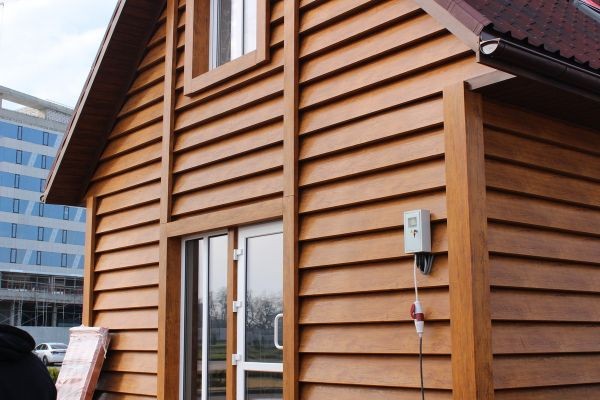
The term "herringbone" refers to the way that the imitation of a wooden lining is created by clearly overlapping siding sheets, with the top board placed at an angle on the bottom board.
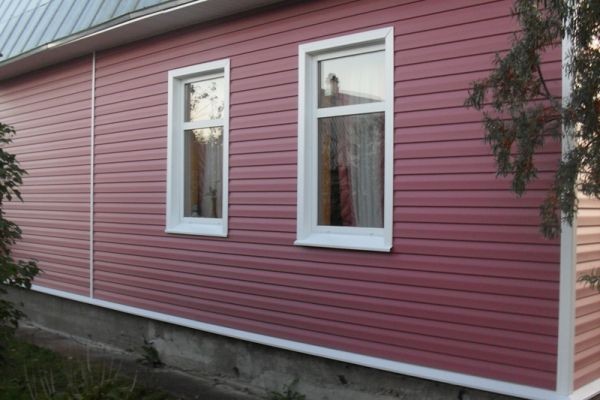
Herringbone cladding can also refer to metal panels, which are composed of vinyl and aluminum sheets covered in a polymer for protection. "Herringbone" comes in a variety of hues, from brown to milky.
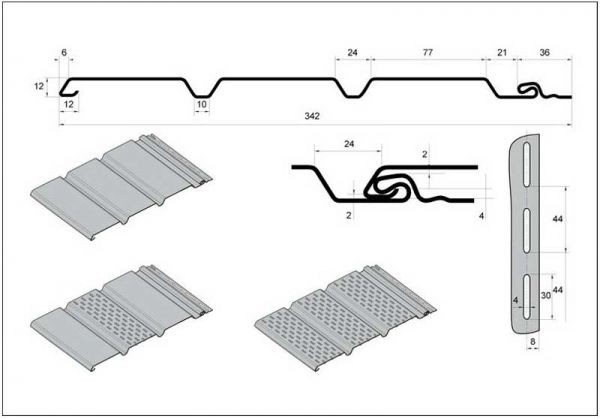
With an additional stiffening rib that is a double bend and a hurricane lock, the Herringbone siding profile is constructed like a broad strip. There can be one, two, or three bends in the plate itself. Only the horizontal direction is used to lay this kind of panel.

The unique zigzag arrangement of rectangular panels or planks that characterizes herringbone siding is used in both exterior and interior design. Because of its striking appearance and the lively texture it imparts to surfaces, this style is well-liked by homeowners wishing to give their houses a creative touch. The pattern gives any building an eye-catching, sophisticated appearance that can accentuate its architectural interest. It is inspired by the herringbone weave found in fabrics. Because of its adaptability, it can be applied to a variety of materials, such as wood, vinyl, and fiber cement, providing options to accommodate a range of preferences and price points.
Advantages and disadvantages
Selecting the cladding material—vinyl or metal—is essential to recognizing the advantages and disadvantages of this style of siding.
Metal
The following are some benefits of metal siding:
- non-flammability;
- coating strength;
- variety of colors;
- ease of installation;
- maintaining performance over a wide temperature range;
- durability;
- fungus and mold do not spread;
- mechanical stability;
- protecting the wall from external influences,
- moisture resistance.
Among the drawbacks are the following signs of metal siding:
- heavier than vinyl (reinforced sheathing required);
- heats up in the sun, increasing the temperature in the room;
- high thermal conductivity (recommended to be mounted on insulation).
In order to avoid paying extra for materials during installation, this factor must be considered.
Vinyl
Vinyl siding is substantially lighter than metal siding because it doesn’t put any strain on the walls.
Additional benefits of vinyl siding are as follows:
- ease of installation;
- large color palette;
- does not heat up in the sun;
- cheaper than metal;
- retains qualities at a large temperature range;
- durable;
- Mechanical stability (moderate).
Among PVC panels’ drawbacks are indicators:
- A rather high expansion coefficient;
- can maintain short burning;
- over time it fades (especially dark tones).
Siding "Herringbone" should therefore be chosen with consideration for both manufacturing material and aesthetics.
Specifications
The level of quality in the material is determined by its compliance with various technical parameters. Given that the facing "Christmas tree" can be constructed from a variety of materials, it is important to take into account the technical features of both varieties.
Metal
The following traits serve as the primary gauge of the material’s quality:
- length – no more 4 meters;
- width – from 20 cm to 25 cm;
- front width – from 17 cm to 22 cm;
- weight m² – from 2400 g to 3500 g;
- sheet thickness – from 0.48 mm to 0.61 mm;
- profile height – from 12 mm to 20 mm.
Vinyl
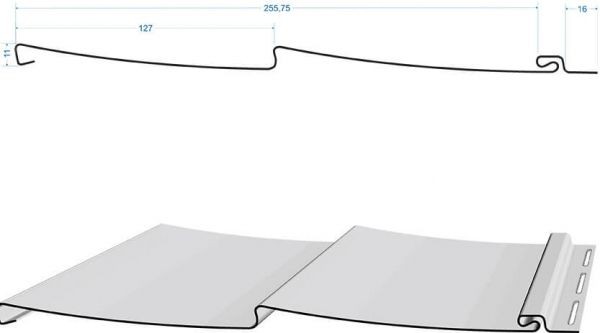
The following traits serve as a gauge of vinyl sheet quality:
- length – from 3.05 m to 3.85 m;
- width – from 20.5 cm to 30.5 cm;
- front width – from 17.5 cm to 27.5 cm;
- weight m² – from 1500 g to 1800 g;
- sheet thickness – from 1 mm to 1.2 mm;
- profile height – 12 mm.
Furthermore, the panels’ production texture can be entirely smooth or have a fibrous texture that resembles chopping a tree along its trunk.
Your siding might be of poor quality if it doesn’t match the technical requirements.
Consequently, buying siding and cladding from reputable manufacturers is advised.
Types of siding
Herringbone siding is categorized based on how many folds are present on the panel:
- in a single bend – that’s what it’s called: “Herringbone”;
- with double bend – “ship plank”.
There might also be a different board that isn’t kinked. The quality attributes of the siding remain unaffected by the panel’s shape.
Preparing the sheathing for Deke siding
High-quality Deke siding is produced for the Russian market, although the primary manufacturing facility is situated in Germany and is run by Germans.
The herringbone Deke cladding is made up of straight panels.
The method for sheathing beneath the deck should be the same as that used for the frame beneath any other siding. The manufacturer advises taking bars with a 3×4 centimeter cross-section and sheathing steps of 40 centimeters.
Experts advise building a siding frame out of metal profiles since they are more robust and don’t need to be processed differently.
The proper way to lathe is as follows:
- on a pre-prepared wall, first mount the outer guides;
- a rope is pulled from the top and bottom, along which the following strips will be mounted;
- all strips must be installed using a level;
- the width of the strip under the Deke must be 7 cm.
It is necessary to mount the lathing perpendicular to the sheathing panels. You can start installing siding panels once all of the guides are in place.

Siding installation
After the walls are ready, install the lathing around the facade’s whole perimeter and then install the "Herringbone" siding by following these instructions:
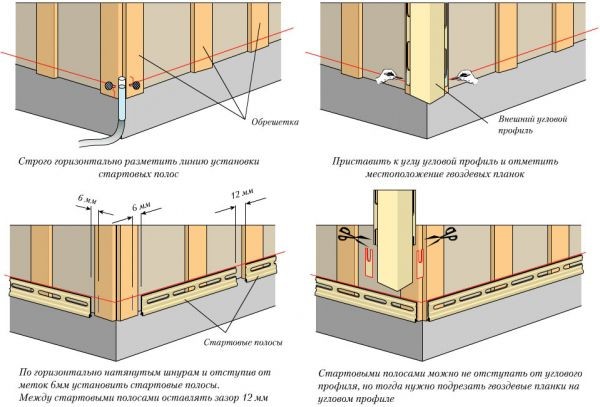
- installation of the panels begins with the installation of the baseboard drain: the strip should be installed along the lower horizontal line of the frame, cut the corners so that there is an overlap of 2.5 cm and fasten them;
- from the lower border of the cladding, measure 20 centimeters up, draw a horizontal straight line (marking) along the entire perimeter;
- according to the marking, it is necessary to install the starting strip;
- the next strip should be fixed in such a way that there is a gap of 5 mm between the adjacent ends of the profile;
- Fix all the planks in a similar way over the entire area of the facade.
It is necessary to leave this space to prevent the panelth from deforming.
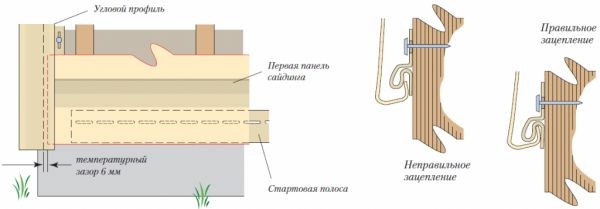
The outside and inside corners need to be fastened next. In order to accomplish this, you will need to fasten the profile to the wall, line it up with the bottom edge, mark it precisely vertically, and fasten it with self-tapping screws all the way around. Please be aware that the panel cannot move downward because the top screws are fixed to the panel’s top.
A finishing profile is used to decorate both doorways and window niches. It is mounted on the outside of the window frame and the inside of the window niche. Every door opening and the area surrounding every window opening is designed in the same manner.
An H-profile is mounted in order to plan the panel joints.

The following is how the herringbone sheets are mounted:
- in the first row of cladding, the panel with the end lower part should be inserted into the corner profile, and the lower part – into the starting strip, check the horizontality with a level and fix with screws along the length;
- a gap of 5 mm should be left between the panels;
having completed the covering up to the window opening, you should cut out a place for the ebb in the panel under the window, and along the line of the cut you made yourself, punch holes for fasteners, secure the panels inserted under the window profile and secure the window ebbs on top; - when the penultimate row of cladding remains, the finishing strip should be attached to it, into which the sheets of the last row should then be inserted and, bending, secured.
PVC siding and metal profile herringbone cladding are installed similarly.
| Feature | Description |
| Design | Herringbone siding features a pattern resembling a zigzag or chevron, formed by rectangular boards laid at a 45-degree angle. |
| Appearance | It creates a visually striking, decorative effect, adding texture and depth to exterior walls. |
| Material | Common materials include wood, fiber cement, and vinyl, allowing for durability and a range of finishes. |
| Installation | The pattern requires precise cutting and fitting, making professional installation preferable for best results. |
| Popularity | Herringbone siding is popular in both traditional and modern architectural designs due to its unique aesthetic. |
Herringbone siding is a distinctive and eye-catching choice for outside house design. Its unique pattern, which is reminiscent of fish bones, elevates any building and sets it apart from more conventional siding options. The character of your home can be improved with herringbone siding, regardless of the material you choose—wood, vinyl, or another.
Herringbone siding has practical benefits in addition to visual appeal. The interlocking pattern offers superior weather protection, shielding your house from wind and precipitation. It is a wise investment for homeowners searching for long-lasting siding solutions because of its durability.
It’s important to balance the advantages of herringbone siding with any potential drawbacks, like installation complexity. Employing a specialist can guarantee that the pattern is applied correctly, optimizing both its aesthetic appeal and practical benefits.
All things considered, herringbone siding is a chic and long-lasting option that can greatly improve the outside of your house. It is a great choice for people looking to combine functionality and style in their home renovation projects because of its distinctive design and protective features.


