
Homeowners frequently have to choose between decorative plaster and liquid wallpaper when it comes to interior wall finishes. Both solutions have special advantages and have the power to change a room’s appearance, but how can you decide which is best for your particular setting? Making an informed choice requires knowing the main distinctions between these materials.
Despite its name, liquid wallpaper isn’t your typical wallpaper. It’s a decorative wall covering composed of natural materials such as cotton, silk, and cellulose. When applied with a trowel, it produces a smooth, textured finish that can cover up flaws and give any space a sense of refinement.
Conversely, decorative plaster is a more conventional method of finishing walls. It entails painting walls with a blend of gypsum, cement, and lime to produce a variety of patterns and textures. Decorative plaster is a flexible option for a variety of interior design styles, ranging from sleek, polished finishes to rugged, rustic appearances.
The chosen aesthetic, the method of application, and the upkeep needs all play a role in selecting between liquid wallpaper and decorative plaster. For your home, it is crucial to carefully consider the benefits and drawbacks of each material in order to get the best outcome possible.
| Criteria | Liquid Wallpaper | Decorative Plaster |
| Composition | Made from cellulose, textile fibers, and glue | Contains cement, lime, gypsum, and sand |
| Application | Applied with a trowel or spatula, similar to paint | Applied with a trowel or spray gun, creating textures |
| Finish | Soft, fabric-like appearance | Varied textures and patterns |
| Maintenance | Easy to repair small areas | More durable and resistant to damage |
| Insulation | Provides slight thermal and sound insulation | Minimal insulation properties |
| Cost | Generally more expensive | Usually less expensive |
| Environment | Eco-friendly with natural ingredients | May contain synthetic additives |
- General advantages and disadvantages
- Decorative plaster
- Liquid wallpaper
- Comparison of technical and operational characteristics
- Decorative plaster
- Liquid wallpaper
- Which is cheaper?
- Which is easier to apply?
- Video on the topic
- Liquid wallpaper = decorative plaster, but is it true??
- WHAT TO CHOOSE: PAPER OR LIQUID WALLPAPER? | CHANNEL DOMDOM.
- TOP 5 wall coverings. Liquid wallpaper or decorative plaster?
- DECORATIVE PLASTER OR LIQUID WALLPAPER? | CHANNEL DOMDOM.
- WHAT IS BETTER WALLPAPER/LIQUID WALLPAPER OR DECORATIVE PLASTER!🔥
- Liquid wallpaper: how to choose and how to apply it to the wall
- Liquid wallpaper: PROS + and – CONS
- Wallpaper or Decorative plaster, which is better??
General advantages and disadvantages
Encyclopedic reference books will tell you that decorative plaster is the final coat of a hardened solution of gypsum, lime, or alabaster that is applied to the walls and ceiling to give the surface a beautiful appearance.
In theory, liquid wallpaper is just decorative plaster—that is, a mixture that is applied to walls to finish them and hardens over time. The following details point to a conceptual misunderstanding: The term "silk plaster" in the technical specifications refers to liquid wallpaper; Wikipedia lists silk plaster as a type of decorative material. A further term that may cause confusion is "Danish decorative plaster," which is really just liquid wallpaper.
You should be aware of the distinctions between these finishing materials so as to avoid confusion. The primary distinction between the two is that while liquid wallpaper lacks quartz sand, decorative plaster does—cellulose is used in its place.
The nearly identical benefits of these materials are another unexpected finding. When it comes to the benefits, these are:
- applied to walls made of any material: gypsum plasterboard, brick, stone, concrete, wood;
- hide imperfections in the surface of a wall or ceiling: cracks, cracks, sinkholes, chips;
- allow you to create various patterns and full -fledged drawings, while in color;
- have good sound insulation properties;
- regulate the microclimate in the room thanks to the ability to “breathe”;
- good insulation;
- have a long service life;
- belong to an environmentally friendly finishing material – the components of the mixture are not hypoallergenic;
- have no seams or joints – a solid surface is more aesthetically pleasing and durable;
- do not have waste in the form of paper scraps, adhesive residues, etc.d.
However, there is still a distinction between liquid wallpaper and decorative plaster.
Decorative plaster
There are further benefits to this plaster:
- high surface strength – difficult to damage mechanically;
- easy care – the wall is cleaned with a wet cloth or vacuum cleaner;
- is not afraid of water, so you can plaster rooms with high humidity (bathroom, kitchen);
- It is also used for external work -it withstands the temperature difference from -55 to +60 degrees Celsius;
- has enormous potential for implementing various design ideas;
- Retains rich, bright color throughout its lifespan.
Among the drawbacks are:
- high cost of finishing;
- difficulty in restoring damaged areas (in most cases restoration is impossible);
- cannot be applied to walls in houses that shrink – they will crack;
- the labor-intensive process of removing from the walls during replacement;
- professionals are required to carry out the work – complex and labor-intensive plastering technology.

Liquid wallpaper
Among the benefits exclusive to liquid wallpaper, the following are particularly noteworthy:
- elasticity – withstands any shrinkage and does not crack;
- do not require experience or training – any beginner can do the job;
- budget cost of finishing;
- ease of removal when switching to another type of finish;
- can be restored if damaged during operation;
- pleasant appearance and texture – soft to the touch, reminiscent of silk.
For information, you can use frozen mixtures that are left over after completing a task to make repairs.
- are afraid of moisture – can only be used in living rooms and hallways;
- cannot be used for facade finishing;
- limited color and texture;
- fade quickly when exposed to ultraviolet rays.

It can be difficult to decide between decorative plaster and liquid wallpaper, but it is easier to understand the differences. Applying liquid wallpaper, which has a smooth texture and minimal upkeep, is similar to painting with a mixture of cellulose and other natural fibers. Conversely, decorative plaster is a thicker substance that produces a more textured, long-lasting finish that frequently has an opulent appearance. Your decision will rely on your preferred style, financial constraints, and level of maintenance. For a warm, distinctive look, liquid wallpaper is perfect, and decorative plaster is appropriate for people looking for style and longevity.
Comparison of technical and operational characteristics
Which is preferable, decorative plaster or liquid wallpaper? This is a question that cannot be answered by the pros and cons listed above. Let’s examine the operational, technological, and technical aspects of these finishes to carry on the comparison.
Decorative plaster
Has no particular composition. It contains various thickeners, fillers, and binders. Quartz sand is the only ingredient utilized as an additive in any and all plaster solutions.
The following decorative plaster kinds are the most common:
- Mineral. Binder – cement. Moisture resistant. Has a low price;
- Polymer. Acrylic based. Very plastic and durable, resistant to aggressive environments;
- Silicone. The main component is silicone resin. The advantages include the ability not to retain dust on its surface;
- Silicate plaster is made on the basis of liquid glass. Resistant to mold and mildew, retards open flames during a fire.
The plaster’s aesthetic qualities are determined by the type of filler used.
Small stones, wood fibers, and mica particles combine to create textured decorative plaster, which comes in a variety of forms:
- “Lamb” – smooth, grainy surface. From the outside it resembles soft wool;
- “Fur coat” – a plastered wall is similar to the previous finishing option, but not soft, but fleecy;
- “Bark beetle” is a very popular type, in which the walls resemble old wood, undermined by the bark beetle – passages are visible.
It’s evident from the name alone that textured plaster has a noticeable texture, which helps you conceal all of the wall’s flaws beneath the plaster layer. The application technology is also the easiest to use because it allows you to complete the task on your own.


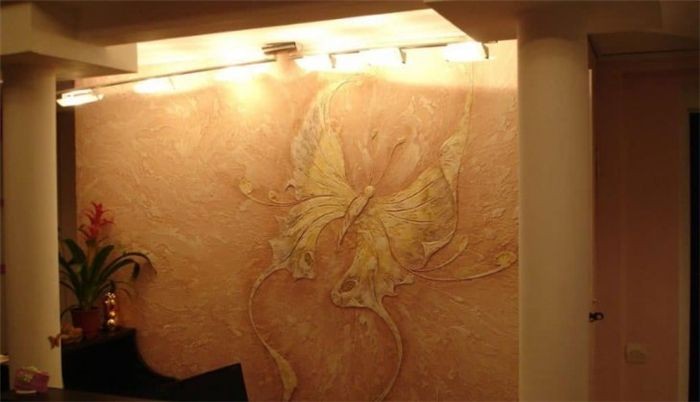
Essentially, mica and fine quartz sand make up structural plaster. Sometimes wood fibers or silk strands are added to create an unusual surface texture. After using such a solution, the wall has a uniform structure that can be covered with special rollers to simulate sandstone, tree bark, etc. d.


Venetian plaster replicates actual marble flawlessly. Special mineral fillers, such as quartz chips, granite, and marble, make this possible. The pattern gets deeper and more delicate at the same time that the filler fractions shrink in size.


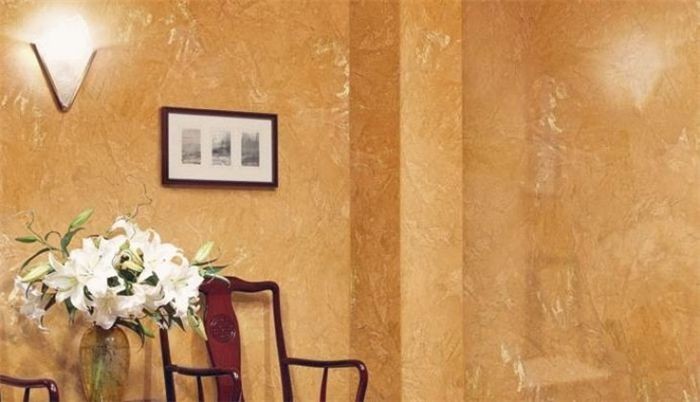
Plaster comes pre-assembled for use. possesses a translucent look. It has been tinted to blend in with the marble used for the room’s décor. Its unique quality is that the finish gets more opulent and plays with shade with each layer of plaster. The wall’s surface is sanded and waxed to accentuate the look of natural stone.
Flock decorative plaster is a recent addition to the building industry. It is composed of multiple layers that are applied to the wall in a specific order: glue, followed by flocks (also known as chips) of acrylic paint in various colors, and finally varnish (this type of plaster does not fit into the classical definitions – it does not contain quartz sand).


Liquid wallpaper
These vary depending on the filler:
- cotton;
- silk;
- cellulose;
- combined (silk-cellulose).
Wallpaper made of cotton. Just like with decorative plaster, even professionals can’t always tell what kind of finishing material is used right away. consist of mineral additives, decorative fillers, and fibers made of cotton and cellulose.
Similar to plaster, they have an irregular texture that makes it possible to make different panels and stucco moldings. If needed, add more paint and adjust the color scheme. One drawback of this type of wallpaper is its relatively high cost.
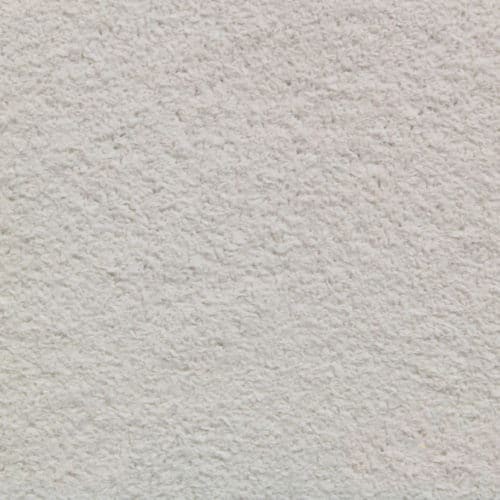
Wallpaper made of silk. The most costly variety (labor-free). includes glue, mineral fillers, dyes, and fibers from silk and cotton.
Please take note that the components of wallpaper made of cotton and silk are similar. The variations in fiber content between the different types of liquid plaster.
You can alter the smooth texture by using different sparkles (glitter), a figured spatula, a special roller, or a stick to cut the relief. Wallpaper is versatile and can be used in any room with any interior decor because of this texture feature. You can paint in addition if needed. They have a long service life without needing to be painted again because they do not fade significantly in direct sunlight.


Wallpaper made of cellulose. It is the least expensive kind of liquid wallpaper since it is made of wood fibers. As a result, their performance indicators are lower: they have a short service life and an unpresentable appearance.
Wallpaper made of silk-cellulose. With the exception of the primary drawback of a somewhat longer service life, silk wall décor eliminates all of the drawbacks of cellulose wallpaper, making it a more financially advantageous option.
It is still unclear where to draw the line when comparing the different features of these finishes, and the confusion only grows. So let’s examine the cost factor comparison.
Which is cheaper?
The cost of 1 m2 of wall covered with each type of finish should be your starting point rather than the price of a unit of material in order to determine which option is less expensive. From there, you can consider the cost of finishing work and the amount of material used per unit area.
Fluid wall covering. One kilogram costs 150 rubles at first. However, the substance is based on cellulose. Cotton cost between 250 and 550 rubles when combined. Let’s use the average value of 400 rubles per kilogram for our computations. In actuality, the mixture consumption per unit area is 4 m2 as opposed to 5 m2, which is more than what the manufacturers state. As a result, the cost of materials for each square meter of wall is 100 rubles.
The price per square meter of work begins at 250 rubles. In reality, a master can be ordered for 300 rubles. The total cost of a 1 m2 wall is 400 rubles.
To give you an idea, 1 m 2 of silk wallpaper will run you between 1150 and 1300 rubles. However, we must stress that this kind of liquid wallpaper is the priciest.
Ornamental plaster. The cost (for a 25 kg bag) varies greatly, ranging from 500 to 4000 rubles. The average cost per package is between 1000 and 2000 rubles. Consumption varies from 1.5 kg/m2 to 4 kg/m2 depending on the type of plaster. Let’s agree on 2.5 kg/m2 as the average. The price of decorative plaster, therefore, will be 150 rubles per square meter (1500 rubles per kilogram/2.5 kg/m 2).
A master can be ordered for 300–1200 rubles per square meter. This time, the cost is between 300 and 350 rubles. /m2 only pertains to phlox plaster. The starting price for other types is 450 rubles per square meter. Applying ornamental plaster will therefore cost, on average, 850–950 rubles per square meter, or at least 600 rubles. The priciest plaster will set you back between 5,000 and 6,000 rubles per square meter.
In conclusion, the decision between decorative plaster and liquid wallpaper is simple to make if you start with the cost aspect in mind. Particularly considering that cotton and silk wallpapers are hard to tell apart from structural and textured plaster, liquid wallpaper is significantly less expensive.
Which is easier to apply?
Although the technology used to apply each type of decorative plaster varies, the following steps can generally be used to describe the process:
- the surface of the wall is cleaned of old finishing material and repaired, then primed and plastered, after which it is primed again;
- the working mixture is prepared in accordance with the instructions printed on the packaging;
- the composition is applied in an even layer over the wall;
- after the mixture has set, an embossed surface is formed using relief rollers;
- after the shine disappears (after 20 minutes.), the surface is smoothed in order to remove the sharp edges of the relief;
- After the plaster has completely dried, it is sanded with fine-grained sandpaper.
Applying liquid wallpaper is a simpler process:
- old wall decoration (paint, wallpaper) is removed, after which cracks and chips are repaired;
- the surface is primed with the mixture selected for application;
- the composition is prepared in accordance with the instructions printed on the packaging;
It’s important to pour out the entire pack to avoid messing with the component proportions.
- The mixture is applied to the wall with a spatula;
- after complete drying, the wall surface is painted (no operation required for painted wallpaper).
A technology comparison reveals that while liquid wallpaper can be applied independently, plastering requires more labor.
It’s crucial to weigh the distinct advantages of decorative plaster and liquid wallpaper when choosing which material to use for your walls. Applying liquid wallpaper is simpler, and it is frequently more tolerant of minor flaws in the wall. Because of its range of hues and textures, which let you express your creativity, it’s a popular option for people who want to quickly update their interior.
Conversely, ornamental plaster provides a premium finish and longevity. It can produce elaborate patterns and give any space a sense of refinement. Even though it could be more difficult to apply, the finished product frequently justifies the additional expense and work, offering a durable and fashionable surface.
The optimal option ultimately comes down to your own tastes and the particular requirements of the task at hand. If you’re looking for a versatile and easy-to-apply wallpaper, liquid wallpaper might be the best choice for you. However, decorative plaster might be a better option if you want a sophisticated and long-lasting finish.
Think about the ambiance you wish to create in your room as well as the amount of time and energy you are prepared to put into the application process. Each material has benefits, so pick the one that best fits your goals and practical requirements.


