
It’s important to select the appropriate plastering technique for your building or remodeling project. Knowing the benefits of both mechanical and manual plastering will help you make an informed choice. It will save you time, effort, and money to understand the advantages and limitations of each method, whether you’re a professional contractor or a do-it-yourself enthusiast.
Using trowels and other tools, plaster is applied by hand in the manual plastering method, which is the traditional approach. For simpler or more complex projects, it is frequently chosen because it provides more control. This technique is perfect for areas that need a customized finish or a personal touch because it allows for precise detailing. But it can be labor- and time-intensive, particularly on larger surfaces.
However, mechanized plastering applies plaster using machines, which makes it a quicker and more effective method for large-scale projects. In order to achieve a polished and seamless finish, this method guarantees a consistent and uniform application. The speed and efficiency of mechanized plastering can save overall labor costs and project timelines, even though the initial equipment cost may be higher.
The decision between mechanical and manual plastering ultimately comes down to the particulars of your project, your financial situation, and the final result you hope to achieve. You can choose the technique that best suits your needs and guarantees a high-quality finish for your building or renovation project by weighing the advantages and disadvantages of each one.
- The essence of machine plaster
- Advantages and disadvantages of machine plaster
- Which is better, machine or hand plastering?
- Which is cheaper?
- Video on the topic
- Mechanical plastering of walls. Faster, cheaper, better quality!
- Machine plastering or handmade | What"s better?
- Machine Plastering or Hand Plastering ?
- MANUAL or MECHANIZED PLASTER
- Machine or manual plastering of walls in repair?
- Plastering walls manually or mechanized by machine, which is better to choose and what are the differences??
- Comparison of machine and hand applied plasters
The essence of machine plaster
What distinguishes manual labor from plaster applied by machine? Plastering has not been exempt from the general automation and mechanization of production processes. The plastering station took over the physical labor of applying the mortar.
It requires the addition of dry plaster mixture and water to function. After being thoroughly cleaned by special augers, the components are fed into a mixing container and high pressure is applied to the wall using a mortar gun and a sleeve.
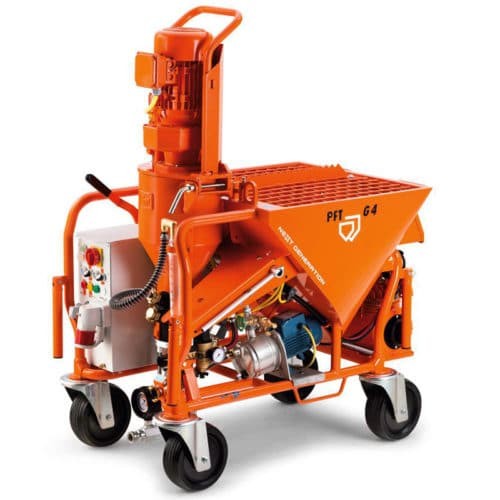
Special additives are added to the solution to stop it from sticking to the machine’s working surfaces (the sleeve and tank walls). The station runs exclusively on dry mixtures prepared in factories. Cement-sand mixtures are used outside, and gypsum plasters are used indoors.
It makes sense to distribute this way:
- Plaster, where one of the components is gypsum, is not used outdoors;
- Cement-sand mixtures are much heavier than gypsum mortars. Therefore, it is much more difficult for a plastering machine to work with them, as a result of which the plaster feeding speed drops by 1.5-2 times.
Concurrently, there is an increase in screw wear, which necessitates expensive replacements. Of course, nobody will use cement mortar to plaster the premises.
Advantages and disadvantages of machine plaster
Plastering station artisans typically observe only favorable features in the automated mortar application process:
- Lack of heavy physical labor;
- The speed of work execution increases by 3-4 times;
- Materials for machine application of plaster at a price cheaper than similar mixtures for a manual method of work;
- The consumption of materials is less than when plastering by hand;
- The cost of the work itself is almost two times lower (from 220 rubles./m 2 when working with the station and 550 rubles./m 2 when applying 3 layers with a trowel);
- The quality of work is higher:
- the mixture is supplied under high pressure, which promotes better adhesion of the plaster to the wall;
- the plaster solution is more uniform in composition, as it is ground with two augers, as a result of which the surface of the plaster practically does not crack;
- errors in preparing the mixture are eliminated – its consistency is programmed into the station.
Experts don’t perceive any flaws. They believe that the topic of "which plaster is better, mechanized or manual" should not even be discussed.
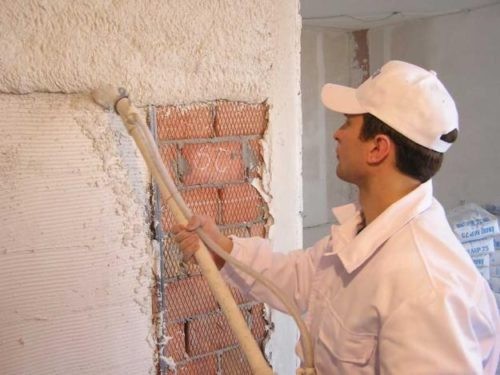
But if you look closely, you can find both absolute and relative drawbacks to the plastering station’s operating technology:
- The high noise level, which precludes work at night, is a relative disadvantage, since during the day the neighbors will understand and tolerate it;
- Work on three-phase current (available only in apartments with electric stoves);
- Long drying period of plaster – 7-8 days;
- A lot of time is spent on servicing the station at the beginning and end of the shift, which will certainly be reflected in the price of work for different volumes of plaster (preparing the station for work according to the regulations should last 2 hours and another 2 hours are spent on washing the equipment after its completion);
- You cannot plaster the walls in the bathroom and kitchen under the tiles. Manufacturers of dry mortars write on the packaging that the mixtures can be applied to walls in damp rooms, including the bathroom. But nowhere is it stated that tiles can be laid on such plaster. Practice shows that it breaks and lags behind on gypsum plaster. The plasterers of the machine station completed the work and left, and what happened to the tiles later, they may not know;
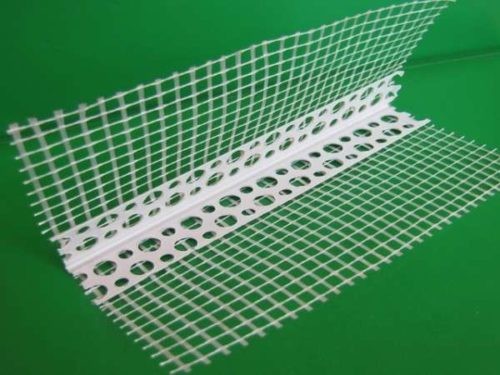
- Mandatory installation of plaster corners in internal corners, which increases the cost of work.
Which is better, machine or hand plastering?
The aforementioned benefits of mechanical plastering appear to definitively and completely eclipse the traditional manual plastering technique. However, a comparative analysis must be done in order to determine objectively which type of plaster—manually or machine—is superior. You won’t be able to distinguish between these techniques until then.
Since we are discussing individual clients in this context, orders for work ranging from 50 to 250 square meters will be taken into consideration concurrently for an individual house and apartment.
- In terms of price, the dry mixture for plastering stations is cheaper than a similar one for working with a trowel. Sounds convincing and yet true. But who said that when manual plastering, gypsum-based mixtures will be used?? They are very inconvenient to use and costly. The use of cement, sand and a concrete mixer leads to the fact that materials cost 2-3 times less when done manually. And the thicker the plaster layer, the more noticeable the difference.
- Indeed, when using dry mortar when operating a machine station, 3 kg of plaster is saved per 1 m2 (consumption 13 kg versus 16 kg, respectively). But when replacing it with cement-sand plaster, this advantage disappears due to the low price of the plaster mixture.
- The quality of work is higher. The difference between machine plaster and manual plaster in the area of plaster quality is imaginary. If technology is followed, there is no difference in quality. The problem of more intense surface cracking in cement plaster is solved using fiberglass fiber. Its use more effectively keeps the plaster layer from shrinking and cracking than in gypsum mortar applied mechanically.
- Only by hand can you plaster the bathroom and toilet due to the gypsum mortar. The best option is to entrust this work to a tiler, so that there are no subsequent problems with the quality of the laid tiles – they will not shift the blame onto each other.
The benefits of plastering stations are still unknown, as you can see. Maybe they are part of the job cost, which is usually the deciding factor.
Depending on the size, cost, and desired finish of the project, manual or automated plastering may be chosen. For small, detailed jobs, manual plastering provides accuracy and is the best option because it gives you more control over the final texture and allows for artistic touches. However, mechanized plastering saves time and labor costs by being faster and more effective for larger areas while still producing a smooth and uniform finish. A well-informed decision that strikes a balance between cost, efficiency, and quality can be made by being aware of the advantages of each approach.
Which is cheaper?
The cost of machine plastering starts at 220 rubles per square meter (data for St. Petersburg). For manual plastering, the cost is between 250 and 300 rubles per square meter for the first layer (because preparatory work is required) and roughly 550 rubles per square meter for the third layer.
Here, everything is immediately apparent. However, it’s not that easy. On the other hand, it is formed based on numerous factors if everything is evident from the plasterers’ price list when using a trowel.
1. The price listed is for work volumes of 2,000 square meters and above. Plastering work becomes more expensive as the volume decreases. The client might disagree, saying that the machine station can finish the task in five to six hours. I’ll win and pay for them. However, some crucial details are absent here:
- It takes time to prepare the surface and install beacons. These will be included in the price;
- Unplastered slopes remain – they are done only by hand. They are not and cannot be in the estimate. It will not be possible to invite outsiders to do this work – professionals always refuse, since there is a lot of hassle and little money. Masters of mechanized plastering charge 1.5-2 times more for such work, since their work in general is valued much higher;
- The price includes the time of travel, preparing the station for work, and cleaning it at the end of the shift. These amounts are significant, but fixed. It’s one thing to divide tens of thousands of rubles by 2,000 m2, and another by 50-250 m2 .
2. The cost of electricity is not included in the price for the work. The apartment’s owner will be responsible for payment.
3. The cost of machine plastering also excludes the labor required to install plaster corners. They each receive their own payment.
We will do a more thorough analysis of the labor costs per 100 square meters of wall in order to completely comprehend whether plastering walls by machine or by hand is preferable.
- price — 350 rub./m 2 ;
- layer thickness 1 cm;
- consumption rate of dry plaster per 1 m2 is 13 kg;
- price of plaster – 410 rubles./bag (“Volma”, 25 kg) or 16.4 rubles./kg.
The materials will set you back 42,640 rubles. Pay: $35,000. For the sake of ease of computation, we won’t include the remaining expenses. You will need to use 77,640 rubles total from the family budget.
For manual labor, you will require:
- cement M400 – 350 kg (14 bags weighing 25 kg at a price of 235 rubles./packaging) for the amount of RUB 3,290.;
- fine sand – 1,500 kg for the amount of 3,000 rubles. (30 bags weighing 50 kg for 100 rubles. per package);
- delivery with lift to the apartment – 4,000 rubles.;
- fiberglass fiber – 200 rub.
Be aware that cement costs can differ greatly depending on the supplier. For the calculations, Portland cement in the middle price range was chosen. Cement is available for 135 rubles per bag.
It will cost 10,490 rubles in total to buy the building supplies that are required. There will be a 55,000 ruble salary. (550 rub./m 2 x 100 m 2). The total amount spent on plastering was 65,490 rubles.
Wordless calculations illustrate the benefits and drawbacks of every kind of plastering job.
| Aspect | Manual Plaster | Mechanized Plaster |
| Application Speed | Slower, as it is applied by hand | Faster, thanks to specialized machines |
| Cost | Usually cheaper due to less equipment | Higher initial cost due to machinery |
| Finish Quality | Depends on the skill of the worker | More consistent and smooth |
| Labor Intensity | More labor-intensive, requiring physical effort | Less strenuous, machines do most of the work |
| Flexibility | Better for small or detailed areas | Ideal for large, open surfaces |
| Materials | Uses traditional materials | Requires specific mixes suitable for machines |
The demands of the project and your unique needs should be taken into account when choosing between manual and automated plastering. Plastering by hand is precise and perfect for intricate or small-space work. It works well for intricate finishes and in tight spaces where bulky machinery might be an issue.
However, mechanized plastering saves time and is more effective, particularly for larger-scale projects. It offers a uniform finish and drastically cuts down on effort and labor costs. When speed and consistency are essential, this approach works especially well for large-scale residential developments or commercial buildings.
The optimal decision ultimately comes down to the scope and scale of your project, your financial situation, and the resources you have at your disposal. Each approach has its benefits, and sometimes the best course of action is to combine the two. You can select the plastering technique that will meet your construction goals and guarantee a high-quality finish by carefully evaluating your needs.


