
A common option for homeowners wishing to give their exterior a rustic, natural appearance is log siding. It has the allure of a classic log cabin without the expenses and complications of genuine logs. But choosing the right kind of log siding for your house can be difficult given the variety that is available.
Your home’s durability and appearance can be greatly impacted by the type of log siding you choose, whether you’re building a new home or remodeling an existing one. This choice is heavily influenced by a number of factors, including material, cost, maintenance, and ease of installation. Making an informed decision can be aided by being aware of the variations amongst the various types of log siding.
The various varieties of log siding that are on the market will be discussed in this article. Every option, including vinyl, engineered wood, and natural wood, has pros and cons of its own. You can choose the type of log siding that best suits your needs and budget by contrasting these different varieties.
Come along as we explore the world of log siding and give you the knowledge you need to turn the outside of your house into a gorgeous, rustic getaway. You’ll know more clearly by the end which kind of log siding is best for you.
| Type of Log Siding | Advantages |
| Vinyl Log Siding | Affordable, low maintenance, weather-resistant |
| Wood Log Siding | Natural appearance, excellent insulation, eco-friendly |
| Engineered Wood Log Siding | Durable, cost-effective, resistant to pests |
| Metal Log Siding | Fire-resistant, long-lasting, minimal upkeep |
| Fiber Cement Log Siding | Highly durable, resistant to rot and insects, low maintenance |
The best kind of log siding will depend on a number of factors, including cost, maintenance, durability, and aesthetics. Although natural wood log siding has a timeless, genuine appearance, it needs routine maintenance to fend off rot and vermin. Engineered wood siding is more durable and requires less upkeep than real logs while still having a realistic appearance. Rustic style can be achieved at a lower cost and with less upkeep with vinyl and fiber cement log siding. In the end, the optimal decision depends on striking a balance between these factors to suit your unique requirements and preferences.
- Log siding
- Metal
- Advantages and disadvantages
- Specifications
- Acrylic
- Advantages and disadvantages
- Specifications
- Vinyl
- Advantages and disadvantages
- Specifications
- Which siding is better
- Video on the topic
- How to sheathe the outside of a wooden house, the best types of materials and technologies for their installation
- Wood siding. Decorating a house with wood siding
- Metal siding for logs. Features of the house, this is important!
- Wood siding. Presentation of Hokla siding. Start of installation of a new facility
- Metal siding under "log"
- Vinyl Siding REVIEW Stroymarket "Interior"
- Metal siding under a tree in Siding Market Yekaterinburg
Log siding
A textured design of panels that mimics a log is one type of cladding panel. This material mimics the appearance of natural wood so well that only tactile sense will be able to tell the difference between the two.
The installation is done so that the facade’s entire surface is covered in log structure, giving the appearance of a wooden house.
Installing the panels on a sheathing—a wooden or metal framework that acts as a siding frame—is recommended. Siding can be clad on any type of surface, including brick, concrete, foam blocks, and wood.
One of the benefits of siding’s dominant position in the market for facade cladding materials is the lack of the need for extra wall leveling.
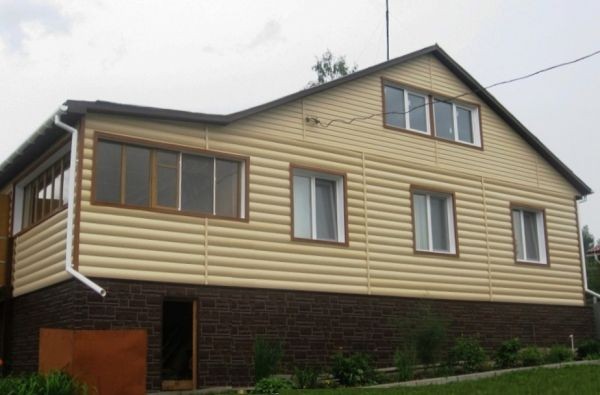
An image of a home with log siding:
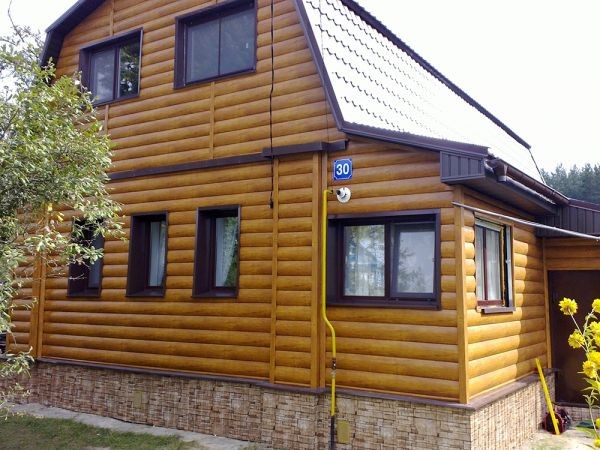
Metal
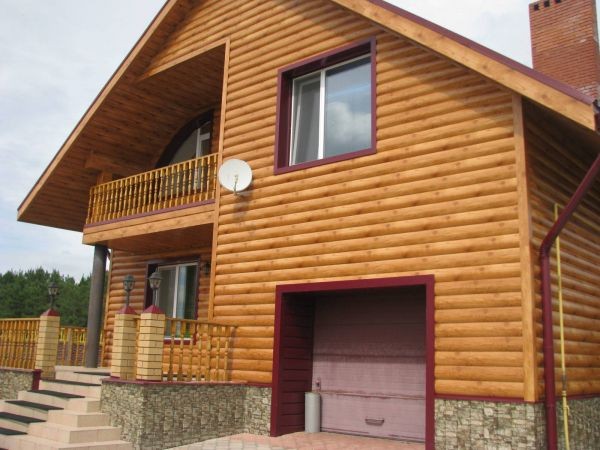
One characteristic that sets apart metal siding panels for logs is a coating that consistently shields the material sheet from different types of mechanical damage.
The last step of hot processing involves coating material sheets with zinc, which produces dependable corrosion protection for the metal.
The primer, textured pattern layer, lamination process, and varnish coating are applied to the sheet’s exterior before it is sealed.
A panel that perfectly replicates a log can be bent or solid, creating a double row of faux beams.
Advantages and disadvantages
The main qualities that set metal panels for the building’s lining apart from their counterparts are their high strength and resistance to temperature fluctuations.
Metal siding beneath a log also offers the following benefits:
- environmentally friendly material;
- does not fade in the sun: has a durable coating;
- large assortment of colors;
- does not get dirty, easy to clean;
- does not burn or ignite;
- the manufacturer promises a long service life (up to fifty years);
- installation is available at any time of the year;
- moisture resistant;
- is not a favorable environment for the development of mold, moss, fungi;
- does not emit toxic substances.
Although metal siding is considered a high-quality material for facade cladding, there are certain drawbacks to metal that should be considered.
- when a dent forms, the sheet must be replaced with a new one: the previous structural state cannot be restored;
- It is recommended to lay an insulating layer under metal siding, since the material has high thermal conductivity and a low level of noise insulation;
- Compared to vinyl analogues, metal siding has a high cost.
The weight of metal siding is a drawback since panels need to be installed over reinforced sheathing.
Strong walls and a firm foundation are necessary for the construction of metal siding.
Specifications
Adherence to technical specifications is the primary prerequisite for superior metal cladding material.
- sheet length – from 50 cm to 6 meters;
- sheet width – 22.5 cm, 32.5 cm;
- thickness – from 0.4 mm to 1 cm;
- The weight of the sheet, depending on the length, can reach 5 kg.
Metal siding can have slightly different characteristics in terms of indicators. Manufacturers are free to use their own technology when producing panels, but they still have to adhere to the GOST-established standards.
Acrylic
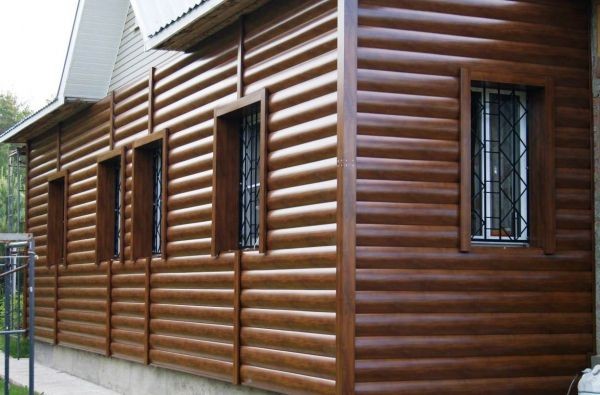
It is very difficult to discern the texture relief of the panel from natural because the imitation acrylic siding beneath the log structure looks so realistic. Because acrylic is made of acrylic polymers, it is a reasonably durable material.
This kind of siding is made by applying protective coatings of premium coloring materials to the hot-cast siding sheet.
Advantages and disadvantages
These are the benefits of acrylic siding:
- increased strength;
- UV resistance;
- durability (manufacturer indicates more than 50 years);
- resistance to temperature changes (can maintain properties up to +85°C);
- prevents the formation of fungi and mold;
- low level of heat absorption;
- resistance to detergents;
- not subject to corrosion;
- durability;
- ease of installation.
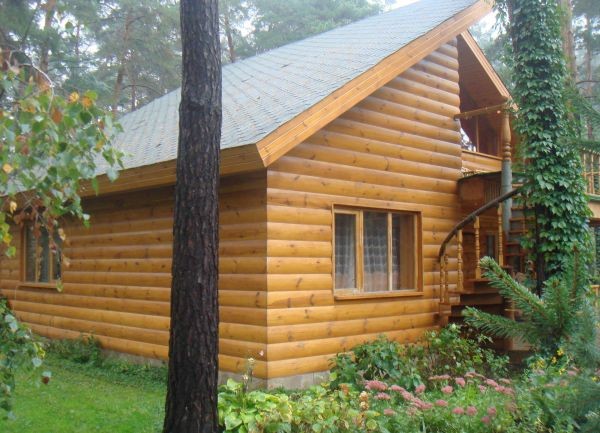
A vast array of natural color textures, including pine, oak, cherry, and other wood species, are available in acrylic siding manufacturing.
Cost is one of acrylic siding’s drawbacks, at least when compared to vinyl panels. However, acrylic decoration is more expensive because of its exact resistance to light, durability, and long service life while preserving production quality features.
Specifications
The material’s operational qualities are guaranteed to be preserved in extreme temperature conditions (ranging from -80 °C to +85 °C) because of the polymers of acrylic nature that contribute to the material’s physical preservation.
Acrylic panels have to meet the following requirements:
- The length of the panels is up to 3100 mm;
- width – from 20 cm to 32 cm;
- thickness – up to 1.1 mm.
Apart from the general indicators, it is important to acknowledge that the elements that make up acrylic are composed of components that give the material the proper qualities:
- antipyrene (fire resistance);
- titanium dioxide (color resistance);
- antistatics (decrease in static electricity);
- modifiers (increased strength).
The acrylic material’s lack of harmful ingredients guarantees the cladding’s environmental friendliness.

Vinyl
The panel material is classified as vinyl (PVC) siding because it contains 80% polyvinyl chloride.
Vinyl siding is made by combining additional ingredients that enhance the panels’ quality with the main raw material, vinyl powder.
Single or double PVC sheets are available. The sheet’s exterior and interior colors matching is one way to tell how high-quality the material is.
Advantages and disadvantages
The material’s primary benefit is that it is both lightweight and has adequate mechanical strength. Furthermore, vinyl panels are the least expensive, but this does not imply that their quality is noticeably lower.
Furthermore, vinyl siding
- easy to install;
- durable (service life – more than 10 years);
- moisture resistant;
- does not lose properties at temperatures from -50°C to +60°C;
- resistant to fire;
- not subject to corrosion;
- is not a hotbed for the spread of fungi and mold;
- easy to care for;
- easy to install (due to its lightness, it can be installed with one hand).
Almost any natural siding shade can be chosen from a large selection of wood-grain vinyl panels at the buyer’s request.
Practical experience indicates that the color of vinyl cladding fades with time, even though manufacturers apply color-preserving agents (such as titanium dioxide) to prevent fading.
This drawback is substantial, particularly if the building faces the sun.
Specifications
The following indications are necessary for vinyl panels to meet international standards:
- sheet thickness – from 0.9 mm to 1.2 mm;
- mechanical strength – D256;
- general flammability – D635;
- surface flammability – E84;
- composition – D1784-81.
Furthermore, the PVC material needs to be acid- and alkali-resistant.

Which siding is better
Which type of siding is superior? Understanding the material’s intended use will help you choose the siding material for a log.
Vinyl siding is a cheap material that is recommended for sheathing outbuildings, garages, and other buildings that are not fit for human habitation and do not require insulation. Because metal siding lasts longer, it is also appropriate. Vinyl, however, is far less expensive.
Acrylic panels are more dependable than vinyl ones because they have extra polymers that guarantee their stability, strength, and resistance to wear, but the cost might not always be to your liking.
A long service life, however, justifies a high price; the manufacturer warrants that the material will retain its quality for as long as fifty years. Vinyl panels, however, can lose their usability much sooner because the sheathing needs to be replaced and their color will fade more quickly.
While metal is more expensive than acrylic and PVC materials, its strength, endurance, and durability are not less.
However, it should be remembered that installing external insulation is necessary for residential buildings with metal siding, which raises the cost of installation significantly.
Furthermore, because metal sheets can weigh a lot more, this option is not appropriate if the load-bearing walls or foundation are not strong enough.
Experts advise combining two techniques when decorating a residential building with wood siding: place acrylic panels where the structure is more exposed to the sun and use PVC siding to cover the remaining portion of the structure.
The process of installing siding panels beneath logs is largely the same regardless of the material: all sheets need to be fastened to the sheathing and should be arranged sequentially, either from left to right (for vertical sheets) or from bottom to top (for horizontal sheets).
The panels feature factory-made holes for fastening to the frame and locking elements to secure them to each other. The weight is the only distinction: two persons are required to install heavy panels.
Siding, in any case, keeps the building neat and improves its aesthetic qualities. Moreover, the building appears cozier and more environmentally friendly due to the imitation of a log.
For this reason, one of the most popular options for facade cladding is log siding. The natural texture contributes to the sensation of coziness, warmth, safety, and comfort by making one feel closer to nature.
The ideal kind of log siding to choose will depend on your own requirements and tastes. Natural wood log siding is a popular option for many homeowners because it provides an authentic and rustic look. It does, however, need routine upkeep to avoid problems like rot and insect damage. Natural wood might be your best option if you’re willing to invest in maintenance and want a classic, natural look.
Conversely, engineered wood log siding offers a look that is akin to that of natural wood while requiring less upkeep and more durability. It is impervious to numerous typical issues that natural wood encounters, including moisture and vermin. For those who prefer the look of wood but don’t want to deal with ongoing maintenance, this makes it a fantastic alternative.
Vinyl log siding could be the best option for people looking for a low-maintenance solution. It needs very little maintenance, is extremely resilient to weather and insects, and is long-lasting. It offers an easy and affordable alternative to natural or engineered wood, even though it might not have the same genuine appearance.
The ideal kind of log siding for you will ultimately rely on your priorities. When making your choice, take maintenance, durability, appearance, and price into account. To choose the best type of log siding for your house, consider the benefits that each type offers in relation to your needs.


