
Grape canopies are important for vineyard management because they protect the grapes and have an impact on their quality. To maximize growth and grape yield, these structures—which are made to protect grapevines from harsh sunlight, rain, and other environmental elements—are essential.
Based on the climate, grape variety, and vineyard practices, there are various types of grape canopies, and each has a specific function. Growers and owners of vineyards can select the best canopy system for their unique requirements by having a thorough understanding of these varieties.
The designs and functions of grape canopies range greatly, from straightforward overhead trellises to intricate retractable shade systems. Every variety provides distinct advantages, like controlling solar radiation to avoid sunburn on fragile grape clusters or reducing the likelihood of fungal infections by enhancing airflow surrounding the vines.
Vineyard managers can make well-informed decisions that affect grape yield, quality, and overall vine health by researching the various kinds of grape canopies. Vineyards can better control their microclimates and increase the productivity and sustainability of their grape-growing operations by putting in place the appropriate canopy system.
Selecting the appropriate grapevine canopy is essential for maximizing growth, safeguarding against harsh weather, and improving grape quality in the field of vineyard management. This article examines several grape canopies, including contemporary trellis systems and classic pergolas, emphasizing their advantages and practical considerations for building and renovating vineyards.
- Types of canopies
- Metal canopy manufacture
- Shed adjacent to the house
- Making a gazebo
- Wooden structures
- Video on the topic
- Trellis for grapes and placement of vines after wintering
- Simple and beautiful formation of grapes on an arch!
- ADVICE FROM KRASNODAR ABOUT THE GENIUS FORMATION OF A GRAPE BUSH
- The most productive, productive and easy to maintain Y-shaped support for grapes.
- How to form a real canopy of grapes in the Moscow region (personal experience)
- Trellis for your grapes.
- 55 grape trellises that will decorate your garden and yard
- The most convenient trellis for grapes – Which one?
Types of canopies
Let’s familiarize ourselves with canopies’ types before we begin to construct them. So, products can be categorized into three groups based on the type of design:
| Arches | They can be either simple, made of flexible rods or wire, or complex – with a concrete base and a metal or wooden frame. |
| Adjacent to the wall | As a rule, such structures are attached to the wall of the house and are made of metal pipes or corners. |
| Gazebos | They represent a complete base for a gazebo. After making it, all that remains is to plant the grapes correctly and direct its branches to get a closed resting place. |
The design type selected is determined by the intended use. For instance, you could build slanting canopies close to the house and a gazebo in the garden. Furthermore, all structures can be conditionally classified based on the kind of material they are composed of:
We’ll talk about the characteristics of producing all kinds of structures below.
Metal canopy manufacture
The process of making a metal canopy is simple. The ability to operate the welding machine and other metal tools is the only requirement. It is true that you can hire a welder if you lack these skills, but the cost of the finished product will increase in this scenario.
Consider the following characteristics of the production of various kinds of structures.
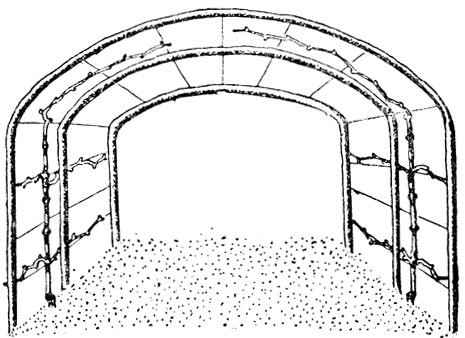
The following supplies will be required to create such a design:
- Metal rods or pipes;
- Materials for the preparation of concrete – crushed stone, sand and cement;
- Wooden boards for formwork.
The following are the directions for creating the arch:

- First of all, you need to perform a drawing of the structure indicating all sizes.
- Then you need to prepare the site – clear it and leve it off.
- Further, from the two opposite sides of the site, the trenches should be dug under the concrete base. Spruce twigs are chosen with a small diameter; trenches with a depth and width of 20-30 centimeters are sufficient. When using more powerful pipes, the foundation must be deeper.
- You need to lay small stones at the bottom of the trenches and make formwork from boards.
- Next, you need to mix the concrete solution and pour the foundation. In this case, metal pins must be inserted into the foundation, onto which the support pipes will be placed.
- While the concrete hardens, which takes at least 28 days, you can prepare the rods or pipes that will form the upper part of the structure. To do this, you need to bend the parts to obtain the required bending radius of the arch.
- After this, you should weld the stand pipes to the pins and connect them together with arcs, which are also welded.
- The final stage is the welding of horizontally located wire jumpers, which will allow you to combine all the elements of the structure into a single structure. Advice! To bend pipes, you can make a simple device with your own hands. To do this, on a flat area you need to draw a semicircle of the required radius and install pins along it. The pipe should be secured to the first pin and bent towards the last.
Now that the arch has been constructed, the floor just needs to be finished and grapes planted along it. Sand can be used as a covering, but then you will have to deal with grass that keeps coming up. Thus, concrete or paving slabs are the best choice.
It must be acknowledged that the grapes’ level of care will determine how appealing the finished product is. It’s important to direct and trim new shoots during the summer, when the plant is growing vigorously and in bloom. The grapes must be properly trimmed three weeks after the last leaf falls, or when sap flow stops.

Shed adjacent to the house
You can create a grape canopy next to it using the following plan:

- Along the wall of a house or other building you need to make a foundation and install racks using the method described above.
- Next, on the wall of the building you need to attach the canopy roof pipes. The type of fastening largely depends on the facade of the building. For these purposes, you can use a corner or a wooden beam that is attached to the wall.
- Next, you need to secure the pipes on one side to the wall, and on the other to the supports by welding.
- After this, jumpers should be made from wire, as in the case of an arched structure.
- Advice! It is better to paint the metal elements of the structure green, in which case they will blend in with the leaves of the grapes and will not be visible.
Making a gazebo
In contrast to a canopy, a gazebo is a more enclosed structure. Additionally, it may have a sturdy roof to protect against the rain. Here, the grapes are only woven along the building’s walls. The gazebo can have a polygonal or rectangular shape.
The following list of features will be discussed when constructing a basic rectangular gazebo:

- First of all, you should complete the foundation according to the method described above. The only thing is, in the case of a gazebo, the foundation is needed on three sides, not two.
- Next you need to install the stands. For these purposes, it is best to use profiled pipes.
- Then all the racks need to be connected to each other with jumpers. You can make a fence in the form of a lattice between the posts.
- Next you need to weld the roof beams to the racks.
- The roof can be made from different materials, for example, polycarbonate is an excellent material. However, if desired, you can also plant grapes along it, as is the case with canopies.
Once completed, the gazebo needs to have a table and benches.
Wooden structures
The idea behind building a wood grape structure is the same as that of the buildings mentioned above, with the exception that wood is used for the racks, which are concreted and buried in the ground. Parts are fastened together using self-tapping screws or nails.
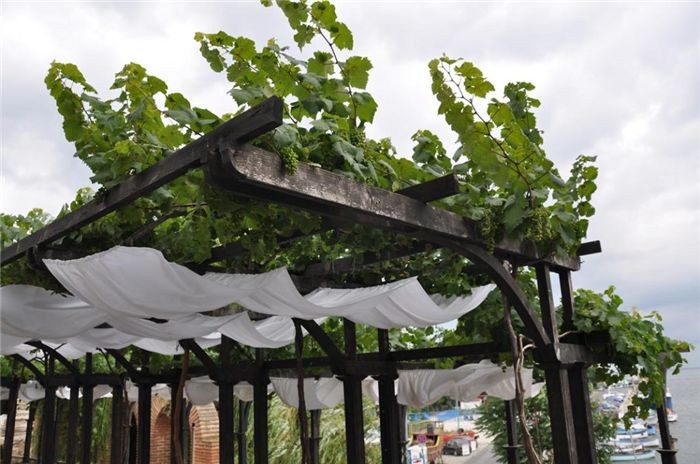
It is true that wooden structures have a very long lifespan. The only requirements are to periodically paint the product or open it with varnish and to treat the wood with an antiseptic.
| Canopy Type | Description |
| Arbor | An open structure usually made of wood or metal, providing partial shade and support for climbing grapevines. |
| Pergola | A garden feature with an open-roof structure supported by columns or posts, offering shade and often used for growing grapevines. |
| Trellis | A framework of wood or metal wires used to support and train grapevines vertically or horizontally, maximizing sunlight exposure for fruit production. |
Your grapevines’ growth and fruit quality can be greatly impacted by the canopy you choose for them. You can choose the right canopy for your vineyard by being aware of the various varieties that are available.
First of all, the pergola canopy presents a conventional and attractive choice. It is made up of several metal or wooden beams hanging overhead to form a covered walkway. In addition to offering shade, pergolas also sustain the vines, enabling them to grow and spread organically.
Second, the trellis system is the best way to make the most of available space and sunlight. It consists of a system of ropes or wires that are positioned in between posts to support the vertical growth of the vines. By improving the air circulation around the grapes, this method lowers the possibility of diseases.
Thirdly, the arbor canopy is a flexible option for small to medium-sized vineyards, combining features of trellises and pergolas. A lattice roof supported by posts is a common feature of arbors, which partially shades the grapes while letting sunlight in to promote growth.
Finally, the umbrella canopy is a symbol of a contemporary method of grapevine care. With each vine, a separate umbrella or shade cloth is stretched to provide precise control over light exposure and weather protection. This technique is frequently applied in areas with erratic weather.
In conclusion, factors like vineyard size, climate, and aesthetic preferences must be taken into account when choosing the appropriate canopy type. Regarding fruit quality, vineyard management in general, and vine growth, each canopy type has special advantages. You can improve grape yield and design a visually pleasing vineyard setting by making informed decisions.


