
One of the most crucial things you can do to preserve the longevity and integrity of your house is to waterproof your basement. A dry basement shields your home’s structure from water damage while also adding more living space. You can avoid foundation cracks, mold growth, and other expensive repairs by keeping moisture out. However, why is it so important, and how can one go about achieving it?
Because they are located below ground level, basements are inherently more vulnerable to water seepage. Via gaps in the walls, windows, and foundation, water from precipitation, snowmelt, and even groundwater can enter your basement. This moisture can cause a number of issues, such as structural problems that jeopardize the safety of your home and mold and mildew that can be harmful to your health. In order to build a barrier that keeps water out of your basement, waterproofing is necessary.
The best method to waterproof your basement will depend on your particular circumstances. There are several approaches available. While interior waterproofing concentrates on sealing the inside walls and installing systems to manage any water that enters, exterior waterproofing applies a waterproof coating to the outside of your foundation walls. Water seepage can also be considerably decreased by enhancing drainage around your house, such as by grading your yard and adding gutter systems. Every approach has advantages and disadvantages of its own, so it’s critical to assess your needs and, if required, seek professional advice.
You can protect your home by choosing wisely if you know how important it is to waterproof your basement and what options are available. Investing in waterproofing solutions protects the value and structural integrity of your home for many years to come, in addition to improving the comfort and usability of your basement.
| Reason | Explanation |
| Prevent Water Damage | Waterproofing protects the basement from leaks and flooding, which can damage the structure and belongings. |
| Reduce Mold Growth | Keeping water out helps prevent mold and mildew, which can cause health problems. |
| Improve Home Value | A dry, usable basement can increase the value of your home and appeal to buyers. |
| Steps | Process |
| Inspect for Leaks | Check for cracks and signs of water entry, both inside and outside the basement. |
| Seal Cracks | Use waterproof sealant to fill any cracks or gaps in the walls and floors. |
| Apply Waterproof Membrane | Install a waterproof membrane on the walls to block moisture. |
| Ensure Proper Drainage | Make sure the ground slopes away from the foundation and install gutters to direct water away. |
| Install Sump Pump | A sump pump can help remove any water that does get into the basement. |
If you want to shield your house from structural problems, mold growth, and moisture damage, you must waterproof your basement. Water seepage into your basement can be avoided by using waterproof coatings, installing appropriate drainage systems, and sealing cracks. By doing this, you not only protect the foundation of your house but also make your living area safer and healthier. If you waterproof your basement properly, it will stay dry and functional for storage, living space, or other uses.
- Why do you need to protect the foundation of your house from water??
- Consequences of not insulating your home from moisture
- What materials are used, how to choose them correctly?
- Processing methods
- Technology of work from inside and outside
- Horizontal laying
- Vertical coating
- Vertical roll
- Internal using mixtures
- Possible process errors and ways to eliminate them
- Average prices for the country
- Video on the topic of the article
Why do you need to protect the foundation of your house from water??
Basement waterproofing keeps building materials intact by reducing or eliminating the amount of moisture that enters certain areas of the structure. The procedure’s primary goal is to preserve the building’s foundation’s integrity for as long as possible in order to avoid damage from temperature exposure.
It is important to remember that waterproofing can be done before, during, or after construction is finished.
In addition to providing external foundation protection, the plinth levels the lower floor, directs wall installation, and permits the creation of additional basements.
Waterproofing a basement is required for:

- Preservation of the building, durability of the building. Groundwater can wash away building materials and cracks will appear under pressure. As a result, the entire structure will be in danger of collapse.
- When building materials come into contact with the ground, they enter into a chemical reaction, wear out faster, and the service life of the structure is reduced.
- Getting into microcracks and free cavities of the base (and then into the foundation), water molecules expand under the influence of low temperatures. This leads to disruption of the integrity of materials and cracks.
- Protection prevents moisture from entering the interior. Otherwise, the ground floor or basement rooms become damp, mold and other troubles appear, reducing comfort and making it uninhabitable. The fungus quickly invades other spaces and can be dangerous to the health of residents.
- Groundwater and stormwater contain a lot of salts. They are deposited on the base, weaken the building mixtures, lead to delamination and destruction of the structure. Salts leave a white coating that changes the appearance of the house and artificially ages it.
Site drainage is also crucial; in order to lay a foundation in groundwater-free soil—a trench or hole under the foundation needs to be prepared before building materials are installed—the soil’s geological development must be completed beforehand.
Consequences of not insulating your home from moisture
Water from the earth and the atmosphere are both present in the building’s basement. This area of the structure is the wettest. The building’s walls and foundation are both impacted by the absence of waterproofing.
What are the effects of not waterproofing a basement?
- If this part of the building is made of brick, it absorbs moisture very well. It rises from the ground up the building and destroys it from the inside. Finishing materials (tiles, panels, etc.) split and fall off in pieces. The external attractiveness of the building is lost.
- Penetration of moisture into the walls threatens to damage the thermal insulation of the room (the insulation gets wet, begins to rot and collapse). Heating your home will become difficult and will require a lot of resources.
- Water penetrates into the cracks of the foundation concrete, erodes it and destroys it. It’s good if the base mixture initially contains waterproofing elements, the appearance of cracks will be delayed for some time. But such a building will wear out faster.
- The concrete base also splits and is torn from the inside by moisture entering through the cracks. The reliability of the building is lost, traces of salt remain on the outer part, the paint falls off along with the plaster.
- It becomes impossible to stay or store anything inside the basement floor. Biological microorganisms are difficult to remove, they spread throughout all rooms, the first floor and walls of the house are especially affected.
The base needs to be waterproofed in three areas: where it meets the wall, the ground, and the foundation. The structure will then have dependable protection.
What materials are used, how to choose them correctly?
Plinth waterproofing materials have different qualities. Based on performance traits, a decision is made:

- Polymer compositions. The physical properties are similar to rubber, they are used more often on the outside, where the base comes into contact with the ground and the atmosphere. Advantages: tolerates temperature changes well, does not crack in the cold, does not need to be cleaned before application, inexpensive.
- Mixtures and primers. These materials are able to penetrate into the deep layers of the base, making them considered the best option for porous concrete and brick. Used for internal and external work. Apply using painting supplies (brushes, rollers). The base with it becomes heat-resistant and is not susceptible to external influences. Can only be applied at above-zero temperatures; before the procedure, you need to protect your respiratory system and exposed skin. The compositions are applied to the cleaned surface. For better penetration into concrete or brick, the surfaces are leveled.
- Covering, mastics. Materials on a cement-polymer base. Applied on top of the base, suitable for any surfaces, no preliminary preparation is required. Disadvantage: bitumen-based waterproofing is short-lived, must be periodically updated. Based on cement and polymers lasts longer, tolerates temperature changes well.
- Rolls: roofing felt, roofing felt, film, membrane. They are convenient to use when laying the foundation. The material is left with a margin in a trench or pit, and then the base is covered with it. So the entire foundation of the building is protected from water, even if it is very close. Roll coatings can withstand the pressure of melt water, inexpensive and environmentally friendly. The most popular option is "Izospan A base". This waterproofing is capable of releasing vapors to the surface, maintaining fresh air inside the basement.
- Injections. This is a special type of basement waterproofing; the solution is injected into the surface. Only specialists are engaged in such work, the method is effective if the waterproofing procedure has not been carried out in advance, it is more expensive than others.
Waterproofing a brick base is necessary because the porous material absorbs a lot of moisture and collapses quickly.
Ideal for:
- mixtures,
- coating,
- treatment with polymer compounds.
In this manner, the brick will keep its beneficial qualities, such as breathability, heat retention, and aesthetic appeal. It is best to do the process ahead of time and start getting ready as soon as the ground is cleared.
Processing methods
Waterproofing comes in two varieties: vertical and horizontal. If the plinth serves as the base of the wall, then horizontal waterproofing between the plinth and the foundation is required. It keeps the walls’ structural integrity for a considerable amount of time by guarding against moisture seeping in from the foundation above. The process is not necessary if the base is an extension of the foundation.

This is possible if the building’s base is composed of:
It is not feasible to waterproof horizontally if the base and foundation are composed of monolithic concrete or rubble concrete structures.
The base protection and the moisture protection on the basement floor need to be connected, and the seam between them needs to be sealed with mastic or a torch. Here, rolled materials—such as roofing felt or roofing felt—are utilized.
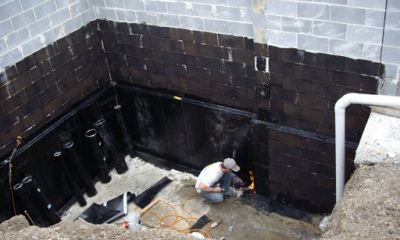
Covering the plinth’s exterior and interior, vertical waterproofing provides defense against soil and atmospheric moisture. Any of the materials mentioned above can be used; however, mixtures, coatings, and polymers are the most practical. Start at the base of the soil and work your way up to the wall’s beginning.
It is done in tandem with horizontal waterproofing, and the materials are carefully blended together at the intersection.
Technology of work from inside and outside
Complete moisture control is implemented both within and outside the base. Since there is a greater risk of water seeping into the basement surface from the inside while the business is operating, external insulation is more crucial.
Horizontal laying
Prior to laying the base, roll materials are placed on the foundation. How to prepare the coating at home:
- Level the surface, remove all debris, seal cracks and crevices with a connecting material.
- Cover the flat surface with bitumen mastic.
- Lay the roofing felt evenly, pressing it tightly to the mastic. Keep an overlap of about 20 cm, there should be no air under the coating layer.
- Melt the roofing felt at the joints with a gas burner, the seams are tight, without holes.
Vertical coating
Bitumen primer and bitumen mastic are required. Guidelines:

- clean the surface from dust and debris, level it;
- go over the surface with a primer (bitumen primer) so that the adhesion of the materials occurs successfully;
- when the primer has dried, apply the mastic evenly and uniformly – the first layer should dry completely;
- apply a second coat.
Mastic may crack after ten years or so due to temperature changes. It is essential to keep an eye on the situation and schedule repairs on time.
Vertical roll
To ensure a more dependable waterproofing layer, the coating is frequently paired with rolled masonry. Mastic, primer, and rolled roofing felt are required.
Method:
- Clean and level the surface.
- Apply primer and wait until dry.
- Apply the first even layer of mastic.
- Before joining roofing felt and mastic, heat the rolled material on a gas burner until soft. This way it will adhere better to the coating.
- Apply roofing felt overlapping, melt the seams using a torch. There should be no gaps left.
- For reliability, it is recommended to apply 2-3 layers of roofing material. Treat all joints with a torch or mastic.
Waterproofing can be added to a house that has already been constructed. The surface must first be thoroughly cleaned and then primed to remove any grease. Cover the top with facing materials (bricks or tiles) once all the layers have been applied sequentially. Countably handle joints.
However, injection waterproofing—which is done by skilled construction teams—is used more frequently. Once the base is complete, the solution is injected, fills the gaps, and solidifies.
Internal using mixtures
Inside the base, mixtures and primers are frequently utilized. They enter the coating’s microcracks, solidify there, and stop moisture from escaping.
Guidelines:
- Level the surface, degrease with primer.
- Moisten the surface for better penetration of mixtures.
- Apply penetrating material.
Adhesive primer (concrete contact) is used as a penetrating material appropriate for concrete plinth walls.
Compounds based on silicon are applied to bricks using a brush or roller. Plastering the surface is a prerequisite if you intend to coat the brick.
Possible process errors and ways to eliminate them
Typical errors
- External waterproofing is not done in advance. To do this after construction, when damage has already begun, it will be necessary to open part of the soil to the base of the base, drain groundwater (if it has reached the surface). Then clean off the damaged surfaces, strengthen them with reinforcement and cement. Apply waterproofing and cover with facing materials (or paint).
- Lack of cleaning, priming. These important elements of the technological process cannot be skipped. The fact that a mistake has been made will become known with the appearance of leaks or damage to the base. Waterproofing will need to be repeated on the finished building.
- Choosing low-quality materials. It is necessary to consider the conformity and possibility of interaction of materials in advance.
Cracks appear as a consequence of errors.
They are removed by filling the crack with primer and cleaning it from the inside out using an iron brush. Use bitumen mastic if the crevice is large. After that, cement is applied and allowed to dry completely before waterproofing the whole base.
Average prices for the country
The type of work determines the price. The average salary in Russian cities
| Type of work | Moscow, r/m2 | St. Petersburg, r/m2 | Regions, r/m2 |
| Vertical using roll materials, coating, penetrating | 650 | 600 | 500 |
| Injection | 4500 | 3400 | 3300 |
| Horizontal | 600 | 550 | 500 |
The complexity, volume, materials, and labor qualifications all affect the final cost.
This section contains everything you need to know about building a basement.
Video on the topic of the article
You’ll learn about waterproofing the basement from the following video:
A crucial first step in defending your house against structural problems, mold growth, and water damage is waterproofing your basement. You can maintain the structural integrity of your home and guarantee a healthier living environment by keeping moisture out. Waterproofing not only raises the value of your house but also shields it from future expensive repairs.
Your basement can be waterproofed using a variety of techniques, from exterior waterproofing materials to interior sealants. Installing sump pumps and coating walls with waterproof materials are examples of interior techniques for controlling water intrusion. These techniques are frequently simpler and less expensive, but they might only offer a short-term solution.
External waterproofing is the best option if you’re looking for a longer-lasting fix. This entails waterproofing the outside walls and excavating the area surrounding the foundation. By tackling the issue at its root, this approach provides long-lasting protection despite being more expensive and labor-intensive.
The best waterproofing technique will ultimately depend on your particular circumstances, including the amount of water damage and your financial constraints. Getting expert advice can help you choose the best course of action for your house. It will be worthwhile to invest the time necessary to properly waterproof your basement since it will ensure peace of mind and protect your investment.


