
Formwork is essential to the construction of strong, long-lasting concrete structures. Corrugated flooring is a creative and effective formwork element. Due to its strength, adaptability, and simplicity of use, this material has become more and more popular in the construction sector.
Known by other names like metal decking or corrugated sheets, corrugated flooring is composed of galvanized steel and has a ribbed, wavy surface. These sheets are frequently utilized as the foundation for concrete slabs in construction projects like bridges and buildings. A stronger, more stable structure is produced by the concrete’s improved grip and bonding due to the corrugated surface’s unique design.
The lightweight nature of corrugated flooring makes it a great choice for formwork. These metal-based sheets are lightweight and simple to handle and install, which saves labor expenses and construction time. Their resilience guarantees that they can tolerate large loads and inclement weather, which makes them a great option for a variety of construction projects.
Additionally, corrugated flooring offers outstanding design flexibility. It can be shaped and cut to fit a variety of architectural specifications, making inventive and effective use of available space possible. Because of its versatility and superior structural qualities, corrugated flooring is the go-to material for contemporary building techniques.
The quality and longevity of concrete structures are enhanced by the integration of corrugated flooring into formwork systems, which also helps to promote more economical and environmentally friendly building techniques. Materials like corrugated flooring are opening the door for creative and dependable building solutions as the construction sector develops further.
| Formwork Element | Corrugated Flooring |
| Definition | A structural element used in concrete construction to shape and support concrete until it hardens. |
| Purpose | Provides a mold for concrete and supports it to ensure stability and strength during the curing process. |
| Material | Typically made from galvanized steel or aluminum, featuring a ridged, wavy pattern for added strength. |
| Advantages | Lightweight, durable, easy to install, and provides excellent support and stability. |
| Applications | Used in floors, roofs, and other horizontal concrete structures in both residential and commercial buildings. |
| Installation | Laid out over structural supports, fastened in place, and then concrete is poured over it. |
- What it is?
- Scope
- Load capacity and dimensions
- Material requirements for the construction of monolithic reinforced concrete structures
- Advantages of profiled sheets
- Flaws
- Manufacturers and prices using the example of the h75 brand
- Video on the topic
- Load-bearing corrugated sheet for formwork/hangars/ceilings (plaque, corrugated sheet, corrugated sheet) corrugated sheet for pouring concrete
- Profiled sheet n75
- We fill the ceiling using corrugated sheets (not removable formwork), height 125mm
- Ceilings made of corrugated sheets #Overlap #Monolithic #Corrugated sheets
What it is?
One type of permanent formwork used in the construction of a lightweight span structure is corrugated sheet for floors. Based on the outcomes of two calculations—one for the installation period and the other for the operation period—the height of the corrugation is determined. Many public buildings, office complexes, retail establishments, industrial buildings, free-standing parking lots, and other real estate properties are constructed with corrugated sheet flooring.
The benefits of this design are as follows:
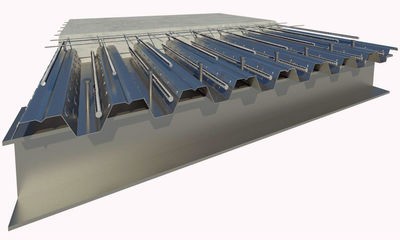
- When used, up to 30% savings in concrete are achieved due to the inclusion of corrugated corrugated sheets in the work – in this case, the protruding elements act as beams, which is why the floor is designed as a ribbed structure.
- Cold-deformed steel sheet serves as external reinforcement of the slab. This reduces the consumption of steel for the construction of the internal reinforcing frame.
- The minimum thickness of a standard monolithic floor cannot be less than 120-140 mm for structural reasons. In practice, slabs with a thickness of 160-240 mm are used, depending on the span and the perceived load. The profiled sheet makes it possible to create an average slab thickness of 70 mm, excluding corrugations. The mass of the finished structural element is reduced by 25-35%, which entails a reduction in vertical loads on walls, pylons and columns.
- Galvanized corrugated sheets do not require additional protection against corrosion and can be used in aggressive environments without destruction.
- When installing corrugated sheets as permanent formwork, there is no need to purchase or rent laminated plywood, which wears out during the construction of the building and is most often subject to disposal.
- Installation of the structural element is carried out much faster, compared to the installation of a conventional monolithic floor.
- The ceiling surface is ribbed, without drips, cracks, oil stains and uneven color. This allows you to beat the ceiling in the room in an industrial style.
Since raw concrete does not have the calculated bearing capacity for two to three days, you should first determine the pitch of temporary supports-posts before installing corrugated sheets for the installation period.
Scope
Corrugated floor sheets are frequently used in the construction of structures and buildings serving a variety of functions. Typically, span structures of the following kinds contain this kind of element:
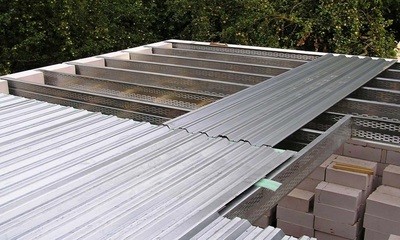
- As permanent formwork for all types of interfloor slabs. In this option, a successful combined use of galvanized sheet and reinforced concrete is achieved.
- As a covering arranged over metal mutually perpendicular beams. In such cases, the sheet acts as a base for the roofing pie.
- In some cases, corrugated sheeting with high corrugation is used as a load-bearing element of flooring along beams for the organization of mezzanines and floors, which are not subject to high load-bearing capacity requirements. In this design, an underlying layer of light and elastic material is placed on top of the profiled sheet, after which sheets of plywood or ACL are laid, forming a smooth surface.
Keep in mind that a cold-deformed sheet can only function along the corrugations when utilized as a stand-alone load-bearing element. Because of this, the designer must compute a beam scheme made up of a series of linear horizontal elements arranged perpendicular to the corrugated sheets.
Load capacity and dimensions
Only specific varieties of corrugated sheeting with higher strength and load-bearing capacity are utilized in the construction of load-bearing span structures. The following table lists the most widely used brands of profiled sheets with fundamental technical specifications that are used to install floors:
| No pos. | Brand profiled sheet | Full width, mm | Working width, mm | Height profile, mm | Thickness metal, mm | Weight 1m, kg | Load bearing capacity per 1 m 2, kN/m 2, at support spacing 2 m | Types coatings |
| 1 | NS 35 | 1060 | 1000 | 35 | 0.45-0.9 | 6.3-8.4 | 2.09-2.22 | Roofing, permanent formwork |
| 2 | NS 44 | 1070 | 1000 | 44 | 0.5-0.9 | 8.3-9.4 | 2.48-2.73 | Roofing, permanent formwork |
| 3 | N 57 | 960 | 900 | 57 | 0.5-0.9 | 5.4-7.3 | 2.9-4.10 | Roofing, permanent formwork |
| 4 | N 60 | 902 | 845 | 60 | 0.5-1.0 | 7.3-9.2 | 3.24-4.60 | Roof, permanent formwork, load-bearing |
| 5 | N 75 | 800 | 750 | 75 | 0.7-1.2 | 8.3-10.2 | 5.82-7.21 | Roof, permanent formwork, load-bearing |
| 6 | N 80 | 800 | 750 | 80 | 0.7-1.2 | 9.3-10.7 | 6.02-6.80 | Roof, permanent formwork, load-bearing |
| 7 | N 114 | 807 | 750 | 114 | 0.7-1.2 | 8.3-11.7 | 6.60-9.72 | Roof, permanent formwork, load-bearing |
The aforementioned indicators make it evident that using corrugated sheets with a corrugation height of less than 60 mm for load-bearing structures is not advised because their bearing capacity does not meet the specifications needed for buildings and other structures to operate safely.
The length of corrugated sheets that are shipped from the factory is determined by the production line’s technological capacity. Generally speaking, this indicator is restricted by transport dimensions; sheets that are 3.0-6.0 meters long are transported to the construction site.
Material requirements for the construction of monolithic reinforced concrete structures
Not all galvanized sheets that have undergone cold deformation can be used as permanent formwork when installing monolithic floor slabs. These elements must meet the following criteria:

- The height of the corrugation and the thickness of the metal must satisfy the calculation of the load-bearing capacity for the installation period – when laying raw ready-mixed concrete, no local deformations should occur.
- Sheets must have high corrosion resistance or have an appropriate protective coating to eliminate the risk of loss of load-bearing capacity during operation.
- The sheet must be selected to such a thickness that it has a fire resistance limit no lower than that of the concrete structure.
- The product must be of high quality without any manufacturing defects.
According to its functional purpose, the completed structure cannot be assigned the necessary class of responsibility for a capital structure if any of the aforementioned requirements are not satisfied.
Advantages of profiled sheets
There are numerous benefits to using galvanized profiled sheet as a stand-alone building material.
- Relatively low price compared to formwork elements for standard monolithic slabs.
- The galvanized surface is resistant to corrosion, which is why the service life of the sheets is up to 30 years or more.
- From the table above it can be seen that the material has a small mass per 1 m2 .
- Corrugated sheeting does not burn and does not emit toxic substances when heated.
- The material is presented on the market both in a technical version and with various powder coating options, which gives designers freedom when decorating the interior.
- Despite the reduced metal consumption, low weight and low cost, corrugated sheeting has an impressive load-bearing capacity (load-bearing capacity indicators are given in the table above).
- The structural element has an insignificant coefficient of linear thermal expansion.
Apart from their structural, functional, and aesthetic benefits, corrugated sheets are lightweight, easy to transport, and don’t require special storage conditions. They also take up less space when stored.
In contemporary construction, corrugated flooring is an essential formwork component because it gives concrete structures the support and shape they need while being durable and simple to install. This article examines the operation of corrugated flooring, its advantages over conventional formwork techniques, and useful advice for applying it successfully in a range of construction projects.
Flaws
The profiled sheet used for flooring has some drawbacks in addition to its benefits.

- When arranging a classic interior, a suspended ceiling is required, since upon completion of installation the steel corrugations remain visible.
- In the event of unexpected deformation, it is no longer possible to return the element to its original appearance.
- If the galvanized coating is damaged, thin steel quickly decomposes in a humid environment.
- Steel overhead may interfere with wireless communications.
In light of this, the property owner needs to be well-informed before investing in profiled sheeting for a ceiling installation.
Manufacturers and prices using the example of the h75 brand
The Russian market is home to numerous manufacturing companies that sell profiled flooring sheets. These businesses engage in open competition with one another.
Quality, adherence to GOST regulations, average cost of completed goods, and flexible pricing based on order volume, number of calls from a single client to the sales department, and other factors are the deciding factors. The following businesses are major players in the market (using the price of corrugated sheeting grade N75 as an example):
- "Neva-Stal", St. Petersburg. 600 – 900 rub/m.
- "Metal Profile", g. Lobnya, Moscow region. 700 – 1000 rub/m.
- "Orenburg Profmetal", g. Sol-Iletsk. 550 – 600 rub/m.
- PC "Metallregionstroy", Lipetsk region. 410 – 620 rub/m.
- "Profstalprokat", g. Tula. Price 600 – 800 rub/m.
- "Pokroff-Vostok", g. Pavlovsky Posad, Moscow region. 800 – 900 rub/m.
The type of surface powder coating, metal thickness, mass of one meter square, total order volume, and other variables all affect the product’s ultimate cost. You must get in touch with any of the above-mentioned suppliers and specify the specifics of the order in order to get a price quote.
In contemporary construction, corrugated flooring has shown to be an invaluable formwork element. Because of its strength and longevity, concrete structures are guaranteed to have adequate support throughout the curing process—a crucial step for maintaining the building’s overall integrity. Many construction projects, big and small, prefer it because of its versatility and ease of installation.
Furthermore, corrugated flooring’s light weight lessens the strain on the structure, enabling more creative architectural designs. Its adaptability to different forms and sizes without sacrificing functionality makes it more appealing. Because of its adaptability, it can be utilized in a variety of settings, including both commercial and residential complexes.
Because corrugated flooring is easy to install, builders can save money on labor and time by using it instead of other materials for formwork. Its reusable nature also supports environmentally friendly building solutions, which is in line with the growing emphasis on sustainable construction methods. In general, using corrugated flooring in building projects improves efficiency and sustainability while also enhancing structural integrity.


