
Protecting your garage’s structure and the belongings kept inside depends on making sure the roof is adequately waterproofed. Insufficient waterproofing can allow water to seep in and cause expensive damage, such as the formation of mold and deterioration of the structure.
The first step in making sure your garage roof is long-lasting and weather-resistant is selecting the appropriate waterproofing materials. There are many options available, each with benefits based on your needs, climate, and budget.
For waterproofing garage roofs, bitumen-based products, liquid waterproofing membranes, and synthetic rubber membranes like EPDM are frequently suggested materials. Different materials have different advantages, like weathering and UV resistance, durability, and ease of installation.
The effectiveness of your garage roof waterproofing depends on proper installation. It entails carefully cleaning, drying, and clearing the roof surface of any debris. A tight seal that keeps water out is ensured by correctly applying the selected waterproofing material in accordance with manufacturer guidelines.
- The need for roof waterproofing
- Types of coverage, selection criteria, prices
- Do-it-yourself styling features
- Features of cold roof insulation
- From concrete slabs
- Zhelezny
- Slate
- underground structure
- Sloping and flat
- Video on the topic
- Video on the topic
- How to use waterproofing material RIZOLIN on the roof
- Self-adhesive waterproofing. Advantages and disadvantages.
- Garage roof repair.Surfacing technique for rolled material.
The need for roof waterproofing
An enduring roof shields an automobile from outside moisture as well. After all, the majority of auto enthusiasts convert their garages into makeshift workshops and utilize a portion of the space for storing seasonal goods. As a result, a sizable amount of personal belongings are at risk of damage from ongoing exposure to extreme weather.
Important: The owners’ lives could be in jeopardy if the garage is linked to the electrical system.
The following are the unnoticed but equally hazardous effects of inadequate waterproofing:
- Dampness on the walls, gradually destroying the building material.
- The appearance of fungi and mold.
- Cracks in the flooring.
- Damage to wooden and corroded steel interior furnishings.
The garage structure itself will consequently experience excessive humidity.
What elements, particularly those that are unheated and poorly ventilated, will cause a garage roof to fail? This:

- Frequent rains and showers, typical for the entire continental and moderate continental climate zone of Russia.
- Heat damage due to prolonged exposure to direct sunlight and heat, not only in summer, but throughout the year.
- Gaps between garage door parts and walls, or between walls and the roof are “favorite” places for roof leaks.
- Absence or poor condition (clogging) of drainage.
The entire structure sustains damage initially from cosmetic leaks in the roof, and later from structural issues.
The presence of waterproofing coating minimizes the roof’s unintentional exposure to UV rays and outside moisture. Waterproofing materials function as a barrier, shielding the garage floor from damage and extending the life of the building.
If the garage’s walls are made of concrete, which is a porous material, waterproofing the roof will shield it from potentially damaging chemicals and moisture from the atmosphere.
Lastly, don’t overlook the purely aesthetic factor: black spots from ongoing water seepage can quickly make a garage appear unsightly.
Therefore, over time, waterproofing a garage roof is far more economical than a total renovation.
Types of coverage, selection criteria, prices
In order for your garage roof’s waterproofing to perfectly match its intended use, it needs to possess certain mechanical and physical characteristics.

- Elasticity. If the waterproofing layer laid on the roof of the garage is not capable of absorbing elastic deformations well, then with sudden changes in external temperature and humidity it will peel off and then collapse, even under relatively small loads.
- Moisture resistance. The material must have hydrophobic properties, repelling moisture and preventing even partial penetration into the thickness of the coating. This also applies to water vapor formed during sudden melting of snow or evaporation of water after heavy rain.
- Thermal resistance, which ensures a constant temperature inside the structure, and for unheated garages allows you to retain heat.
- Strength: the ability of a coating to withstand a given level of external loads, including impact, while completely maintaining its shape and integrity.
Membranes for waterproofing and polymers of the mastic type comprise the two categories into which the entire range of developed waterproofing materials is divided.
Sheet materials representing membrane waterproofing have a total thickness of no more than 3 mm. Such a waterproofing sheet is multilayered, with each layer hermetically joined to the next.
The following technical standards apply to PVC waterproofing membranes: GOST R 56704-2015
- Nominal sheet thickness, mm: from 1 to 3.
- Tensile strength at external pressure up to 60 kPa, MPa: 8.
- Maximum permissible stretch during elongation,%: 200.
- Ultimate temperature resistance, 0С: -30…+120.
- Water resistance at maximum external pressure, h: 24.
- Resistance to aggressive environments, h: 30.
Since the material is non-toxic, welding is used to join adjacent sheets.

Roll material comes in lengths of up to 60 meters and roll widths that range from 1 to 15 meters.
This type of waterproofing coating is not afraid of thermometer readings between -60 °C and +120 °C because it can be used in a fairly wide temperature range.
In addition, PVC waterproofing lasts for 40–50 years and can withstand extended exposure to UV radiation. The base doesn’t need to be specially prepared.
The entry of outside moisture into the garage is prevented by the application of PVC-based membrane waterproofing. As a result, the room won’t contain an excessive amount of water vapor, which encourages the growth of processes that lead to wall deterioration. Cons: The material loses its flexibility in cold weather, and the price is expensive, ranging from 1200 to 1400 rubles per square meter.
Roofing waterproofing GI-K, a rolled material based on asbestos that is impregnated with bitumen containing oil during the manufacturing process, is thought to be an alternative to polymer waterproofing.
Under GOST 7415-86, the technical specifications for waterproofing are established.
- Ultimate tensile strength, N, not lower: 294.
- Daily water absorption,% by weight, no more than: 20.
- Ultimate temperature resistance, 0С: -20…+50.
- Flexibility, calculated in the number of bends before failure, not less than: 20.
- The highest pressure that does not affect water resistance, kPa: – 1.
The relatively low allowable external pressures, fire hazard (because bitumen is a component of the composition), and toxicity—which is demonstrated by the release of dusty asbestos particles during roll cutting—are the drawbacks of waterproofing. However, the material’s price does not go beyond 450–500 rubles per square meter. Adhesive mastics are used to join adjacent rolls.
The following kinds of polymer moisture-resistant mastics are used to arrange garage waterproofing:

- Polymer, which are characterized by the durability of their protective characteristics, heat resistance and elasticity, which is almost completely preserved over a wide temperature range.
- Bitumen-latex, characterized by a shorter drying time and good adhesion to all types of roofing coverings. Resists well to external temperature influences, including solar radiation.
- Rubber-bitumen, the scope of which is the process of complete replacement of waterproofing on the roof of a garage.
Mastics have the drawback of typically not being appropriate for direct use. The majority of brands contain two ingredients that must be combined right before use, giving them a short window of useful life.
Because mastic compositions have a higher viscosity, they are applied uniformly across the surface of the treated roof. These materials range in price from 200 to 400 rubles per kilogram.
Do-it-yourself styling features
Any consumer can install sheet waterproofing membranes; it’s not a difficult task. The guidelines that follow must be adhered to:
- It is mandatory to have ventilation gaps that are provided between the upper plane of the main coating and the waterproofing layer. Such gaps must be at least 20…25 mm, so the waterproofing coating is installed without tension.
- The layers are laid with an overlap, with an overlap of at least 40…50 mm. Typically, manufacturers of these products mark the boundary laying zones, which makes installation of the coating easier.
- To connect PVC-based membranes, industrial hair dryers are used that develop temperatures up to 500…5500C. The quality of the connection will improve if the areas to be joined are treated with a neutral cleaner. If this equipment is not available, it is acceptable to use construction tape.
The increased thickness of the rolled material explains why waterproofing installation is more difficult.
- As in the previous case, the surface to be laid is cleaned of dust and dirt.
- Then an adhesive melt is prepared from bitumen and resin, which, as the work progresses, is poured under the roll.
- Next comes rolling of the roll, carried out with a steel roller or wide roller.
- After setting, the excess is removed with a scraper or roofing knife.
Following the installation of the waterproofing’s main surface, steel brackets—which must be composed of stainless steel or anodized aluminum—are used to join the sheet’s edges to the garage roof’s primary material. It makes sense to use a construction stapler to connect.
An arrangement of garage roof waterproofing that is more flexible, albeit labor-intensive, is to use waterproofing mastic. It can be applied with a brush or roller in a single, continuous layer.

Using a spray bottle, whose design enables you to spray liquid compositions with higher viscosity, will make the process more efficient.
The sections of the garage roof that are close to ledges or corners are not appropriate for using a sprayer to apply mastic to.
It has to be done again after the first layer of mastic has dried completely. In addition to applying a waterproofing coating, waterproofing mastic can be used to make small repairs to existing waterproofing where small cracks or peelings have been found.
When sheet membrane materials are used to cover the majority of the garage roof and mastics is used to waterproof areas with intricate configurations, a combined method is also employed.
Lately, polymethyl methacrylate and polyurethane-based cold-installed waterproofing compounds have become more and more popular. They can be used on all kinds of flat or sloped roofs because they are long-lasting and simple to install.
Features of cold roof insulation
There are several materials that can be used to build garage roofs. Let’s examine garage roof insulation for various roof types.
From concrete slabs
Due to concrete’s operational durability, concrete roof installations on garages are becoming more and more common. But because of its porosity, the material is also prone to deterioration. This shortcoming will be partially offset by a waterproof coating.
You must take the following actions in order to independently waterproof a concrete roof:
- Clean the coating from dirt and debris.
- Repair minor identified damage in concrete, for which you can use silicone sealant. It is recommended to smooth out the applied composition with a spatula. At the same time, press the silicone into the damaged area and allow it to dry completely.
- All seams are carefully closed with seam tape, for which you can use construction tape.
- A layer of primer is applied to the entire surface of the roof, if necessary – in two layers (only after the first one has completely dried!).
- Using a paint sprayer, cover the surface with a vapor barrier primer. It should be processed systematically, from one end of the roof to the opposite. Overlap the previous line every time you start a new one. Allow the vapor barrier to dry before applying a second coat.
Any weather-resistant paint can be applied to the formed surface to enhance its appearance.
Zhelezny

Such coatings are most susceptible to corrosion in locations where connecting fasteners are positioned. The truth is that the holes should be waterproofed by rubber washers placed beneath the bolt heads.
You will need to replace each bolt one at a time if this was not done at the time, or if fasteners made of regular carbon steel were installed.
If there is joint leakage, there was probably not enough overlap—at least two corrugations. When condensation builds up at the joints or microdamage is observed in the steel sheets, waterproofing will also become necessary.
The first step in waterproofing is to completely disassemble the steel covering. Then, a sheet of low-density polyethylene with anti-corrosion and thermal stabilization additives, and a minimum thickness of 16 mm, is placed on the exposed surface in compliance with GOST 16338-85. The profiled flooring is then installed.
If the waterproofing is being installed for the first time rather than being replaced, it is preferable to use steel or aluminum sheets with a plastic coating in place of standard steel sheets. These sheets can have a box shape rather than be flat.
Painting the steel roof with bitumen paint is a less ideal solution because, while it is undoubtedly waterproof, it is also vulnerable to thermal influences, including solar UV radiation.
Slate
To stop water damage to your slate roof, do you need to waterproof it? Slate tile installation is the best choice. The following are the material’s benefits:
- Almost absolute waterproofness (water absorption rate – no more than 0.4%).
- Extremely low coefficient of thermal expansion, which is especially important during sudden warming or cooling.
- High durability.
Since slate is a fairly brittle material, precautions are taken to keep broken branches, stones, and other objects from falling onto the garage roof while the slate is being installed.
Installing slate tiles on pitched roofs with an angle of 200 degrees or more is the only way to fully enjoy all of their benefits.
When installing a traditional slate roof, the joints should be treated with any hydrophobic mastic at the same time.
underground structure
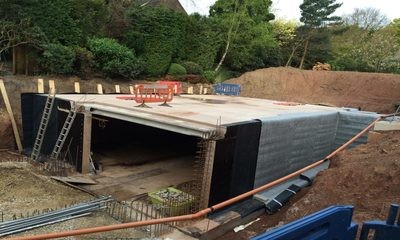
The walls below ground level need to be made waterproof because the moisture in the soil pushes the walls and foundation upward due to hydrostatic pressure, even though the above-ground portion of the structure needs to be weatherproofed.
An underground garage’s waterproofing is a concern from the very beginning of design.
The space is dug out to the necessary depth, formwork is erected around the pit’s edge to keep the surrounding dirt in place, and waterproofing is put in place before the garage’s concrete walls are built. It will thus be challenging to fix any errors.
Prior to beginning the process of correcting improper waterproofing material installation, internal leaks must be fixed in an underground garage that already exists.
Roof supports, reversible slopes, and any gaps in the flashing where the top edge of the flashing meets the exterior walls above can all allow moisture to enter a garage. These locations ought to all be recognized. Please be aware that liquid and discolored garage walls could be signs of moisture entering the garage.
If the damp spots are limited, the issue can be resolved by adding more plaster to the affected area using formulations that contain crystalline waterproofing material. This material can be purchased separately or as a suitable supplement to traditional plaster.
Use the crack injection method if there is a substantial amount of moisture on the walls. Small diameter holes are drilled into a concrete wall by specialized companies as part of this type of waterproofing. After that, urethane or epoxy is injected there. It seals channels where water can enter by filling voids and pores.
Sloping and flat
When coating the roofs of flat garages, Applying liquid rubber to the surface is advised; alternatively, bitumen-latex mastic can be used. The substance readily clings to the base coating and is neither toxic nor combustible. Nonetheless, the roof needs to be initially prepared, and this is done in the following order:
- Applying a vapor barrier (rolled material is used as a membrane).
- Laying thermal insulating polystyrene foam covering.
- Performing screed followed by priming.
- Formation of the actual waterproofing coating.
Liquid rubber operating parameters are chosen in accordance with TU 5775-001-84364322-2014.
Sheet material, such as PVC sheets (whose characteristics and methods of installation have already been discussed), is utilized to waterproof pitched roofs. It is important to align the direction of the sheets and their overlap to prevent moisture buildup in the spaces between them.
Video on the topic
Watch the video to learn how to waterproof a flat garage roof:
| Material | Installation Tips |
| EPDM Rubber | Clean the roof surface thoroughly, apply adhesive, and carefully roll out the rubber sheet, ensuring there are no bubbles or wrinkles. |
| Modified Bitumen | Use a torch to heat the adhesive side of the bitumen and press it firmly onto the roof surface, overlapping seams by at least 3 inches. |
| Liquid Waterproofing Membrane | Apply with a roller or brush in thin, even layers, allowing each coat to dry completely before applying the next one. |
| Roofing Felt | Secure the felt with roofing nails or staples, overlapping each sheet by at least 2 inches, and seal the seams with roofing cement. |
| PVC Membrane | Unroll the membrane over the roof, secure with screws and plates along the edges, and weld the seams with a hot air gun for a waterproof seal. |
It is essential to make sure your garage roof is adequately waterproofed in order to safeguard your possessions and preserve the integrity of the building. Leaks and water damage can be avoided by choosing the appropriate materials and installing them correctly, which will ultimately save time and money on future repairs.
There are numerous efficient waterproofing materials on the market, such as bitumen sheets, rubber coatings, and liquid membranes. Every option has benefits, so when choosing one, it’s critical to take your unique requirements, financial situation, and local climate into account. For your garage roof, do your homework and choose a material that will provide dependability and durability.
Selecting the appropriate material is not as important as installing it correctly. Make sure to apply the waterproofing material according to the manufacturer’s instructions and best practices, whether you choose to do it yourself or hire an expert. This guarantees a weather-resistant, sturdy seal that is safe to use.
In conclusion, investing the time necessary to properly waterproof your garage roof will safeguard your investment and give you peace of mind. You can choose a solution that will guarantee your garage stays dry and functional for many years by being aware of the materials that are available and the installation methods that work best for you.
We look at the best supplies and techniques in our guide on waterproofing a garage roof to keep your garage dry and free of leaks and water damage. We dissect the benefits of well-liked solutions like EPDM rubber and bitumen membranes, describing how each works best for various kinds of roofs. Step-by-step installation instructions are provided so that even do-it-yourselfers can create a sturdy and waterproof garage roof. This post provides you with useful advice on how to protect your garage from the weather, regardless of whether you’re building from scratch or remodeling.


