
Selecting the ideal plot of land is one of the first choices you’ll have to make when creating your dream house. What kind of house you can build and how much room you’ll have for landscaping and outdoor activities depend greatly on the size of your plot.
Understanding the dependable minimum and maximum dimensions for a land plot is crucial, regardless of whether you’re designing a small cottage or a large estate. These measurements may change based on your preferences, the kind of home you wish to build, and local laws.
We’ll go over the important things to think about in this post when figuring out how big your land plot should be. From building codes and zoning regulations to useful factors like garden area and privacy, we’ll give you the knowledge you need to make an informed choice.
| Land Plot Dimension | Description |
| Minimum | Usually, the minimum size for a land plot for individual housing construction is around 300 square meters (0.07 acres). This allows for a small house and some outdoor space. |
| Maximum | There is no strict maximum size, but plots over 10,000 square meters (2.5 acres) are uncommon for individual homes. Large plots allow for extensive landscaping, gardens, and additional structures. |
It is essential to have a solid understanding of the maximum and minimum dimensions of a land plot when designing individual housing construction. This information guarantees effective use of available space, conforms to zoning regulations, and provides for required amenities. We’ll look at the ideal plot sizes, taking into account both the necessities of daily life and the requirements of the law, to assist you in making well-informed choices for a practical and cozy home design.
- Regulations and rules
- Plot area
- Minimum
- Limit
- Construction standards
- Useful video
- Video on the topic
- DIVISION OF A LAND PLOT into two or more, as well as shared ownership and with a HOUSE. What is important to know?
- How I increased the area of my land plot by 5 acres
- in Russia, the maximum volume of private houses is expected to be commissioned – over 70 thousand. m² #house #izhs #russia
- Minimum distances from the boundaries of a land plot. #fence #construction #construction #privatehouse
- What you need to know when dividing a land plot
Regulations and rules
The Russian Federation’s Land Code establishes the minimum and maximum dimensions of a single building plot for residential purposes.
Depending on who owns the land, executive authorities set specific sizes:
- for areas in federal ownership, standards are established in accordance with federal laws;
- regional laws apply to lands in regional ownership;
- the sizes of municipal land plots are regulated by municipal regulations.
Such land regulation is reasonable and completely compliant with the state’s territorial policy.
Unlike territories in a state of development (e.g., the Far East), it is impossible to allot large plots of land to everyone in the conditions of dense urban development or on federal lands.
Plot area
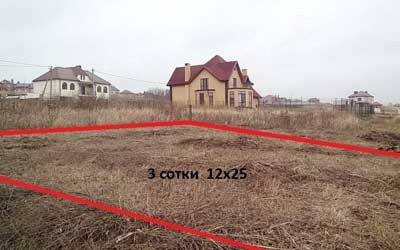
There are values below or above which it is impossible to "rise" or "fall," even though each region and municipality has its own maximum values of land plots allotted for residential development.
Therefore, a plot with the status of individual housing construction cannot be smaller than 3 acres in order to be used for the construction of a residential building.
Such a plot will not be registered by the state authorities, represented by Rosreestr, even if the developer is prepared to "huddle" on a smaller area.
The process of getting building permits will also present challenges. Consequently, consider their minimum size when searching for affordable and small lots of land for building.
The maximum size of a single housing construction plot varies greatly depending on the Federation’s subject and even the locality. Although 30 acres is the national average, more detailed data must be collected for each locality or region separately.
Plots that are larger than what is allowed will also make it impossible for the state to register them.
You have to become acquainted with the rules that apply in your area in order to avoid making a mistake and select the appropriate site. The simplest method is to speak with your local government representatives and obtain the information you require directly.
In addition, you can look up relevant legislative acts related to your area, region, or locality online:
- In the search bar of your browser, you must enter the request “Land Use and Development Rules” and the name of the locality or region, region
- In the document that opens, look for an article whose title includes the phrase “parameters of permitted construction”. You will find the information you need about the maximum size of individual housing construction plots there
Please take note that the numbers provided for zones g1 (low-rise buildings with individual houses) should be of interest to you.
Minimum
Three acres is the minimum amount of land required for a single residential development. The following criteria were used to establish this general indicator for Russia:
- sanitary and hygienic requirements for the distance between residential buildings on border plots of land (SNiP 31-02-2001);
- distance from the house to the fence;
- from house to street (red line).
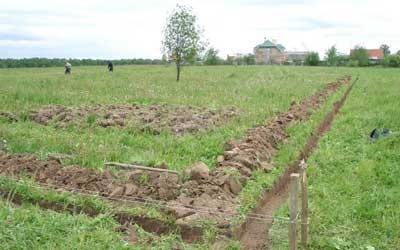
In addition to assessing whether a residential building can be constructed, the minimum plot size is considered in the event that the landowner wants to split his one large parcel of land into multiple plots.
Dividing a 6-acre plot into two equal shares, for instance, won’t work if the minimum indicator for individual housing construction in your area is 4 acres.
Since every region or municipality sets its own regulations, the general minimum indicator for the size of a single housing construction plot is essentially never used in actual construction.
Let’s use the most well-known regions of Russia as an example to discuss the minimum areas of land plots.
| Name of the territorial object | Minimum area (in acres) |
| Moscow | Not installed |
| Moscow region | 4 |
| Saint Petersburg | 3 |
| Leningrad region | 6 in cities, 10 in villages |
| Novosibirsk | 6 |
| Ekaterinburg | 4 |
| Krasnodar region | 4 |
Limit
Only when state or municipal land is given to citizens for free is there restriction on the area of a land plot meant for residential development. There are no limitations if you buy a plot of land with your own money.
The following factors are considered when calculating the portion of the site set aside for residential development:
- the presence of free sites in a particular subject of the Federation;
- the demand of the population for land;
- marital status of the applicant and the presence of dependents;
- project of the future residential structure and t.D.
| The name of the territorial facility | Maximum area (in hundreds) |
| Moscow | Not installed |
| Moscow Region | thirty |
| Saint Petersburg | 15 |
| Leningrad region | 25 |
| Novosibirsk | 10 |
| Ekaterinburg | 25 |
| Krasnodar region | 10 |
Construction standards

All SNiP requirements must be followed on the current land plot in order for the future residential building to comply with current building standards and regulations.
For various kinds of land plots and buildings and structures, different standards have been developed.
If the municipality has given you a piece of land at no cost, you will need to consider the following when building:
- Residential development should not occupy more than 30% of the total area of the plot – with a minimum land plot size, your house should be no more than 90 square meters. m., the larger the plot of land is provided, the more spacious the house the developer can afford.
- On a plot of no more than 12 acres, it is allowed to build only one residential building (this requirement does not apply to the number of outbuildings).
- A residential building cannot be located closer than 5 m from the street (“red line”) and 3 m from the side passage.
- It is important to comply with the requirements of SNiP 30-02-97 in relation to neighboring boundaries, residential and outbuildings:
- between residential buildings – a distance from 6 to 15 m, depending on the combination of materials for the supporting structures of buildings;
- from the house to the boundary between neighboring plots – at least 3 m;
- from outbuildings to the plot boundary – not less than 1 m.
You won’t have any issues registering your property rights to real estate if you can construct a home on a minimum-sized plot of land while keeping in mind all of these specifications.
Useful video
Watch this educational video to learn the correct way to plan buildings on a plot and what mistakes to avoid.
A successful project depends on determining the proper dimensions for a land plot used for individual housing construction. Whether you’re searching for a small lot in an urban setting or a roomy yard for a garden, it’s important to take your needs and the laws in your area into account. Maximal and minimum dimensions are important to make sure you can construct a cozy, useful house.
Make sure there is adequate room for the house, utilities, and any desired outdoor areas when determining the minimum size. Balance is important because a smaller plot may restrict how big your home can be or how much outdoor space you can use. Furthermore take into account the ease of access to infrastructure and necessary services, as these factors may affect the viability of a smaller plot.
Larger plots allow for the freedom to build elaborate gardens, outdoor living spaces, or other structures for those who like more room. But keep in mind that larger lots could require more money for upkeep and development. Adherence to zoning laws and building regulations is crucial, as they have the potential to limit the maximum size of your property.
The size of your ideal land plot ultimately depends on your needs, budget, and lifestyle. Whether you choose a small, comfortable lot or a larger one, careful planning and attention to local regulations will help guarantee that your custom home building project is both doable and enjoyable. You can design a home that satisfies your needs and fits comfortably in the designated space by finding the ideal balance.


