
Because of their strength and adaptability, asbestos cement sheets have long been a mainstay in the building sector. These sheets are frequently utilized for siding, roofing, and other purposes. Asbestos cement sheets are still used in some areas and for some purposes, even though asbestos is a known health hazard. Making wise choices for building and remodeling projects requires an understanding of the various kinds of asbestos cement sheets and their attributes.
Asbestos cement sheets come in a variety of forms, each intended to satisfy a particular set of requirements and tastes. Every type of sheet has its own advantages, from corrugated sheets that are frequently used in roofing to flat sheets that are used for walls and ceilings. These sheets are well known for their durability, resistance to fire, and capacity to tolerate inclement weather. They are available in different thicknesses and sizes to meet a range of construction needs.
Although health concerns have led to a significant decrease in the use of asbestos in building materials, asbestos cement sheets are still used in many parts of the world. Understanding the safety precautions and rules pertaining to their use is crucial. Builders and renovators can better navigate their options and ensure safe, effective application in their projects by understanding the features and types of asbestos cement sheets.
| Type | Characteristics |
| Standard Asbestos Cement Sheet | Commonly used for roofing and wall cladding; known for its durability and resistance to weather conditions. |
| Textured Asbestos Cement Sheet | Features a rough surface that enhances grip and provides a decorative finish; often used in exterior applications. |
| Corrugated Asbestos Cement Sheet | Has a wavy surface that adds strength and flexibility; frequently used for industrial and agricultural buildings. |
| Flat Asbestos Cement Sheet | Smooth and even surface, ideal for applications requiring a clean finish; used in both residential and commercial settings. |
- Asbestos cement sheets: advantages and disadvantages
- Types and technical characteristics
- Sheathing device
- Slate installation
- Useful video
- Video on the topic
- Asbestos cement board ACEID GOST 4248-92. Application and technical characteristics
- Lifehack asbestos-cement flat sheet.
- Slate is different from cement particle board, Novosibirsk. 89039016921
- Characteristics and prices for slate in the Megastroy Yaroslavl store
- Chemistry – Simple: types of asbestos and their effects on the body
- What you need to know about roofing materials. TYPES AND THEIR FEATURES.
- How to choose bituminous shingles.
Asbestos cement sheets: advantages and disadvantages
Numerous benefits account for the high demand for asbestos slate:
- Sustainability to exposure to sunlight.
- Fire resistance.
- Low electrical conductivity.
- Cheapness.
- good sound insulation.
- Corrosion resistance.
- Sustainability to the effects of alkalis.
- Ease of installation, maintenance and repair of asbestos-cement roofing.

Benefits of slate made of asbestos
Additionally, there are drawbacks to asbestos cement that emphasize the need to choose more modern, high-tech alternatives.
- Relatively short service life, averaging 20-30 years. But it depends on weather conditions and the quality of roof maintenance. In a dry climate, with regular replacement of damaged slabs and painting of slate, the material can last 40 years.
- Fragility: under impact impacts and deformations of the sheathing, the sheets crack and crumble.
- Heavy weight: It is difficult to install slate slabs on the roof alone; you need help from other people.
- Harm to the environment. Amphibole asbestos is recognized as a toxic carcinogen. Asbestos-cement slate releases more and more asbestos dust into the air over time, poisoning it. Proper roof painting allows you to minimize emissions.
There is no scientific evidence to support the harmful effects of chrysotile asbestos. However, it is harder to locate on the market; the amphibole variety is more common.
Types and technical characteristics
Asbestos cement sheets come in two varieties: wavy and flat. Pressed and non-pressed flat materials are distinguished, and the number of waves varies among profiled sheet types.
Pressing sheets of asbestos-cement improves the material’s technical properties. During the production process, pressed flat sheets are further compacted, increasing their weight, density, bending strength, and resistance to frost.
| Asbestos cement sheets: characteristics | Pressed sheet | Unpressed |
| Bending strength, MPa | 23 | 18 |
| Thickness, mm | 3600, 3000 and 1200 | 3600, 3000 and 1200 |
| Width, mm | 1500 and 1200 | 1200 and 1500 |
| Thickness, mm | 6, 7, 8 and 10 | 6, 7, 8 and 10 |
| Density, g/cm 3 | 1.75 and 1.8 | 1.6 and 1.7 |
| Number of defrost and defrost cycles | 50 | 25 |
The table shows that while the dimensions of pressed and unpressed sheets are the same, the density, strength, and durability of the materials vary.
Pitch roof installation is complicated by the need for correct arrangement and reinforcement of overlaps, so flat sheets are not used for this purpose. This region uses a lot of corrugated asbestos-cement slabs. There are five, six, seven, and eight wave profiles of asbestos-cement slate available.
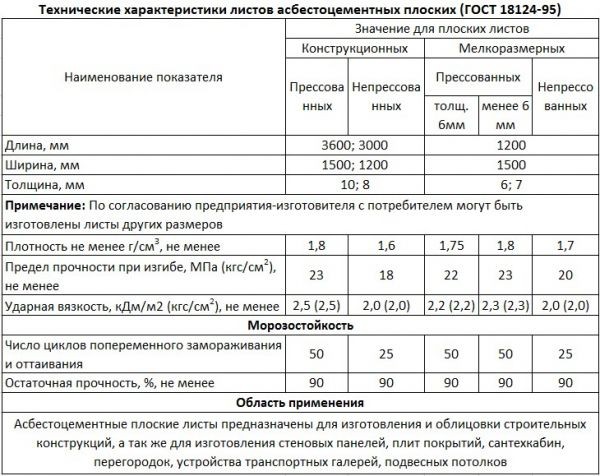
GOST 18124 95 flat-pressed asbestos cement sheet
The 7- and 8-wave varieties are the most widely used. The width of asbestos cement corrugated sheets varies: a 7-wave sheet’s dimensions are 980 mm, while an 8-wave sheet’s dimensions are 1130 mm. The other parameters are nearly the same.
Dimensions of asbestos cement sheets:
- Length: 1750 mm.
- Thickness: 5.8 mm.
- Bending strength: 16 MPa.
- Density: 1.6 g/cm3 .
- Number of freezing cycles: 25.
- Weight: 26.1 kilograms according to GOST, weight of asbestos-cement sheet per m2 – 10.47 kg.
The dimensions of a sheet’s length, width, and thickness may differ slightly based on the manufacturer, as the information above only outlines the common requirements of state standards.
Sheathing device

For corrugated asbestos cement sheets, lathing needs to be sparse; ideally, there should be 50–70 centimeters between the boards. This lathing is used to arrange structure bars with a 50 x 50 mm cross section.
Using wood screws or regular nails, the sheathing is fastened to the rafter legs once it has been laid out.
Three times the board thickness should be the length of the fasteners.
The best buildings are crafted from larch and pine. The humidity of these wood species is low. The bars are treated with an antiseptic solution prior to the sheathing installation in order to guard against rot and fungal invasion.
The heights of the even and odd boards in the sheathing should vary. Installing odd elements raises even elements by 4–6 mm. By doing this, you can prevent the slate sheets from warping while being installed.
Installing the sheathing involves going from the roof’s overhang to its ridge. A stretched cord is used to align elements that extend past the overhangs, and excess length is cut off of the boards along its path.
Because of the greater load on the sheathing in these regions, the boards are laid closely, even in sparsely populated areas, along ridges and valleys.
Following the installation of the main structure, frontal boards are put in where the overhangs are, gutters are installed, and the overhangs and gables are covered with clapboards.
For flat slate, the sheathing needs to be continuous. Its construction is done with edged boards covered in a solid carpet. Plywood sheets can be used in place of edged boards.
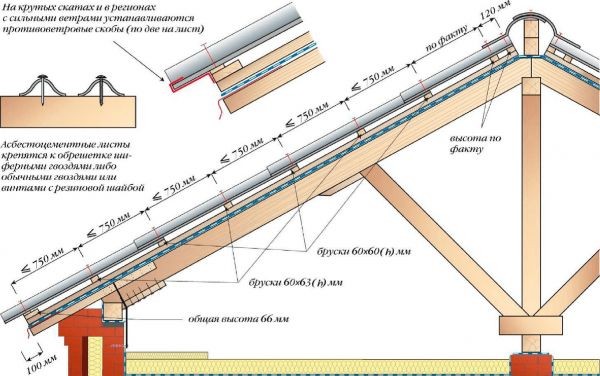
Slate installation
Determine how much material will be needed before you begin. This is accomplished by multiplying the slopes’ length and width, dividing the result by the area of a single sheet, and then multiplying the result by 10%. The reason for this premium is that the slate is laid in layers. The following plan is followed when installing asbestos-cement corrugated sheets on the roof:
- Painting asbestos-cement sheets increases their operational potential. The first layer of paint is applied before installing them on the roof, the second layer is applied after the installation of the roof is completed.
- The overlap between the sheets in the horizontal plane is equal to one or two waves. The second option requires more money, but it increases the reliability of the design.
- The slate is attached to the sheathing using special screws or self-tapping screws, characterized by a larger cap compared to standard products and the presence of a rubber lining under it. This design of the elements is due to the requirements for waterproofing the fastening areas.
- Holes for fasteners are marked and drilled in advance before laying slate on the roof to avoid damage to the material during its installation. The diameter of the holes must exceed the diameter of the fasteners by 3 mm. The installation locations of screws or self-tapping screws should alternate from the lower corner of one wave to the upper cavity of another wave. The sheet is fixed, as a rule, at three points: along the edges and along the center line.
- Since slate is a heavy and fragile material, safety precautions must be observed when installing it. It is most convenient to lift asbestos cement sheets onto the roof using a system of blocks and a nylon cable. If the work is carried out on a low building, then you can get by with the help of other people without constructing such structures. Wooden scaffolds with steps are mounted on top of the roof – this will allow you to move along the roof and carry out repair work.
- More detailed diagram installation is shown in the video below.


How to properly trim corners
Useful video
Watch the video to learn the insider tips for installing asbestos-cement sheets:
Everybody involved in building or renovating must comprehend the various kinds of asbestos cement sheets and their properties. These materials’ affordability, fire resistance, and longevity have made them important components of construction projects for many years.
It’s important to understand the health risks that come with asbestos exposure, even with its benefits. In order to guarantee safety, asbestos cement sheets must be handled, installed, and disposed of properly. Although there are now a lot of safer options thanks to modern developments, it’s still crucial to understand how to handle asbestos cement that already exists.
Making educated decisions about the types and characteristics of asbestos cement sheets is made easier as we transition to safer and more environmentally friendly building methods. When it comes to building new projects, remodeling existing ones, or maintaining older ones, this knowledge guarantees that durability and safety come first.
There are several varieties of asbestos cement sheets, and each has special qualities that allow it to be used for a variety of building applications. These sheets are a popular option for siding, roofing, and other building applications because of their strength, fire resistance, and insulating qualities. Even though they have advantages, it’s crucial to handle and use them properly because asbestos exposure poses health risks. For your construction projects, knowing the distinctions between the types and their particular applications can help you make wise choices.


