
The quality of screed mortar you use is important when doing outdoor construction projects like laying a patio, driveway, or garden path. The base layer that gives the surface stability and durability is composed of outdoor screed mortar. A solid and long-lasting foundation can only be ensured by carefully measuring and adhering to the preparation guidelines.
Three essential ingredients are usually found in outdoor screed mortar: cement, sand, and water. Depending on the particulars of your project, like the kind of surface you’re building and the weather it will withstand, the ratios of these elements may change. The right mixture guarantees that the screed mortar sets correctly, adheres well, and can effectively withstand outdoor elements.
The ratio of cement to sand is one of the most important factors to take into account when making outdoor screed mortar. The strength and workability of the mortar are determined by this ratio, which makes it crucial. One part cement to three parts sand (1:3 ratio) is a typical ratio. Cohesion and flexibility are provided by this mixture, which strikes a balance between the cement’s binding qualities and the sand’s granular texture.
Another essential ingredient for making outdoor screed mortar is water. It does this by activating the cement and enabling the mortar to be blended into a consistency that is workable. Water additions should be carefully monitored; too little can make the mixture difficult to apply and compact, while too much can weaken it. Attaining the ideal equilibrium guarantees that the mortar solidifies appropriately and reaches the intended strength.
Outdoor screed mortar preparation calls for a methodical approach. First, mix the dry ingredients (sand and cement) according to the recipe. Stir them well until they are evenly colored, taking care to avoid any lumps or uneven dispersal. Next, add water a little at a time while continuing to mix until you have a moist but not too wet consistency. When applied, the mortar should spread readily and maintain its shape when shaped into a ball.
You can make sure that your outdoor screed mortar is appropriate for the job by knowing the component proportions and using the right preparation methods. The longevity and stability of your construction project can be greatly enhanced by taking the time to properly prepare the mortar, whether you’re installing a new patio, pathway, or any other outdoor surface.
- What does the concept mean??
- Regulatory quality control
- Material characteristics
- Performance Requirements
- Tips for choosing a brand and class
- Class
- Brand of screed
- Waterproof grade
- Abrasion indicators
- Why is it important to choose the right ingredients??
- Outdoor components
- Basic
- Cement
- Sand
- Crushed stone
- Water
- Additional
- Epoxy two-component resins
- Modifying additives
- Antifreeze components
- Hydrophobizing additives
- Proportions and calculation example
- Tools for preparing the mixture
- Step-by-step instructions for kneading
- Possible difficulties and errors
- Average expenses in the Russian Federation
- Video on the topic
- Screed mortar. Semi-dry screed.
What does the concept mean??

The primary building material used to screed concrete floors on streets is mortar, which is made up of fine and coarse aggregates (crushed stone and sand), a hydraulic cement binder, and a variety of plasticizers, antifreeze, and modifying additives.
Depending on the degree of mobility, the solution is either liquid or plastic. It is then poured into a formwork that has been previously prepared, layered on top of a compacted sand-gravel mixture and a fixed mesh of steel reinforcement that is protected to the necessary extent at the bottom of the screed slab.
Due to the presence of waterproof polymer components, the solution for concrete floor screed on the street has high strength characteristics, increased resistance to temperature changes, and water resistance. Additionally, the presence of plasticizers lengthens the binder components’ setting period by two to three times.
Regulatory quality control
The following regulatory documents, which are in effect throughout our nation, set forth requirements for the primary attributes and chemical makeup of concrete floor screed mortar on the street:
- SP 71.13330.2017. Insulating and finishing coatings.
- GOST 13087-2018. Concrete. Methods for determining abrasion.
- SP 63.13330.2018. Concrete and reinforced concrete structures.
- GOST 26633-91 Heavy and fine-grained concrete. Specifications.
- GOST 31489-2012. Garage equipment. Safety requirements and control methods.
- SP 29.13330.201.1. Floors.
- GOST 30459-2008 Additives for concrete and mortars.
- GOST 27006-86 Concrete. Squad selection rules.
- SP 34.13330.2012. Car roads.
Only the regulatory documents mentioned above are used as the basis for production of concrete ingredients by all officially registered businesses, which are used to screed outdoor floors. Every individual producer creates their own formula and creates technical specifications (technical conditions).
Prototypes are taken out of each batch and put through regular testing on lab benches based on the material’s manufacturing results. The manufacturer receives a certificate of conformance to the specifications, enabling him to issue an official quality certificate for each product unit, as long as the necessary strength and other performance characteristics are met.
Material characteristics
Certain technical characteristics are established for each type of concrete based on carefully chosen basic and additional ingredients. These characteristics enable the creation of a structure that satisfies all operational requirements:

- The main characteristic of concrete is its compressive strength class, which for outdoor floor screeds should vary from B20 to B30 or more, provided that special requirements are imposed on the finished structure.
- Concrete tensile strength class, or Bt. Considering that the structure of the material does not work well in tension, the maximum indicator used for floor screeds in open areas is Bt 3.5 — Bt. In this case, to ensure the static position of the cross-section within the working height of the bonton structure, between the pairs of forces, with direct bending, reinforcement of the lower (stretched) zone with steel rods or meshes is used.
- Frost resistance – operation of the screed outdoors under conditions of constant temperature changes across the zero mark in temperate zone conditions must be at least F
- Water resistance – periodic exposure to precipitation requires the provision of an increased grade, which allows achieving excellent water-repellent properties of the structure – from W6 and above.
- The density of heavy concrete should vary between 2200 – 2400 kg/m3 .
- A concrete screed installed outdoors is constantly exposed to the most aggressive mechanical stress, which is why it must have an abrasion index of at least 1.2 – 1.3 g/cm 2 .
To ensure that all potential mistakes in the selection of ingredients for street screed concrete are completely eliminated, it is advised to plan ahead and identify all the minimum acceptable and ideal technical qualities of the building material of the aforementioned category.
Performance Requirements
The master must consider the following fundamental needs for every component when creating the solution, keeping in mind the aforementioned necessary qualities of heavy concrete for outdoor floor screed:
- Cement grade, which must be no less than M400 under standard operating conditions and no less than M500 when using a screed under increased dynamic loads.
- The frost resistance of screed concrete is ensured by the addition of special modifying additives to the solution, as well as a fraction of fine aggregate, which significantly reduces the porosity of the finished material.
- Water resistance is achieved by using special high-strength cement, as well as a fraction of aggregates, since porosity negatively affects not only frost resistance, but also facilitates moisture absorption of the structure.
- To achieve maximum frost resistance and water resistance, it is recommended to use washed river or quartz sand with a fraction of 1 to 5 mm.
- The density of the material is influenced by the proportions of concrete, namely, the amount of cement, sand and crushed stone. To obtain a dense and high -strength structure, the use of at least 25% of the M400 brand and above is required.
- To achieve maximum abrasion of the finished structure, you should use the highest grade of cement – from M500, and also treat the finished hardened material with polymer penetrating additives, or arrange a final floor covering on the street, taking the screed as a reliable load-bearing base, provided that its thickness (from 70 to 200 mm) satisfies the requirements of static calculations to ensure load-bearing capacity.
It is advised to write down these requirements on paper prior to making a purchase and then choose the desired material based on the quality certificate of the product that is being sold. These requirements precisely reflect the minimum acceptable indicators of each component of the concrete screed.
Tips for choosing a brand and class
Prior to selecting the appropriate concrete brand and class, take the following factors into account:
- the nature of the operation of the surface of the open area;
- the thickness of the design of the street screed, on which the total strength and crack resistance of its structure depends.
Class
This is how it ought to be:

- B20 – these small indicators of concrete strength, which are achieved using M300 cement, are widely used when constructing structures on a summer cottage, for designing pedestrian paths, recreational or sports grounds. The same applies to the construction of pedestrian walkways in the courtyard areas of residential complexes.
- B22.5 – B25 – is especially often used to design car parking areas in the country, as well as near small shops, restaurants or other public buildings. Also, this class is often used for the design of hard surfaces in park areas.
- B25 – B30 – a higher class of concrete is used for the production of screeds in parking lots near large shopping centers, as well as in places with intensive use and high traffic of people, for internal driveways and small roads.
- More than B30 – everywhere used in the improvement of the territories of warehouse complexes, industrial buildings, as well as for organizing road roads, regional or federal significance.
Brand of screed
In relation to the brand:
- F75 – a small frost-resistant grade is used in covered ventilated parking lots, or on terraces, in gazebos in summer cottages, as well as in warm regions of our country.
- F75 – F100 is a standard indicator of frost resistance, which is often included in the working design when landscaping the courtyards of residential complexes, or local driveways, as well as parking lots for cars.
- More than F100 – used when it is necessary to meet the highest operational requirements in harsh climates with frequent temperature changes across the zero mark during the cold season.
Waterproof grade
These are the signs:
- W4 – standard conditions for the operation of screeds in summer cottages, or in other territories located on a hill, which excludes the potential fluoreability of the territory and a high level of lifting of groundwater.
- W6 – is used when improving land plots with a high level of groundwater, when their rise in the spring, or after heavy rains, can cause short-term flooding of the territory.
- More than W6 – used for areas of land that are often under water, or under special operating conditions of the territory and all hard surfaces located on it.
Abrasion indicators
The prerequisites for abrasion are as follows:

- From 0.9 – 1.1 g/cm 2 – used for medium intensity use and light foot traffic.
- From 1.eleven.3 g/cm 2 – used for landscaping areas or organizing parking near shopping malls and other public buildings.
- More than 1.3 g/cm 2 – most often, used in the design of driveways, turning platforms of heavy equipment, warehouse zones in the open territory and other special land with the most intensive operation and increased brake loads from the transport wheels.
A manufacturer’s certificate of conformance, brand recognition, and numerous positive customer reviews of the company’s products posted in independent online forums are some of the most crucial factors to consider when selecting the essential and superior ingredients for concrete floor screed from the store.
Why is it important to choose the right ingredients??
For the following reasons, choosing the proper ingredients for a concrete street screed is crucial to planning local areas or landscaping:
- Achieving the required structural strength.
- Satisfying requirements for abrasion and other types of physical wear.
- Providing the required grades for frost resistance and water resistance by adding special additional polymer or mineral ingredients.
- The ability to accurately calculate the amount of reinforcement in concrete.
- Based on the working height of the screed, the thickness of the reinforced concrete product is accurately determined.
- The required amount of plasticizers will allow you to avoid cost overruns and at the same time delay the setting period of the screed to the required values.
- Modifying additives will strengthen the structure of the concrete screed at a reduced thickness, add elasticity to it, which will reduce the risk of brittle fracture, and also accelerate the gain of structural strength after the binder has set.
There is a greater chance of the structure experiencing rapid physical deterioration, necessitating restoration and replacement, if the screed’s chosen properties do not satisfy the project’s requirements or existing regulations. These actions invariably result in exorbitant material expenses and diminish the profit margin derived from the property’s operation.
Outdoor components
The owner of the land or a craftsman will require a specific set of basic and additional ingredients in a specific proportion, along with those that meet the operational and design requirements for them, in order to create a concrete screed on the street.
Basic
More than 95% to 97% of the volume of the liquid concrete mixture is composed of the main ingredients. These consist of the fillers and binders listed below, which provide the future structure with more strength:
Cement
Since the grade of cement affects the final structure’s ability to support loads, the hydraulic binder is the most crucial part of a concrete floor screed.

After hydration, cement undergoes an active reaction with the water, which subsequently evaporates to form a dense stone structure.
Conditions:
- The cement must be dry, without lumps or foreign impurities.
- The maximum moisture content of cement cannot be higher than 40% – 50%, as it begins to react prematurely with water.
- The shelf life of screed cement is no more than 3 – 4 months from the date of production of the bulk material at the plant.
- Recommended cement grade – M400 – M500.
Sand
Both light and heavy concrete, as well as the cement-sand mortar, require fine aggregate.
Conditions:
- It is recommended to use only quartz quarry or washed river sand, since this material has the highest compressive strength.
- The sand fraction must be at least 2 mm and no more than 5 mm.
- The sand should not contain clay particles, and its humidity should be at least 15%.
Crushed stone
Only large aggregate, such as crushed granite stone, is used for concrete floor screed on public roads. This is done only if the concrete floor screed is thick enough (at least 100 mm) to prevent the sharp edges of the crushed stone from showing through the surface, and if the master can vibrate each area while pouring the mixture into formwork.
Conditions:
- For outdoor floor screeds, it is recommended to use only granite crushed stone, which should be thoroughly washed before mixing.
- The fraction should not exceed 20 mm, all edges should be angular to ensure better adhesion to cementitious materials.
It is advised to use a compressor to warm up all inert aggregates before beginning work in cold weather in order to speed up the chemical reaction and prevent ice from forming on them.
Water
Essential for the binder to hydrate and for a chemical reaction to occur with the cement that encourages hardening. The liquid mortar’s workability and plasticity in the formwork are also influenced by water.

Conditions:
- The water must be clean, without foreign solid mineral or organic impurities, without oil inclusions or other components.
- The water temperature should be above +5 – 10 o C.
Crushed limestone or gravel may be used in certain circumstances, but in these instances, the indicators of strength, water resistance, and frost resistance will be much reduced.
This means that none of these parts may be utilized anywhere other than summer cottages or other hard areas that are not used frequently.
Additional
To make street screed concrete, you might also need additional liquid or bulk ingredients, which alter the mixture’s chemical composition and improve a number of its technical properties. These ingredients are in addition to the main ingredients.
Epoxy two-component resins
Necessary to serve as a binding agent in concrete and to create elastic connections between coarse and fine aggregates. If a finishing coating is not intended to be applied on top, they are typically used to create a floor screed on the street.
Positive characteristics of epoxy resins include improved resistance to temperature fluctuations, increased water resistance, and increased resistance of the crystal lattice to exposure to direct sunlight.
Modifying additives
Used to improve hydration and lengthen the time it takes for binder components to set by modifying the chemical composition of concrete as needed. Modifying additives are always beneficial if the floor screed is thicker than 150 mm or if the facility’s location necessitates long mixer trips for the completed solution.
The primary need for modifying additives—which might contain polymers—is that they have to be safe for the environment and shouldn’t endanger human health. Furthermore, every element in these additives needs to form a chemical bond with the living cement.
Antifreeze components
Because of the mineral salts they contain, the liquid mixture’s freezing point is considerably delayed, allowing work to be done throughout the year. Can be used in temperatures as low as -10 o C because salt water doesn’t crystallize for at least 30 minutes.
In order to accurately verify the antifreeze properties, according to the climatic conditions at the construction site at the current time of year, the consumer should carefully study the product’s quality certificate and instructions for use before purchasing antifreeze additives.
Hydrophobizing additives

Elements that drastically lower the porosity of concrete. They are made up of viscous polymer components that, when they dry, form an impermeable and unbreakable film on the surface of the concrete structure and the completed structure.
This guarantees the structure’s anti-frost qualities as well as its hydrophobicity, which is crucial in areas that might flood in the future. If moisture doesn’t enter the pores, it won’t freeze there and expand later, destroying the material’s structure.
To make raw concrete meant to be laid in a screed, it is advised to buy extra ingredients, but only those that are natural or mineral-based, or polymers that don’t have elevated toxicity (less than T1). This will lessen the possibility of adverse effects on users’ health, which is crucial when landscaping spaces close to children’s or medical facilities.
It is essential for anyone working on outdoor projects to know the proper mixture for outdoor screed mortar, such as installing tiles or paving stones. This article delves into the essential elements—such as water, cement, and sand—and their precise ratios to create a long-lasting mixture that endures use and weather. We’ll go over detailed preparation advice to make sure your mortar sets correctly and creates a long-lasting, sturdy foundation. Whether you’re an experienced builder or a do-it-yourself enthusiast, knowing these fundamentals will improve your outdoor construction skills and make sure your projects last.
Proportions and calculation example
Depending on the technical and operational requirements for the future design (based on 1 m 3 of completed structure), all of the above materials must be used in the following proportions when making a mortar for concrete screeds on the street:
- The amount of cement, depending on its brand and strength indicators, ranges from 23% – 25% to 33% – 35%, provided there is no crushed stone as a coarse aggregate.
- If full-fledged concrete is used to screed the floor, and granite crushed stone is added to its composition, then the volume fraction of cement is reduced to 20% – 25%.
- Regardless of which screed is used in the structure – concrete or cement-sand, the main filler that gives structure and strength is quartz sand. In the absence of chips, it is dosed into the liquid solution in an amount of up to 70% – 75%, or 0.75 m 3 for each cube of concrete.
- In the case of preparing heavy concrete with coarse granite crushed stone aggregate, the mass fraction of sand is reduced to 55% – 60%, since up to 25% of coarse granite-based aggregate is added to the structure. That is, based on 1 m 3, it is necessary to add up to 0.5 – 0.6 m 3 sand and up to 0.25 m 3 crushed stone.
- All additional ingredients described above, which increase the frost resistance, water resistance or strength characteristics of concrete, and also delay its setting period, are dosed in a total amount of no more than 3% – 5% of the finished liquid mixture. Thus, for 1 m 3 of concrete no more than 30 – 50 liters of all additives will be required.
- Water, which is necessary to start the chemical reaction, is added in an amount of 90 – 100 liters for every 1 m 3, to achieve mobility P2, or 20% – 30% more when it is necessary to obtain mobility P3.
- The amount of water depends on the expected mobility of the mixture. For mobility P2, 1 m 3 requires from 90 to 100 l, and for mobility P3 – from 110 to 130 l.
The following is an example of how to calculate all of the primary and secondary ingredients needed to make concrete for a street screed that will be laid beneath hard pedestrian pathways on a summer cottage in the fall, based on the proportions mentioned above:
- If it is necessary to make a concrete screed on an area with dimensions of 20 m x 2 m, then its area is 20 x 2 = 40 m 2 .
- With a thickness of such a screed of 100 mm, the volume of concrete for it is 40 x 0.1 = 4 m3 .
Considering all of the previously mentioned ratios, mix concrete with the following amounts of cement, sand, plasticizers, crushed stone, and water:
- Cement grade M400 – 25%, or 4 x 0.25 = 1 m 3 .
- Quartz quarry sand of medium size and with a moisture content of 14%, makes up 50% of the total volume, or 4 x 0.5 = 2 m3 .
- Anti-frost additives, since concreting is carried out at low temperatures – no more than 1% = 4 x 0.01 = 0.04 m 3 .
- Epoxy resins and water repellents to ensure increased water resistance of the finished composition – 1% + 1% = 2%, or 4 x 0.02 = 0.08 m3 .
- The same volume of modifying additives will be required to increase the strength and elasticity of concrete – 2%, or 4 x 0.02 = 0.08 m3 .
- It is recommended to accept the mobility of such a mixture for convenient and quick installation in P3 formwork. To achieve it, you need to add at least 130 liters of water per 1 m 3, or 130 x 4 = 520 liters per 4 m 3 of street floor screed under the paths.
Given that all additional ingredients are dosed according to weight and that commodity containers are made with volumes of 10 l, and that their density is roughly equal to this water-related indicator, which is 1000 kg/m3,
- Plasticizers – 1% = 2 x 10 l = 20 l.
- Antifreeze additives – 1% = 2 x 10 l = 20 l.
- Epoxy resins – 1% = 4 x 10 l = 40 l.
- Modifying additives – 1% = 2 x 10 l = 20 l.
Additional computations in the video:
Cement is only available on the market in retail bags weighing 40 or 50 kg, with a volumetric weight of 1600 kg/m3. This indicates that 0.625 kg, or 13 bags weighing 50 kg apiece, will be needed to dose 1 m 3 of cement.
It is advised to provide a reserve amount of material, ranging from 5% to 7%, when preparing concrete by hand for screeding an outdoor floor because there is a significant risk of inadvertent defects, cement loss, or the inclusion of inert materials.
Therefore, it is advised to consider 4.2–4.3 m 2 of the completed structure rather than 4 m 2 when determining the precise dosage of all ingredients for a particular screed.
It is advised to use a shrinkage cone to measure the concrete’s degree of plasticity as soon as it is ready, and then to use the shock-pulse method for non-destructive testing to determine the final structure’s strength once it has gained freshness.
Tools for preparing the mixture
When making an outdoor floor screed, it is best to get in touch with experts who will use only state-of-the-art equipment and complete all tasks on schedule and with proper quality, all thanks to a tested process chart. If this isn’t feasible, you can prepare the screed concrete yourself using the following instruments and supplies:
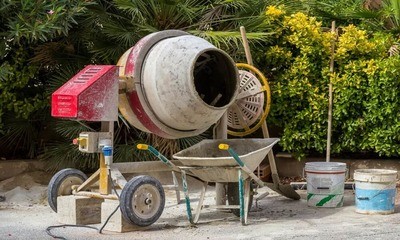
- The main equipment is a concrete mixing device, which, as a rule, is powered by an electric motor and has a receiving hopper with an internal volume of 100 to 300 liters, depending on the category of the device and the amount of concrete required for outdoor floor screed.
- For accurate dosage of components such as plasticizers, water, antifreeze or modifying additives, it is recommended to purchase a measuring cup or other graduated container.
- To accurately calculate inert materials, you should use industrial scales with a weighing limit of up to 150 – 500 kg.
- Scoop shovels are used to feed cement or inert materials into the bunker.
- If a constant supply of water in large volumes is required, a hose will be required that is connected directly to the building"s water supply.
- To supply the finished mixture, depending on the volume and distance of transportation of the solution from the place of mixing to placement in the structure, you will need a stretcher, wheelbarrows or a concrete transfer pump.
High-quality tools must be used, and the machinery must be serviced, grounded, and free of hazards to the operator’s health. It also needs to be cleaned of any residual dirt and prepared for use.
Step-by-step instructions for kneading
In order to produce screed on the street after self-mixing concrete mortar, all of the points in the flow chart below need to be completed, while keeping in mind a few subtleties:
- The mixer hopper is cleared of all traces of old concrete; if necessary, the hardened material is beaten and peeled off with spatulas or other sharp steel tools.
- Cement is poured into the bunker in the required proportion.
- The mixer is plugged in and starts to rotate.
- As it rotates, sand is added to the hopper, 10 – 20 kg, for which it is recommended to use steel buckets.
- When sand is added in strict accordance with the recipe, it is also necessary to pour crushed stone into the container if the project involves the preparation of full-fledged concrete for floor screed on the street.
- The entire dry mixture is mixed in a mixer for 3 – 5 minutes, until the lumps completely dissolve and a homogeneous composition with a single color is achieved.
- Next, you need to start dosing water based on the calculation of 100 – 120 liters per cubic meter of concrete. Thus, if 200 liters are mixed in the mixer, then the amount of water is from 20 to 25 liters.
- Water is added in small volumes, 1 – 3 liters each, and the mixer continues to rotate with the same intensity.
- When the mixture acquires the necessary plasticity, it is recommended to check its mobility indicator on a special galvanized cone.
- At the final stage, if there are additional requirements for the finished mixture, plasticizers, modifying or anti-freeze additives are added to the concrete, in a total amount of 3% – 5%, as mentioned above.
- The mixer continues mixing the concrete for another 1 – 2 minutes, after which the finished concrete can be poured into a shipping container and sent for placement into the structure.
Following preparation, the concrete needs to be poured into a trough that has been previously prepared with a base made of compacted sand and gravel, reinforcement, and formwork flanging.
This is because liquid concrete sets an hour after preparation because moisture begins to evaporate. It can stay liquid for up to three hours if plasticizers are used, but after that it will still harden quickly and become unfit for use in the structure.
Possible difficulties and errors
The property owner or master may commit several grave errors when mixing concrete for laying a screed structure outside, which could have detrimental effects.

- Incorrect dosage of ingredients – the mixture will not achieve the required mobility or mechanical strength when placed in the structure and subsequent hardening.
- Poor quality, damp cement, or contaminated inert materials – any clay impurities or other inclusions of debris on the basic materials for concrete cause a decrease in its performance characteristics.
- Insufficient amount of water – the mobility of the hard mixture does not allow achieving the proper degree of compaction.
- Excessive amount of water – too liquid concrete mixture will flow outside the formwork, seep into the compacted soil of the base, and, as it hardens, decrease in volume with the formation of shrinkage cracks, which will require the installation of an additional layer of self-leveling floor or finishing surface, for example, paving stones or paving tiles.
- Insufficient amount or complete absence of plasticizers, water repellents, modifying or antifreeze components – at low outside temperatures, water quickly crystallizes and does not have time to enter into a chemical reaction with the hydraulic binder, and, in the case of long-term concreting of the structure, the concrete solution can quickly set, which does not will allow you to lay it with proper quality.
- Violation of mixing technology – hard lumps of cement in concrete, or insufficiently uniform mixing of binders and inert materials, leads to local delamination of the structure, which, in turn, causes chips, cracks and other screed defects requiring repair.
- Incorrect choice of cement brand, lack of crushed stone or other violations of the technological map – despite the chemical reaction that has taken place, the concrete slab of the street screed can quickly undergo physical wear and tear due to the insufficient strength of its structure.
You must acquaint yourself beforehand with professional master classes and video lessons, which are frequently shared with other users in the public domain, in order to avoid the mistakes listed above.
Average expenses in the Russian Federation
In order to prepare a concrete solution for laying a floor screed in an open area, the following expenses must be paid for the acquisition of basic and additional materials:
- Ready materials for making screeds, involved in factory conditions:
- Sand concrete mixture with plasticizers and antifreeze additives, intended for outdoor use M400 – M500 – 190 – 250 rubles. for 1 bag weighing 40 kg.
- Ready-made dry screed with increased weather resistance and mechanical strength – 250 – 300 rubles. for 1 bag weighing 30 kg.
- Portland cement brand M400 – 500 – 600 – 800 rub. for 1 bag with a weight of 50 kg.
- Fine and coarse aggregate (sand and crushed stone):
- Quartz sand increased coarseness, or washed river sand of increased strength – from 2400 – 2600 to 2900 – 3400 rubles. per 1 m 3 .
- Crushed stone on natural granite, with a small or medium fraction (from 15 to 20 mm) – from 5100 – 6100 rubles. per 1 m 3 .
- Polymer, mineral, mixed or organic additives:
- Antifreeze additives with different temperature resistance limits – 380 – 480 rub. for 10 l.
- Plasticizers for extending the setting period of the concrete mixture – 300 – 450 rubles. for 10 l.
- Modifying additives for heavy concrete street screeds or other structures – 350 – 450 rubles. for 10 l.
- Epoxy resins with hardeners in the kit – 200 – 350 rubles. for 5 l.
- Methyl acrylates and other polymer components share of increasing the strength characteristics of concrete mix – 50 – 150 rubles. for 1 l.
- Water-repellent components for creating a reliable polymer film – from 3400 – 5600 rubles. for 20 l.
- Reinforced road meshes:
- High-strength road mesh made of structural steel d5 – d7 A500s, with a cell having dimensions of 100 x 100 mm – 440 – 680 rubles. for 1 m 2 .
- Road reinforcement with a periodic profile, according to GOST, d5 – d10 A500s – 40 – 70 rubles./kg, 35 – 65 thousand. rubles. per 1 t.
- Waterproofing membranes, vapor barrier films, insulation boards for creating a floating concrete screed outdoors, which prevents heaving, deformation and destruction of the board:
- Vapor barrier polymer membranes – 1.6 – 2.2 thousand. rub. for 50 – 120 m2 .
- Rolled bitumen or polymer elastic high-strength waterproofing – 1.7 – 5.2 thousand. rub. for 4.5 – 25 m2 .
- Plates made of extruded polystyrene foam with increased density and with interlocking joints made of a machined profile, along the perimeter of the ends of the products – 4.5 – 7.5 thousand. rub. per 1 m 3 .
The process of mixing concrete consists of mechanically loading the components into the mixer and then dragging the completed mixture across the whole surface of the impending pour. In this sense, attracting low-skilled labor at low prices suffices to carry out such production operations.
In addition, the customer can always get in touch with the closest batching plant and place an order for the finished product that strictly complies with the technical specifications if he is unable or does not want to prepare concrete for screeding on the street by hand in order to prevent mistakes in proportions or the mixing process.
The following ranges represent the price range for concrete in the Russian Federation’s central zone (per 1 m 3 of completed material):
- Cement-sand mixture based on hydraulic binder with grade M300 and without the addition of coarse aggregate – from 4200 – 4400 rubles.
- Structural concrete class B15 on gravel or crushed limestone – from 5000 – 5100 rubles.
- Heavy medium-strength concrete B 20 – B22.5 – from 5200 – 5300 rubles.
- High-strength heavy concrete B25 – from 5300 – 5500 rubles.
- Heavy high-strength concrete B30 and above – from 5500 – 6000 rubles. and more.
- Adding anti-frost or other modifying additives, water repellents, plasticizers, which increase the cost of the finished mixture by 5% – 15%.
Please be aware that delivery is included in the price of a complete mixer when ordering ready-mixed concrete or concrete with BSU. Therefore, depending on the capacity of the car mixer hopper, it is most profitable to order concrete or cement-sand mortar in quantities of 5 to 10 m 3.
The customer will be charged more for delivery if he needs to order between one and two m3 of concrete because the car is fully functional regardless of the quantity of material ordered.
The region in which the work is done, the difficulty of the logistics, the type of concrete, the supplier’s marketing strategy, and the quantity of products in the batch can all have a small impact on the prices listed above.
| Outdoor screed mortar: proportions of components | Preparation rules |
| 1 part cement, 3 parts sand, water as needed | Ensure a clean, dry surface. Mix materials thoroughly. Add water gradually to achieve desired consistency. Apply evenly and level immediately. |
For outdoor screed mortar to be both durable and effective, the component proportions must be just right. The primary ingredients are cement and sand, which are usually combined in a ratio that guarantees both workability and strength. In outdoor spaces, this mixture serves as the foundation for finishes such as tiles, stones, or other materials.
The first step in preparation is choosing the appropriate sand—typically sharp or builder’s sand—which gives cement mixtures good cohesion. The intended use and the local climate of the installation site influence the sand-to-cement ratio. To achieve a homogenous blend devoid of clumps or uneven patches, thorough mixing is required.
The required consistency is attained by progressively adding water. While too little water can make the mixture difficult to work with, too much water can weaken it. A mixture that is easily spread but maintains its shape when compacted is the desired result. Paying close attention to the water content guarantees that the mortar sets correctly and sticks to the substrate.
In order to apply outdoor screed mortar, the mixture must be spread evenly over the prepared surface and brought to the appropriate thickness and level. A smooth finish that supports the final surface layer can be achieved with the use of techniques like troweling and screeding. For the mortar to become stronger, it must cure properly, which is usually accomplished by keeping it damp and shielding it from drying out too soon.
In conclusion, the secret to a successful building or renovation project is understanding the dimensions and preparation of outdoor screed mortar. Understanding these ideas and adhering to best practices for application and mixing allow builders to guarantee a strong base for outdoor surfaces that are both aesthetically pleasing and functional.


